Back in Brussels – Seasons in the Sun
After a good night’s sleep, I awoke Wednesday morning with renewed energy and ambitious plans for my last full day in Brussels. After a Thursday train ride to Frankfurt Airport and a short flight Friday, I’d be in Tirana. I had two guided walking tours scheduled for Saturday and, Saturday night, would be joining the Intrepid group for a week so I decided to continue exploring Belgium’s capital city on my own.
After breakfast I’d start my morning by visiting Laeken Cemetery – the oldest cemetery in Brussels. It’s still functioning as well. From there I would be off to the Atomium a structure that’s come to be synonymous with the city. Although perhaps a curious coincidence, I wasn’t inspired by this photo.
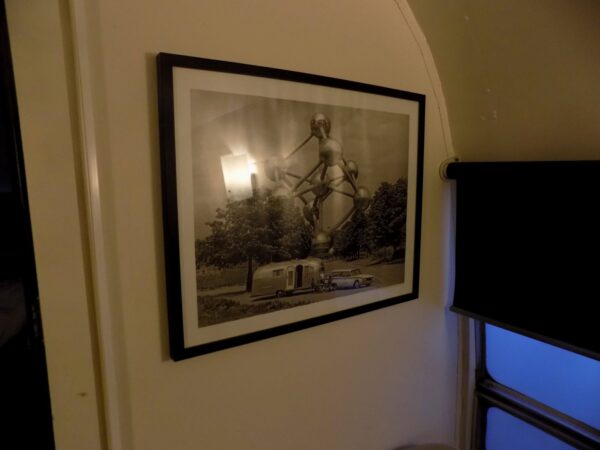
I can say for certain that the trailer is parked near the Atomium. I’m uncertain whether it’s actually the trailer serving as my hotel room. My afternoon plans included visits to at least either the Magritte Museum or the Musical Instruments Museum. I hoped for both.
I said goodbye to L and thanked her for her help. She was ill and was going to the doctor before her shift ended.
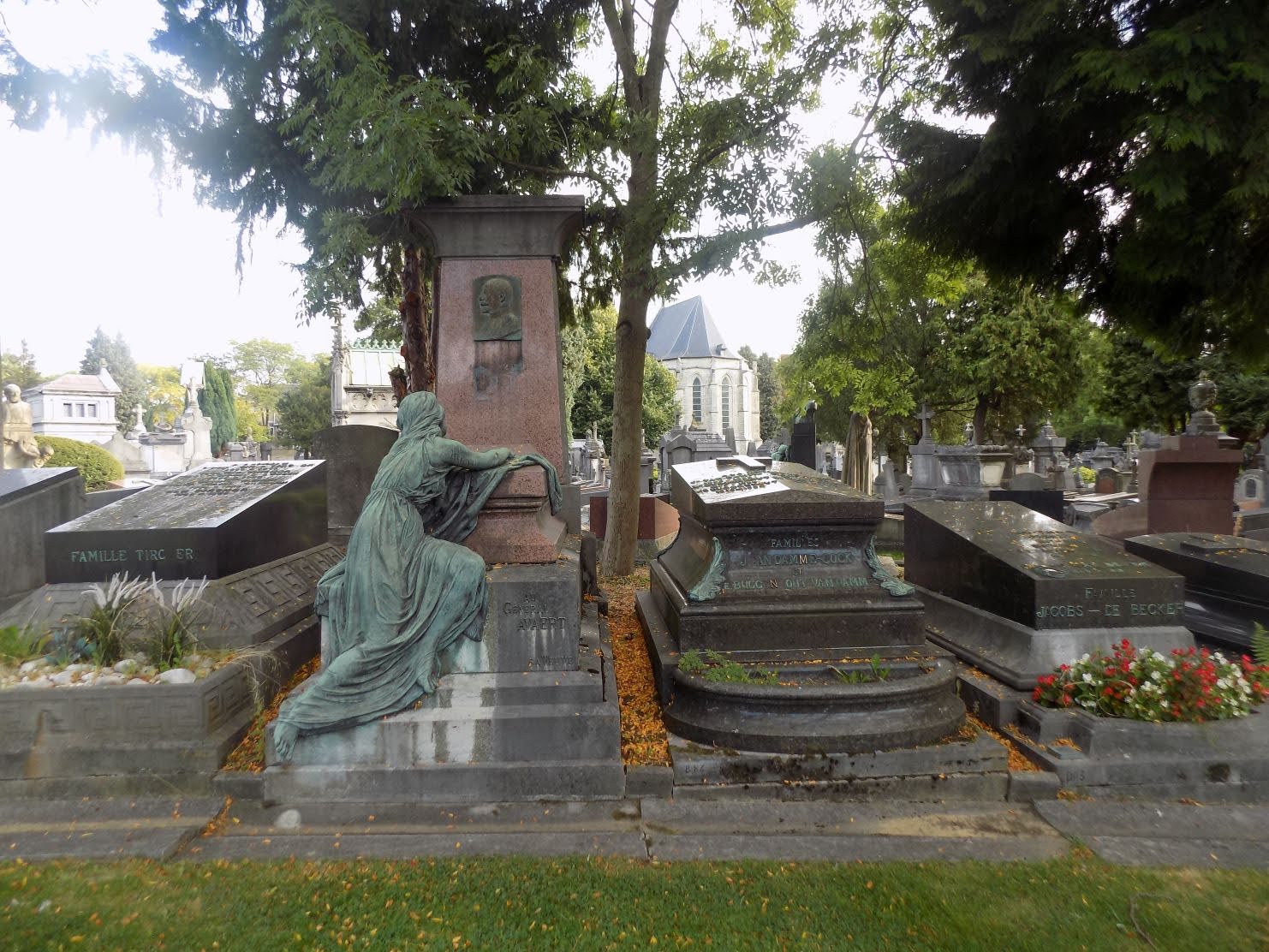
Laeken Cemetery
Established in the 13th century, I think Laeken supplants the Old Jewish Cemetery in Prague as the oldest cemetery I’ve visited. It’s likely, though, that this cemetery wasn’t considered a special burial ground until the middle of the 19th century when Queen Louise – the first queen of Belgium – requested her burial there in 1850. The Royal Crypt of Belgium was consecrated there in 1872.
Since then, enough famous Belgians have been interred at Laeken that it’s often called the “Père Lachaise of Brussels” although it’s less than one-seventh the size of its Parisian counterpart. And, as I began my obambulation of the cemetery, I could see why there was a connection.
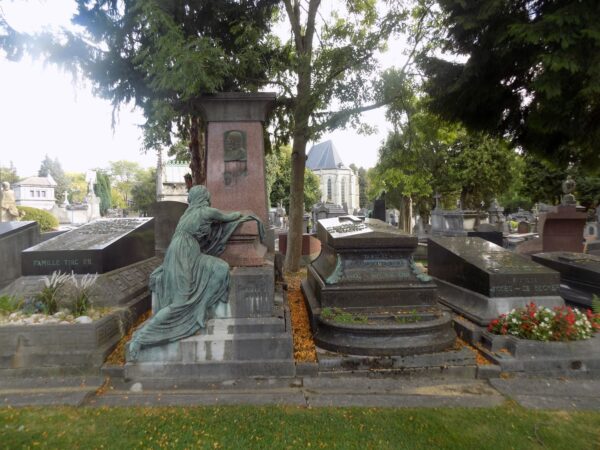
Similar in some ways, there are also several distinct differences between the two. While Père Lachaise has the Communards wall and other military graves and memorials, it doesn’t have a dedicated section for military graves. Laeken does. And, by its uniformity,
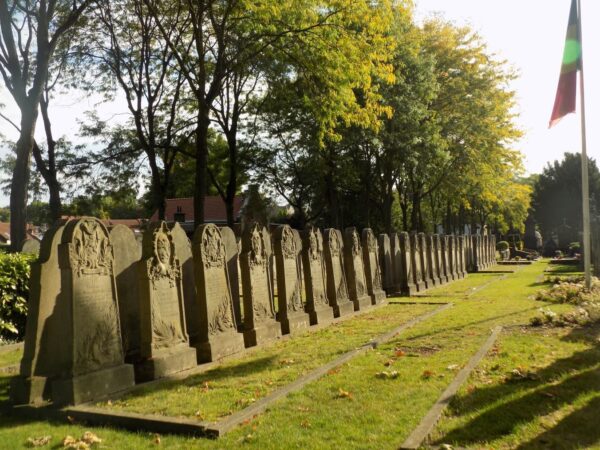
it’s immediately recognizable as a military cemetery.
In addition to the memorial seen above, Laeken Cemetery is replete with monuments sculpted by Ernest Salu and his successors. In fact, there’s a small museum dedicated to Salu near the cemetery’s entrance. (Perhaps I’ve missed them but I can’t recall a museum of any kind – let alone one dedicated to a specific artist and his student-successors incorporated into any of the other cemeteries I’ve visited.)
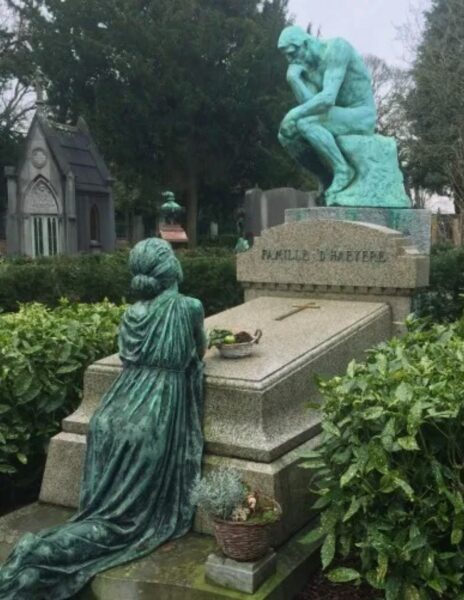
You can also find here a monumental casting of Rodin’s The Thinker. Purchased by Josef (Jef) Dillen in 1927 with the express purpose of marking his grave, it’s one of the original 24 known castings of the sculpture made during Rodin’s lifetime. Here, one of Salu’s mourning women is looking longingly at him.
Laeken has one other feature that I chose not to visit – its crypt. Here’s Atlas Obscura’s description:
Beneath Laeken Cemetery lies an extensive crypt whose funerary galleries stretch out in eerie silence. While never entirely abandoned, the crypt has certainly suffered its share of decay over the years, often resulting in some messy and highly malodorous situations.
Although it underwent a significant restoration and certainly would have added a unique aspect to my visit there, I had no real interest in seeing this part of the cemetery. If it peaks your interest, you can watch this short video.
Desta vez caí
Those who know me or who retain detailed memories of one of my posts about Hawaii are familiar with the Portuguese phrase, “Tropeço frequentemente e, as vezes, caio.” In English this would be, “I trip frequently and sometimes I fall.” Plug this section header into an online translator and it will render the phrase, “This time I fell.”
Although its historical importance to Brussels is, perhaps, as vintage as my hotel room, The Atomium, built for the 1958 Brussels World’s Fair can be considered as much a symbol of modern Brussels as the Mannekin Pis or the Het Steen are of historic Brussels. Roughly two-and-a-half kilometers from Laeken, the Atomium was far enough that I could have taken the Metro but not so far that walking there seemed unmanageable. And since I enjoy walking and view the activity as a way to get a feel for a strange place, I chose to walk.
I passed some interesting shops and walked through a neighborhood most tourists don’t see – as I expected I would. What I didn’t expect (but should have) was the fall I’d take after tripping over a loose stone. I was less than 200 meters from the Atomium.
A friendly and solicitous woman came over and I told her (in English) that I was fine – which I was. What wasn’t fine, however, was my camera. My sturdy Nikon Coolpix had survived many falls in many different countries. This was its ferricadouzer. This is the first picture I took with it.
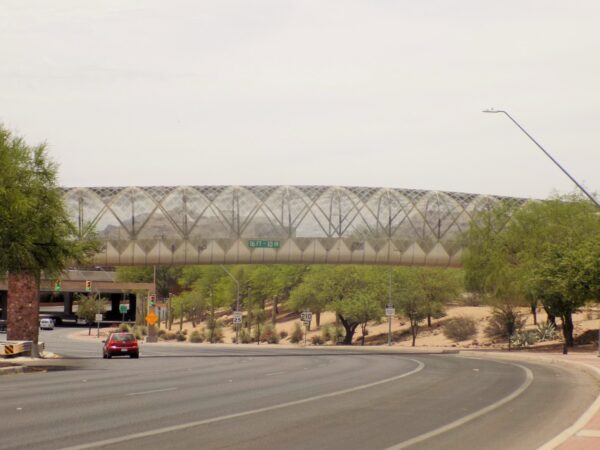
And this would be the last.
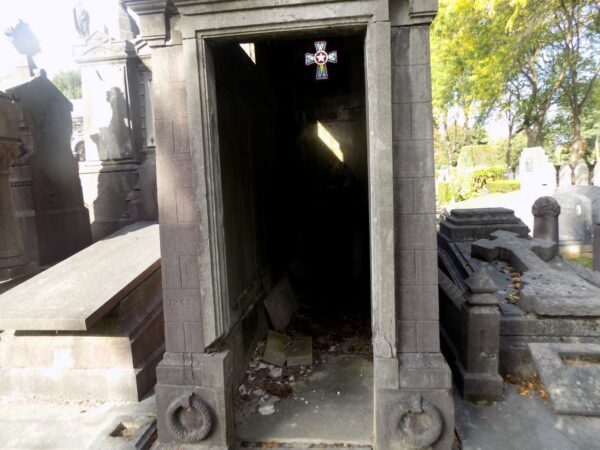
For the remainder of the day, I’d need to use the camera on my phone.
Carrying a camera in today’s world is an interesting phenomenon. While the cameras I use are far from professional quality, the sight of someone toting one around on holiday is unusual enough that I’ve found people generally assume I’m a serious photographer. If they say something, I will quickly disabuse them of that notion. It’s likely that the camera on my phone is better than the one I carry.
(I use the camera for three main reasons. First, even if the likelihood is small, the disruption from losing or damaging the camera is simply the potential loss of the equipment and the photos thereon. Losing or damaging my phone could have serious repercussions.
More important are reasons two and three. Reason two is the clarity and volume of the shutter sound from the camera. I don’t get that from the phone – at least not from my phone – and I have missed some pictures I thought I’d taken. Finally, because of the weight and balance of the camera, I hold it much more steadily than I hold my phone. I’ve trashed many phone photos because of my shaky hands.)
Despite cold war tensions, the Western worldview in 1958 was more hopeful than the quotidian worldview at the end of the first quarter of the twenty-first century. Thus, when Brussels’ Expo 58 established its theme of “Bilan du monde, pour un monde plus humain” (“Evaluation of the world for a more humane world”), the organizers were projecting optimism about the future, emphasizing a better life for humankind spurred by technological advances.
The Atomium
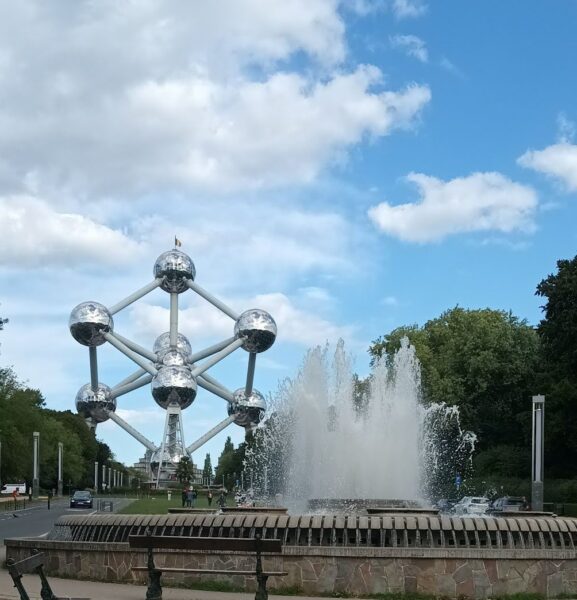
represents a unit cell of an iron crystal magnified 165 billion times and its name combines atom and aluminum – the structure’s original covering. The Expo’s organizers expected to dismantle the structure within six months but it proved so popular that it became iconic not only of the Expo but as a symbol of progress representing the future.
Makes you think all the world’s a sunny day
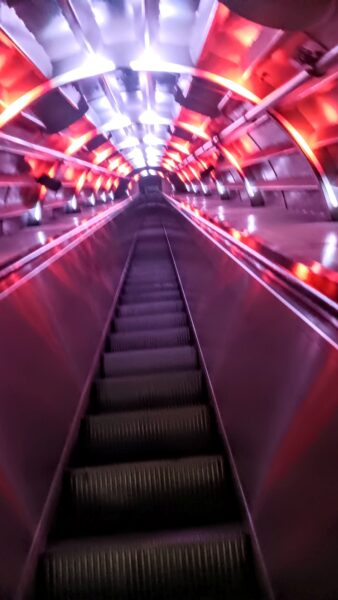
When I finished walking through the exhibitions
and taking in the expansive city views
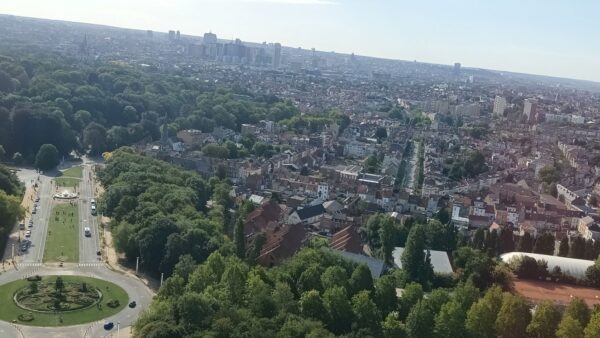
at Brussels’ most popular tourist attraction (the lines are long so be prepared), I decided it was time for lunch. Of course I had to try a Liege style waffle and the irony of having that particular style in Brussels wasn’t lost on me.
After my sweet lunch, I decided to return to the hotel where I was finally able to crack open the camera and rescue the SD card that held so many photos. I spoke with L’s replacement receptionist, M, who suggested two stores where I might by a replacement. Both were within walking distance and at the first, I found a Kodak camera I thought would be perfect. Interestingly, the gentleman who assisted me (and the purchasing process was lengthy and unwieldy) told me he was a Lebanese Jew who came to Brussels 10 years ago to visit his sick father and, though his father died, he has stayed in Brussels trying to accumulate enough money to make Aliyah in Israel.
I returned to the hotel to acquaint myself with the new camera and by the time I was finished with that, this unplanned adventure effectively scuttled my plans to visit either the Magritte Museum or the Museum of Musical Instruments because they would close within an hour of my entry.
Fortunately, the neighborhood around the hotel was rather lively and, though I’d eaten at the same restaurant on consecutive nights I had a number of other choices and opted to walk around the corner to Pescobar where I had feta stuffed squid.
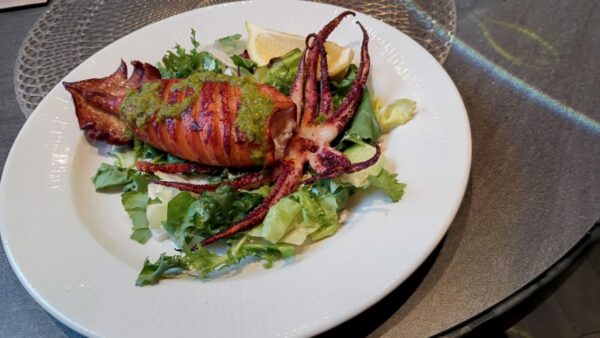
(I’m generally disinclined to photograph my meals so this may be the last picture of this type that you see.) As for the day’s other pictures, you can look at them here.
Tomorrow, I have a long train ride across the Belgian and German countryside to Frankfurt Airport so I’ll start examining the history of my next destination – Albania.
-
It’s just a shot away – Prizren
March 6, 2026 -
Some things looking better, baby – Getting into Kosovo
March 4, 2026 -
Here, where the sky is falling – Kukës
March 2, 2026 -
That’s when we fall in line ’cause we got Berat
February 27, 2026 -
Walking on the big stuff – a climb to Tragjas
February 25, 2026
2 responses to “Back in Brussels – Seasons in the Sun”
I’m OK if you don’t post any more food pictures if it looks like that, especially after the recent run of great shots of pies and blondies on Testudo Times!😁
Some people like food pictures even if they’re not pictures of dessert (and I love me some dessert)!
And here’s a warning, I took a food tour in Tirana (afternoon of the first day). Lots of pictures but no more squid. I promise.