…and the pavements are burning – Musket Wars and Waitangi
The Czech prime minister’s tour prevented us from seeing parts of the museum so we spent considerable time learning about internal conflicts of the 19th century in Aotearoa.
Musket Wars.
While there’s much to admire about Māori culture, it can’t be said their history isn’t circumscribed by regular and violent intertribal conflicts. As I’ve noted previously, many in Europe viewed New Zealand as “an untamed lawless frontier” and any reports of the fighting between Māori iwi would have certainly further defined that image.
I also noted that firearms were among the goods the Maori received in their trade with the whalers and sealers who were adventurous enough to ply those waters. The introduction of European muskets altered the dynamics of Māori warfare eventually generating a significant arms race between tribes.
The first known use of muskets in intertribal fighting happened in 1807 or 1808, during the battle of Moremonui between Ngāpuhi and Ngāti Whātua iwi. Ngāpuhi, led by Pokaia, had a few muskets in their arsenal as they engaged Ngāti Whātua at Moremonui Gully about 200 kilometers northwest of present day Auckland.
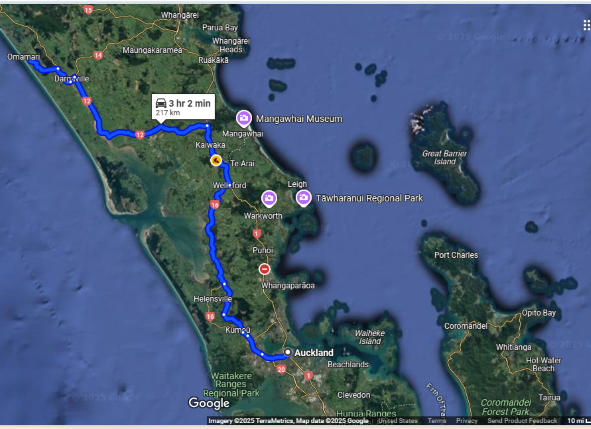
[From Google Maps]
The two iwi had been engaged in years of back and forth fighting always seeking utu (payback) for both real and perceived wrongs. In this instance Ngāti Whātua launched a surprise attack against Ngāpuhi a few of whom had muskets in their arsenal. Ngāpuhi musketeers opened fire but their limited range, number, and long reloading times to limit the weapon’s effectiveness and Ngāti Whātua ultimately overwhelmed their foe.
However, a young chief, Honga Hika survived the battle and intuited that under different circumstances, muskets could provide a substantial advantage. Desiring utu – an essential mechanism for restoring equilibrium in social relationships and addressing breaches of tikanga or customary practices – for his two brothers who were killed in the battle he traveled to England a decade or so later and, while there, he sold land to a French trader in exchange for 300 muskets.
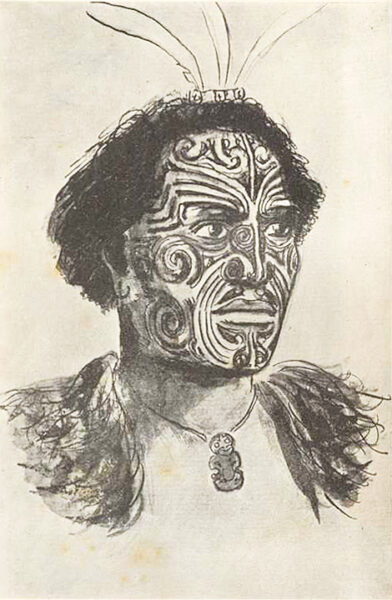
[From Wikipedia By S. Percy Smith CC BY-SA 3.0]

Once he returned to Aotearoa, Honga Hika used his mass of muskets to launch devastating raids across the North Island. This led to more and more individuals needing to seek some form of utu. While it didn’t always involve avenging a death by bringing death, there can be little doubt that the raids led by Honga Hika escalated the arms race among other tribes. In 1825, he used those muskets plus others he’d acquired to decisively defeat Ngāti Whātua at the battle of Te-Ika-a-ranganui finally gaining revenge for the death of his brothers.
This is just one (often considered the beginning) of a series of battles that ravaged Aotearoa for decades across the middle of the 19th century. If you’re interested in gaining a deeper understanding of these conflicts, you can watch this half-hour video.
One important element to keep in mind is that these wars were escalating simultaneously with the British efforts to accelerate their settlement of Aotearoa. Thus we come to
The Treaty of Waitangi.
It’s probably reasonable to opine that the British people arriving in New Zealand were likely not, as Miss Jean Brodie might have said, “la crème de la crème” and were probably mainly comprised of sealers and whalers, runaway sailors and escaped Australian convicts, and Christian missionaries. Since it’s also likely that the people making up the first two of these groups were inclined to participate in, let’s say, unruly behavior, there’s an underlying logic to this serving as one factor for both the British and the Māori to negotiate a treaty that would lead to some form of legal governance.
The British had a few other things in mind as well. They wanted to secure some measure of sovereignty to prevent any possibility of French annexation and protect their growing economic and commercial interests within a stable colony.
One basis for the relationship came from an 1831 letter that, Te Whakaminenga, the Confederation of United Tribes, had sent to the British Crown requesting both protection for Māori and assistance in managing the incoming settlers. The Crown appointed James Busby in 1832, and he was recognized as the first official British Resident of New Zealand.
At least some Māori leaders also had concerns about potential French aggression and, while they had significant concerns about European settlement in general, had established trading relationships with the British and they themselves sought to limit any French efforts to settle Aotearoa.
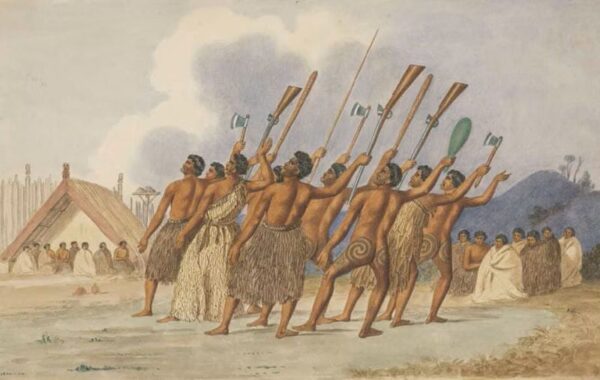
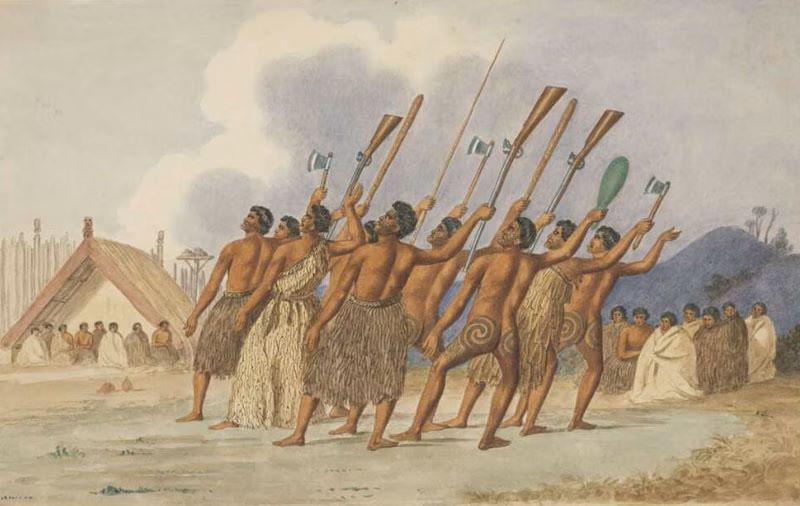
[War dance, New Zealand, about 1845, by Joseph Jenner Merrett National Library of Australia (PIC Drawer 12898 #T2783 NK1272)]
Their concerns about the French heightened when, in June 1835, Charles Phillippe de Thierry declared himself the King of Nuku Hiva of the Marquesas Islands sending notice to James Busby that he intended to land in New Zealand to establish himself as the “sovereign chief” of New Zealand. Thierry likely thought he had some legitimate claim since he had “purchased” 40,000 acres of land in New Zealand from Honga Hika for 400 muskets, powder, and shot. (Of course, Māori had no concept of individual land ownership and Honga Hika likely made this “sale” under somewhat false pretenses.)
Beyond this, Māori sought assurances that their land and resources would remain under their control unless voluntarily sold and they also wanted a treaty that affirmed Māori sovereignty while accommodating British governance.
Growing concerns among Māori led to the circulation and signing of He Whakaputanga o te Rangatiratanga o Nu Tirene (Declaration of Independence of New Zealand) declaring New Zealand a ‘whenua rangatira’ – an independent country. (The lands cited as Nu Tirene are equivalent to those called Aotearoa New Zealand.)
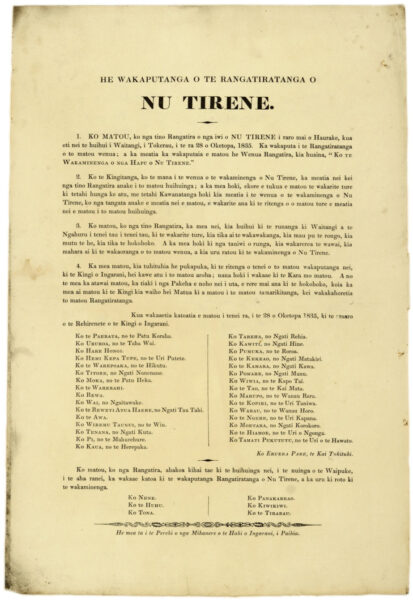
The document, originally drafted by Busby, and translated into Māori by Reverend Henry Williams of the Church Missionary Society has four articles.
- The Chiefs of the Confederation of the United Tribes of Nu Tirene declare New Zealand an independent state.
- New Zealand’s sovereign powers will reside with the collective chiefs of the land.
- Māori will hold congressional meetings every autumn in Waitangi.
- A copy of the Declaration is provided for the King of England.
Eruera Pare Hongi, a close relative of Hongi Hika, produced a final version of the Declaration that 34 northern chiefs signed on 28 October 1835.
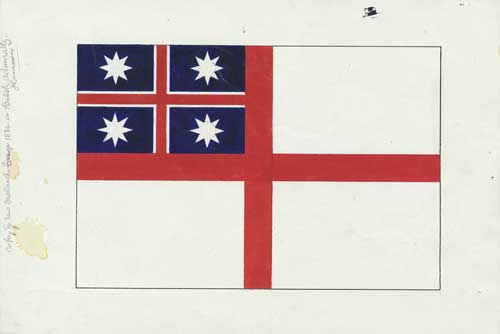
Busby sent the Declaration to the colonial office in Britain. Through King William VI, who registered the flag Te Kara o te Whakaminenga o Ngā Hapū o Nu Tirene
[From Te Ara]
that Maori had chosen in 1834, the British Government acknowledged its legitimacy.
For Māori, He Whakaputanga asserted their authority over Nu Tirene or the lands known as Aotearoa New Zealand. For Northern Māori, The Treaty of Waitangi (or Te Tiriti o Waitangi) couldn’t exist without He Whakaputanga. Recognition of Māori ownership had to be acknowledged and established to give validity Te Tiriti. William Hobson arrived in the Bay of Islands in January 1840 with orders from the British Government to negotiate a treaty with Māori that without He Whakaputanga Māori would have seen as invalid.
After some negotiation, Hobson drafted the treaty and Busby amended it. Assisted by his son Edward, Reverend Henry Williams, who had translated He Whakaputanga, translated it into te reo Maori and presented it to hundreds of Māori Rangatira who had been called to attend a meeting at Waitangi held on 5 February. There were some differences of opinion as the Rangatira discussed the treaty through the night. By the morning, 43 of the 46 chiefs present signed it.
Copies were then circulated through the country to obtain additional signatures from rangatira who had not attended the February meeting. Although 540 leaders would sign Te Tiriti over the ensuing seven months, Hobson published the Proclamation of Sovereignty, declaring Queen Victoria’s ‘full Sovereignty of the Islands of New-Zealand’ in May just three months later.
Unfortunately for both parties, issues soon arose concerning differences in wording between the English and te Reo Māori texts. The most contentious issues likely related to sovereignty and governance and land ownership and preemption.
Conflict was the inevitable result. The first skirmish likely occurred at Wairau in 1843 between New Zealand Company settlers and NgatiToa.
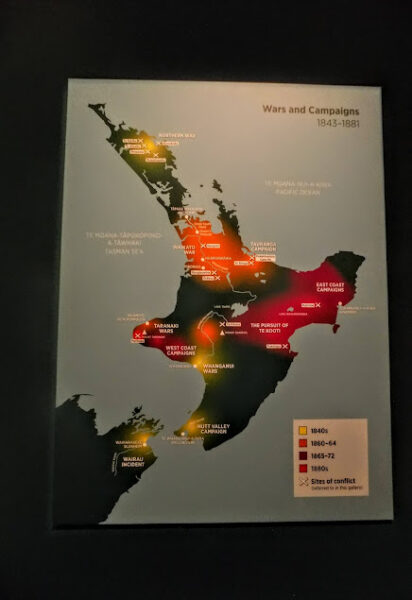
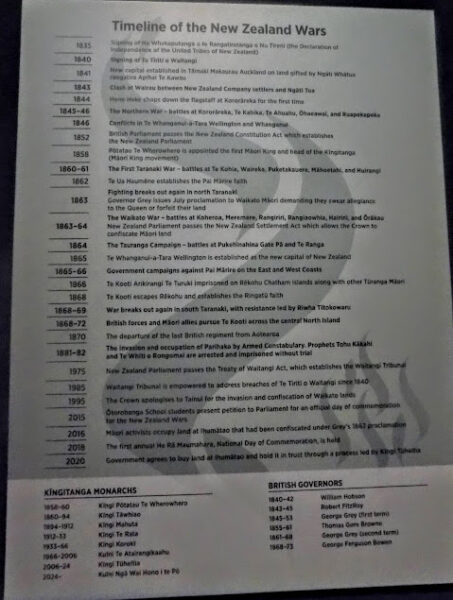
By 1845, the New Zealand Wars began in earnest with the Battle of Kororāreka. The Wars continued in different parts of the country for several decades resulting in significant loss of life, livelihoods, and land. The last British regiment wouldn’t leave Aotearoa until 1870. And, as the photo below shows, many issues remain unsettled through the first quarter of the 21st century.
Although we had a ferry ride to Devonport for supper, like most of the included meals, this one earned not a single comment in my notes. For those clamoring for photos, they’re here.
-
It’s just a shot away – Prizren
March 6, 2026 -
Some things looking better, baby – Getting into Kosovo
March 4, 2026 -
Here, where the sky is falling – Kukës
March 2, 2026 -
That’s when we fall in line ’cause we got Berat
February 27, 2026 -

Walking on the big stuff – a climb to Tragjas
February 25, 2026
2 responses to “…and the pavements are burning – Musket Wars and Waitangi”
What is the place that is among the last of the attached photos? It looks really cool all lit up…
The map is mainly the North Island and is on display at the War Memorial Museum in Auckland.