The indigenous people of Da?ow?aga? (Olympic Valley and me Supplement two)
Headnote: The question marks used in Da?ow?aga? here and in the post title are linguistic symbols indicating a glottal stop. (As English speaking Europeans moved west, they anglicized Da?ow? to Tahoe. Da?ow? is the Wá∙šiw word for lake and the aga? means “by the shore.”) Although a glottal stop sometimes appears phonetically in my native language of English (think of the quick stoppage of air in the phrase uh-oh) it doesn’t appear as a phoneme. That is, it conveys no meaning and has no corresponding symbolic representation even as a diacritic mark. Thus, I used the International Phonetic Alphabet symbol.
Wá-šiw Country
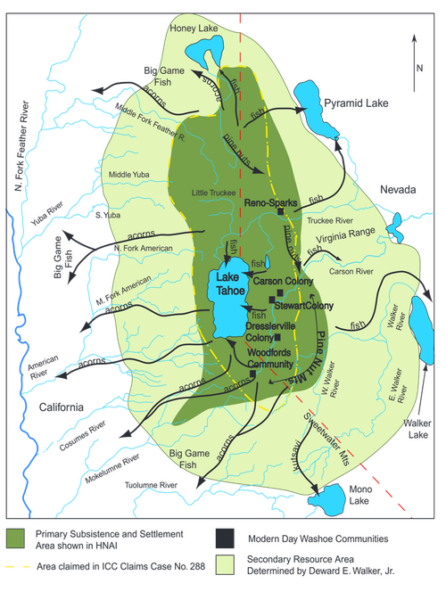
[From Washoe Tribe]
Among the reasons I append geological and archeological posts to my visits to places in this series is that I find understanding these aspects of places integral to my travel experiences. To me, they’re beyond being merely interesting and educational and I hope some of my readers respond similarly. Discovery is an essential element of travel for me and I try to jettison the limitations of my cultural perspectives and biases as much as possible and make a concerted effort to gain some understanding of the native culture of a place. Often that means gaining knowledge of the geography as well as the people.
Those who read my accounts of my travels through Australia know the deep fascination I developed with the varied yet similar cultures of the indigenous people of that continent particularly in their notion of Country (and my shallow understanding of the concept). Alfred L. Kroeber’s 1907 monograph The Washo Language of East Central California and Nevada describes the Wá∙šiw language as a language isolate that,
On comparison with neighboring linguistic families Washo shows much morphological distinctness. In general phonetic character and structural transparence it belongs to the Central Californian class, which includes the Maidu, Wintun, Pomo, Yuki, Yokuts, Costanoan, and other families. But it differs from these languages in the important characteristics of lacking syntactical cases and possessing pronominal incorporation, so that it cannot be more than partially included with the Central Californian morphological type. In its possession of instrumental prefixes Washo agrees with Pomo and Maidu of this Central type, but differs from other families of the same group, such as Yuki and Yokuts. As yet there seem to be no special resemblances between Washo and any single families of the Central group.
As the only Californian language at once east of the Sierras and in intimate contact with Shoshoneans, the question of a possible morphological resemblance of Washo to Shoshonean is particularly important. There is but little evidence of such affinity. The phonetic systems of the two families differ in important points.
When I read that, it piqued my curiosity. (Language isolates are rare. As this map of much of North America
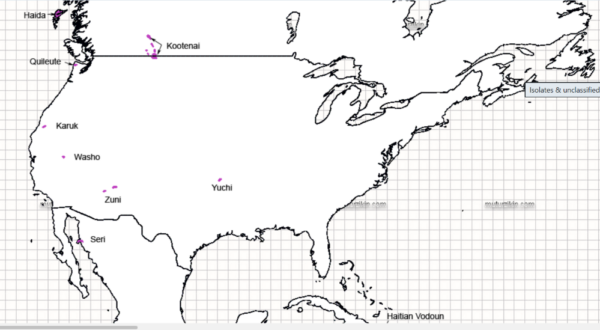
[From Muturzikin.com]
shows, there are only eight on the continent. Of the more than 7,000 languages currently spoken globally {between 350 and 400 in North America} estimates of existing isolates worldwide range from a mere 75 to 150.)
Then I read Herman Fillmore’s description of the Wá∙šiw (Washoe) phrase that locates a person’s origin. He explains that, rather than meaning “from this place,” it means, “I am this place. This land is an extension of me and I’m an extension of place as well.” While many Indigenous American groups share a sense of being a people from a place, few, if any, have a place name as a tribal endonym. (For example, the name Sḵwx̱wú7mesh {Squamish} means “people of the sacred water” and links the tribe to the coastal lands they occupy but this lacks the specificity found in Wá∙šiw that places Lake Tahoe as not merely the center of their territory but the center of their tribal and individual identities. While other endonyms mean “the People” and may express “of this place” implicitly, the Washoe formulation is unusually compact and explicit. In their expression “people from here”, the location is clear and need not name any other geographic feature or direction.) Perhaps my reaction is a bit of overreach but this similarity to the relationship the First Australians have with Country combined with the Wá∙šiw linguistic isolation stunned me and set off days of research. So get yourself settled in as I write about Wá∙šiw because I think it’s going to be a long ride.
Before I go further
In this post about the music of Puerto Rico, I pointed out that one can find a category of content creators on YouTube where people post reactions to music that’s old to me but new to them. While I drop into that well occasionally, what I find they frequently miss is the ability to contextualize the music and hear it as we did. That is, I’d like them to react with the ears of the era because so much of the music they hear today – from chord structures and progressions to technical adaptations and advancements – are built from this earlier creativity. For example, when we heard A Day in the Life as the penultimate song on Sgt Pepper’s Lonely Hearts Club Band, we’d never heard anything like it in pop music. (Of course, that was frequently true when The Beatles were involved.)
This map might seem familiar to regular readers of this blog
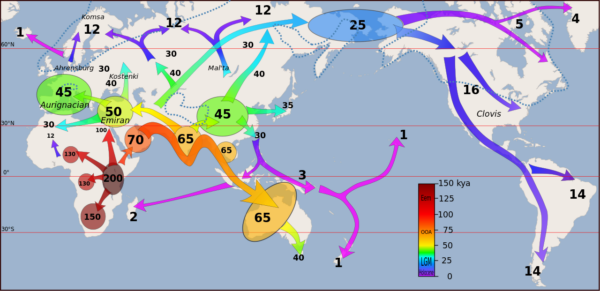
[From Wikipedia By User:Dbachmann – Own work;Map: File:World map blank shorelines.svg (the shoreline map is {{PD-USGov-USGS}}, derived from a mercator svg map posted in 2005, extracted from an original file released by pubs.usgs.gov), CC BY-SA 4.0.]
but it depicts a crucial piece of information contextualizing and, perhaps explaining, why the First People of the Americas might not have fully realized the notions of Country expressed by the First People of Australia. And the difference, as I’ve written previously, is time and isolation. The first people of Australia populated that continent at least 40,000 years before the first Asians began their slow migration across Beringia to populate the Americas some 9,000 years later. Thus, it’s likely that even had the two groups set out with identical belief systems, time, environment, and circumstance would have modified the beliefs of both groups in different ways over the course of hundreds of generations. It seems plausible that, while the Australians were settling into their respective Countries and a relatively stable landscape and ecology, these Americas bound migrants had to shape their world views to the varied climates and landscapes through which they moved before ultimately settling as the Wá∙šiw did perhaps as long as 14,000 years ago in the Great Basin with Lake Tahoe as their heart. Adding the additional tens of thousands of years in isolation before they had any contact with Eurasian outsiders and you provide time add layers onto the notions they carried with them and time to deepen their connection with Country.
In the next post, I’ll explain the connections I made.
-
Photos and their stories – Lisbon – Summer 2026 part two – plus an egg-straordinary bonus
August 21, 2026 -
Photos and their stories – Lisbon – Summer 2026 – part one
August 21, 2026 -
The indigenous people of Da?ow?aga? (Olympic Valley and me supplement three)
August 19, 2026 -
The indigenous people of Da?ow?aga? (Olympic Valley and me Supplement two)
August 17, 2026 -
Olympic Valley in the time before humans (Olympic Valley and Me Supplement one)
August 14, 2026