The sun struggles up another beautiful day – Afternoon at Te Puia
After lunch we made the first of our two trips this day to Te Puia. This segment of our visit would be to the New Zealand Māori Arts and Crafts Institute (NZMACI) where we’d be able to see firsthand Māori artists and artisans working to sustain and advance their cultural and artistic traditions.
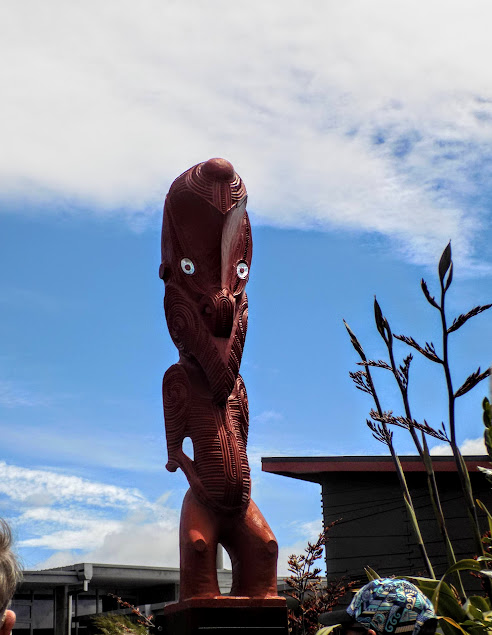
A sign at the entrance to NZMACI calls it wānanga or a space of shared learning. Entering it, visitors walk down a path bordered by ten tekoteko – four males, four females and two of no sex.
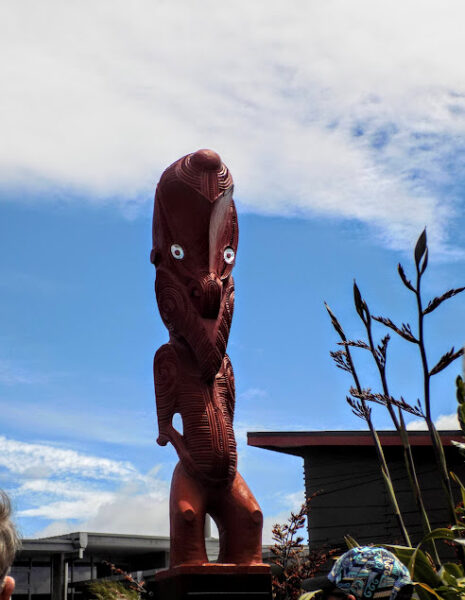
They are intended to symbolize not only the tūpuna (ancestors) themselves but also the way they passed on knowledge. However, before Te Puia was a wānanga, it was a pa or fortified village.
If we accept the conventional history that dates Māori arrival to sometime in the thirteenth century, it didn’t take the Ngāti Whakaue iwi long to build a pa in Te Whakarewarewatanga O Te Ope Taua A Wahiao (the gathering place for the war parties of Wahiao). The fortified village dates to 1325. It was not only impenetrable and never taken in battle but its location in the geothermal valley generally called simply Whakarewarewa provided the iwi ample resources particularly for heating and cooking.
With the signing of the Treaty of Waitangi in 1840, the end of the Musket Wars two years later, and the departure of the last British regiment in 1870, the fortifications at Te Puia had outlived their usefulness. Still, nearly a century would pass before the NZMACI Act passed Aotearoa’s Parliament in 1963. This established Te Puia as a center for preserving and promoting Māori culture.
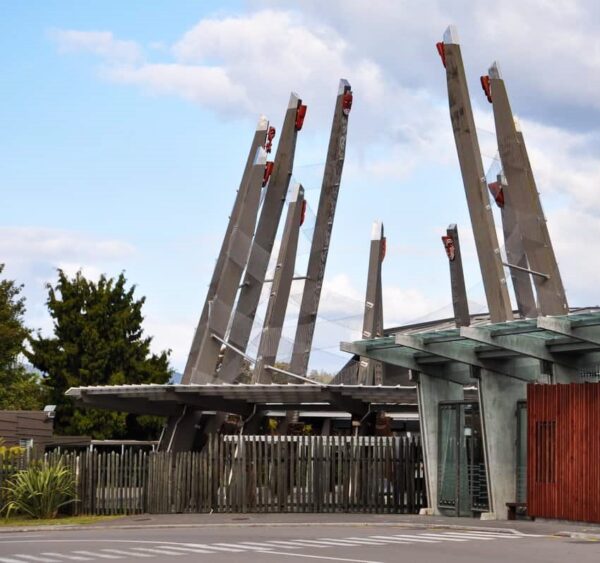
Over time, its mission expanded and in the first part of the 21st century it became home to national schools for traditional Māori arts, including wood carving, weaving, and stone and bone carving. It was these schools that our group would tour on our afternoon visit.
Each school has a rigorous application process in which applicants must prove their Māori descent and a passion to adhere to Te Ao Māori (the Māori Lifestyle) but, more importantly, they must also demonstrate ability in Māori art and/or design together with a willingness to attain the required level of knowledge to complete their qualification. Once admitted, students are on scholarship.
Te Takapū O Rotowhio
Our first stop was at the National Stone and Bone Carving School – Te Takapū O Rotowhio in Māori. Here, students learn traditional methods of carving pounamu – the Nephrite Jade/Greenstone that had profound cultural, spiritual, and historical significance for Māori as well as methods of carving bone and other stones.
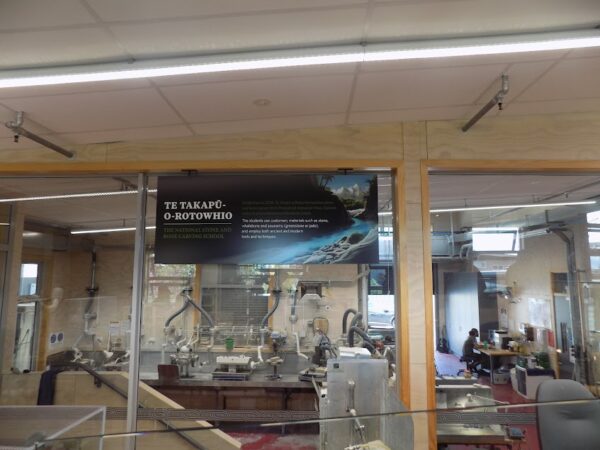
The school opened on 5 October 2009 and was initially led by Lewis Gardiner – a well-regarded pounamu artist of his generation. The current leader is Stacy Gordine who is uri (or a descendent) of the brothers Hone Te Kauru and Pine Taiapa who were renowned for their work as master carvers from the Ngāti Pouru iwi. Generally, only men will be responsible for this sort of carving.
Te Rito O Rotowhio
We next visited Te Rito O Rotowhio – the National Weaving School. The school’s name honors the baby shoot at the heart of harakeke – the flax bush. While the Māori don’t use the rito itself in their weaving, it carries great symbolic importance within their culture. The young and vulnerable core is protected by the surrounding leaves that are symbols of the centrality of individuals and and emphasizes communal well-being over individualism.
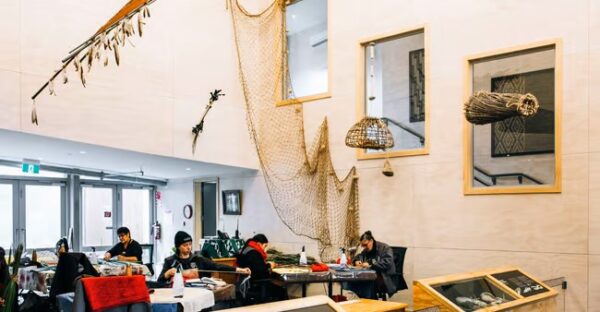
Te Wānanga Whakairo Rākau
We also had the chance to look at the wood carving school Te Wānanga Whakairo. The importance of wood carving to Māori is perhaps best embodied in this statement found on the school’s website, “Ehara i a te rākau te whakaaro, kei ā te Tohunga tārai i te rākau te whakaaro.” (It is a carver, not the wood that has the understanding – If you forget your ancestors, you too are forgotten.)
Thar she blows (or not)
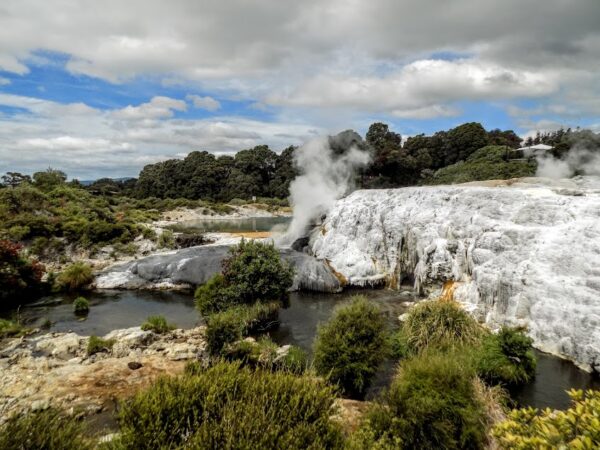
After touring the schools, we had the opportunity to walk through part of Te Whakarewarewa Thermal Valley that’s home to Pōhutu – the largest natural geyser in the Southern Hemisphere. As you might find in other geothermal areas, you don’t have to walk very far to find bubbling mud pools.
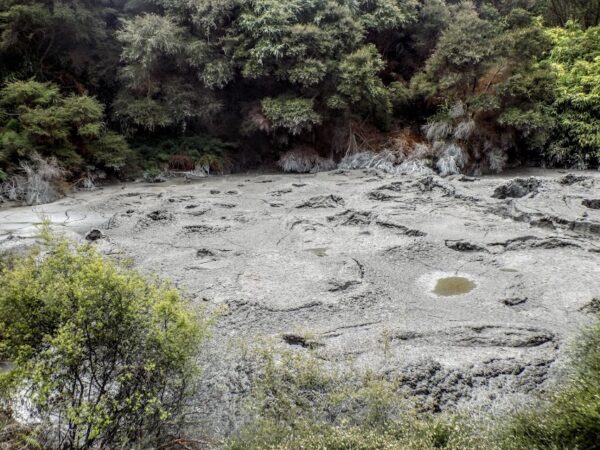
Māori traditionally used this thermal mud to treat cuts and burns. Then, in 1878, an arthritic Irish priest bathed in the mud here, declared himself cured, and walked to his home some 65km distant. This visit is sometimes credited with making Rotorua a destination for spa treatments.
Of course, the star of this show should be Pōhutu. Said to erupt at least 15 times daily, it was uncooperative during our visit. It steamed and sputtered but nothing more. For me, it was a geezer geyser.
After a brief visit to the shop, it was time to go back to the hotel for a brief break before we’d return for the buffet overload dinner and a Māori cultural experience. Here’s where you can find the rest of the photos from the morning.
Back to Te Puia
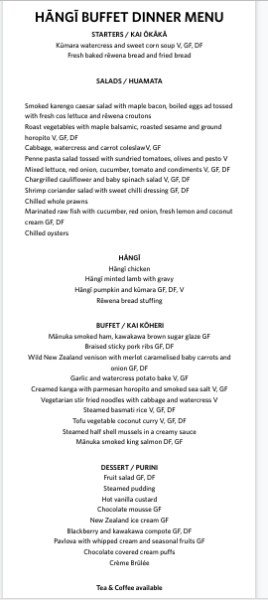
I don’t expect you to be able to read the screen capture of the buffet menu but I’m reproducing it to give you some idea of the meal’s breadth and size.
Although I probably could have used a wheelbarrow to move me toward the marae (pronounced muh-RYE) where we’d share a Māori cultural experience, I had to walk to the waharoa and stand with the group while we waited for the pōhiri or traditional welcome ceremony.
It begins with the karanga – a blast on a shell followed by words of welcome to the manuhiri (guests) from the kaikaranga – a female caller – of the tangata whenua or people of the land. The karanga acknowledges ancestors, welcomes visitors, and bridges the physical and spiritual realms.
This is quickly followed by the wero which is a ceremonial challenge performed by iwi warriors. At our ceremony three warriors approached and retreated. This is the third and the gentleman next to the escort represented all that evening’s participants. (This was not a RS exclusive event.)
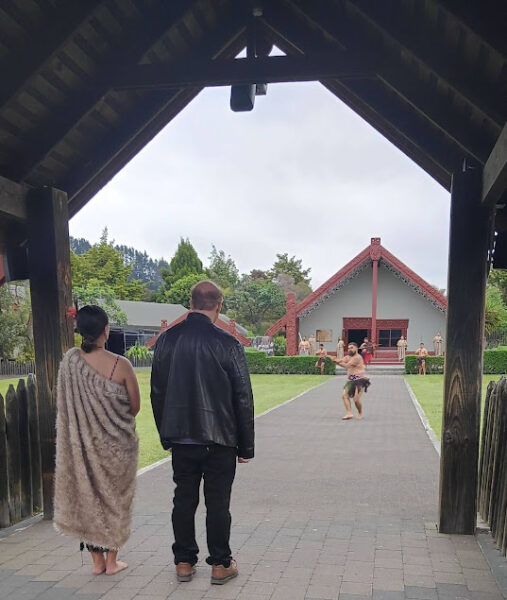
The wero’s purpose is to serve as a demonstration symbolizing both martial prowess and peaceful intent. On the other hand, looking at the video below, it’s easy to understand how unknowing visitors could be intimidated at this stage.
Once our peaceful intent has been determined we began walking inside where we would be entertained by speeches (whaikōrero) and songs (waiata). This is both typical and atypical of this ceremony. Generally both tangata whenua and manuhiri participate in this part of the ceremony. Its purpose is to emphasize shared ancestry, purpose, and unity.
We didn’t, as I recall, have any manuhiri speakers and also didn’t engage in either koha – an exchange of gifts – harirū (handshakes), or hongi (pressing of noses). The latter symbolizes sharing the ha (breath of life) and is another gesture of unity.
You can see the very end of the ceremony in a video in this folder.
There was more entertainment to come with traditional dances by both men
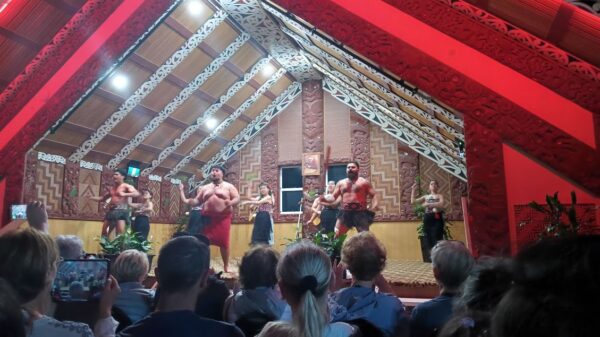
and women.
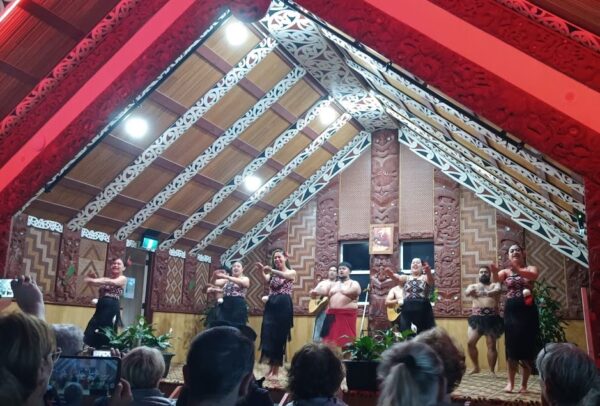
There are more photos in the folder linked above.
Tomorrow, we leave for Christchurch on what will be by far, the busiest day of the trip to date.
-
It’s just a shot away – Prizren
March 6, 2026 -
Some things looking better, baby – Getting into Kosovo
March 4, 2026 -
Here, where the sky is falling – Kukës
March 2, 2026 -
That’s when we fall in line ’cause we got Berat
February 27, 2026 -
Walking on the big stuff – a climb to Tragjas
February 25, 2026