The First People to explore and possibly settle in the Adirondacks (Lake Placid and Me – supplement two)
Those of you who read the series of entries about Montreal in this category likely have at least some general knowledge of the first people to arrive in the Adirondacks particularly since their history isn’t as distinct from one group of migrants to another as is that of the area’s geology with respect to the surrounding area. However, since there are some differences and not everyone reading this post will have read that earlier one, let’s take a look.
The first Lithic people (often called Paleo-Indians) arrived in the northeastern part of the continent between 14,000 and 16,000 years before present (BP) as the ice from the last glacial maximum receded. As noted in the previous post, the melting ice sheets released tremendous amounts of water. They also no longer blocked inflow from the ocean resulting in the creation of the Champlain Sea.
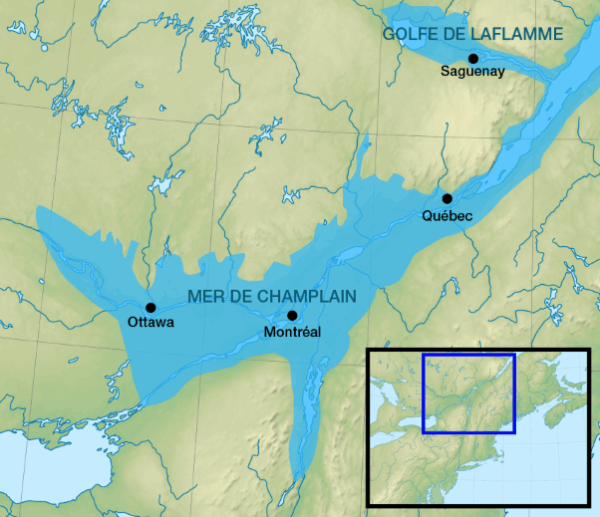
[From Wikipedia By Orbitale – CC BY-SA 3.0]
However, the Champlain Sea was quite short-lived as seas go. It began receding due mainly to isostatic rebound and within 3,000 years had left only remnants including its namesake lake.
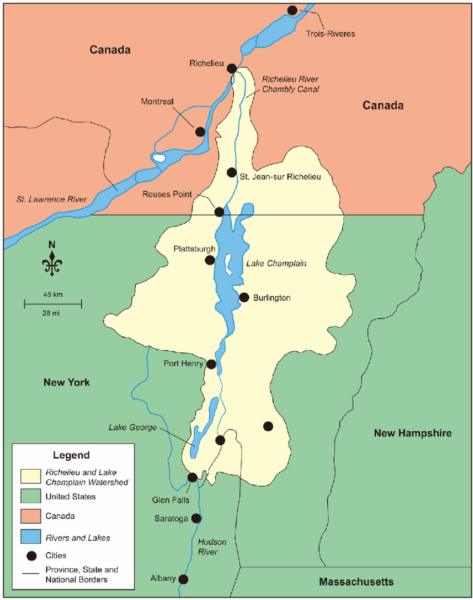
[From Research Gate – CC BY-SA 4.0)
The earliest arrivals in the Adirondack region likely came from the Saint Lawrence River Valley and this semi-nomadic hunter-gatherer Laurentian Culture (also called the Saint Lawrence Iroquoians) settled primarily along the shores of the receding Champlain Sea and occupied the area from about 12,000 BP to 3000 BP or about 1000 BCE. Archaeologists call this the Archaic period. During this time, the climate gradually warmed. Boreal forests replaced tundra. (Boreal forests are primarily composed of evergreen coniferous trees primarily spruce, pine, fir, and larch. These trees are well-adapted to the long, cold, harsh winters and acidic soil that typify the taiga.)
As the climate changed, the early Lithic people were likely hunting moose, elk, and woodland caribou. However, as the climate continued warming, the boreal forest retreated northward and a mixed deciduous forest of the sort we see today replaced it. For the most part, elk and caribou followed the boreal forest. By 8000 years ago much of the large fauna we see today such as black bears, moose, white-tailed deer, bobcats, and smaller animals such as beavers, river otters, red and gray foxes, and raccoons occupied the area.
During the transition from the Archaic to the Woodland period, the Saint Lawrence Iroquoians gradually vanished from the archaeological record as a distinct culture. (The Woodland period extends for 2000 years from 1000 BCE to 1000 CE. The term was introduced in the 1930s to describe prehistoric sites falling between the Archaic hunter-gatherers and the agriculturalist Mississippian cultures.) However, since these were cultures without written histories the reasons for their disappearance are speculative.
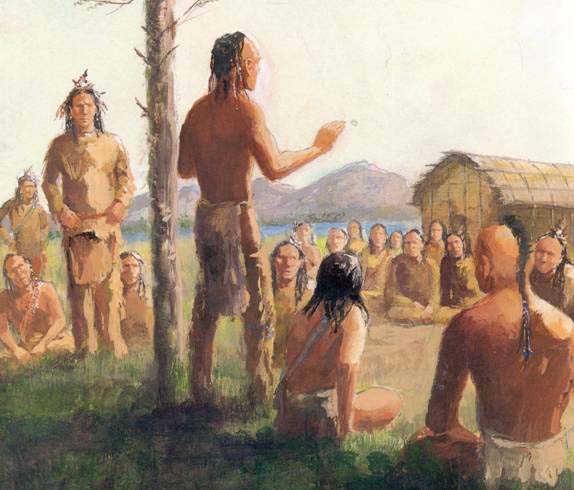
[From Crystal Links]
It’s likely that a combination of factors including wars over hunting grounds lost to other Iroquoians – the Mohawk nation of the Haudenosaunee in particular – some migration westward toward the Great Lakes since they were known to have a trading relationship with tribal people in Minnesota, and the spread of European diseases were responsible. It’s also possible that some individuals or small groups, either by force or mutual agreement, became part of neighboring but linguistically related groups such as the Mohawk and Algonquin.
The high Adirondacks aren’t the most hospitable place to live and it’s likely that before the establishment of the Iroquois Confederacy that united the Five Nations – Kanienkehaka (Mohawk), Oneyoteaka (Oneida), Onondagega (Onondaga), Gayogohono (Cayuga), and Onandowaga (Seneca) – sometime between the 12th and 15th centuries (or perhaps as early as 1142 according to some sources), the area’s tribes traveled through the area to use the available resources. (Since this is the common term for this confederation, I will use it in lieu of specific tribal names.) More permanent settlements began appearing sometime after 1000 CE but these were located in the warmer, more fertile valleys outside the high peaks of the Adirondacks.
History generally reports that first contact between Europeans and the First Nations people in this area occurred in 1609 when French explorer Samuel de Champlain, who had allied with some Algonquin tribes, entered the region and engaged in a skirmish with the local Haudenosaunee near what is now Lake Champlain.
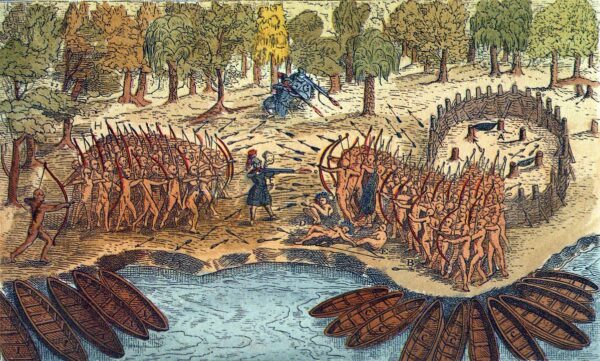
[From Wikimedia – Public Domain]
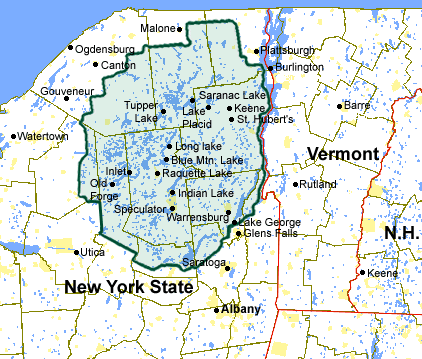
Early Europeans reaching the area perceived the Adirondacks as vast, inhospitable wilderness. In the late 18th century, Thomas Pownall wrote a “Topographical Description” of the area intended to accompany Lewis Evans’ 1755 map. He noted that the Native Americans of the area called it, “the Dismal Wilderness, or the Habitation of Winter” indicating further that the region was “either not much known to them, or, if known, very wisely by them kept from the Knowledge of the Europeans.”
Of course, by the time Pownall wrote his description, the area had likely been considerably depopulated by smallpox and measles in the previous century and later by wars with encroaching settlers. Pownall’s description held sway over the broader public for more than a century and, while there were scattered military and trading outposts, the region remained largely unsettled until the mid to late 19th century. The town of North Elba was established in 1849 and Lake Placid wasn’t incorporated until 1900.
[From Adirondak.net]
The physical and spiritual foundation of the world
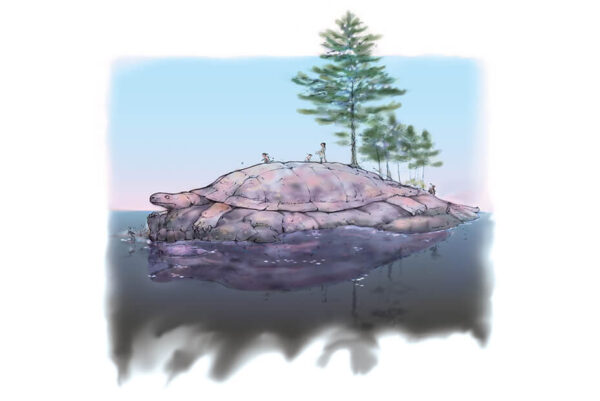
I’m going to end this chapter by trying to share a Haudenosaunee view of creation and I’ll allow you to think I was nudged in this direction because the Haudenosaunee call the continent Turtle Island.
In a time before the world inhabited by Haudenosaunee came to be, there was only water and sky. All the creatures of that time lived in the water and the Sky People lived in Skyland.
One day, Sky Woman fell through a hole beneath a great tree and plunged toward the water. The animals who live in the water saw her falling toward them. They understood she couldn’t survive in the water and acted quickly to help her.
Birds rising from the water caught Sky Woman and gently lowered her onto the back of a giant turtle. Knowing that Sky Woman needed land to live on they tried to bring up land from the depths of the water. Only the muskrat succeeded. He dove deeper than all the other animals and, exhausted, brought up a small clod of earth in his paws.
Sky Woman took this small bit of earth and spread it on the back of the turtle’s shell. She walked in circles and the land grew until it became the place where the Haudenosaunee dwell. The turtle’s shell became the foundation of the land.
[From One Indian Nation]
For many Native Americans – not only the Haudenosaunee – the turtle represents protection, longevity, and wisdom in addition to having a connection with Mother Earth. The turtle’s association with water and land also mirrors the transition from chaos (primordial waters) to order (earth). Not only are turtles long-lived and sturdy, they carry their homes on their backs, making them fitting symbols for the Earth itself and for the early nomadic lifestyle of most Native American tribes.
For Haudenosaunee, its slow, steady movement represents perseverance and patience. Its willingness to support the new world stands as a symbol of stability, endurance, and the importance of balance in creation. The Earth that rests on the turtle’s back and the cooperation of all the animals in saving Sky Woman signify that all life depends on the natural world and its creatures.
-
It’s just a shot away – Prizren
March 6, 2026 -

Some things looking better, baby – Getting into Kosovo
March 4, 2026 -
Here, where the sky is falling – Kukës
March 2, 2026 -
That’s when we fall in line ’cause we got Berat
February 27, 2026 -
Walking on the big stuff – a climb to Tragjas
February 25, 2026
2 responses to “The First People to explore and possibly settle in the Adirondacks (Lake Placid and Me – supplement two)”
“I like turtles”
Why? 🙃 Seriously, I do, too. And I’m fascinated how easy it is to find global turtle mythology.