Tell me what you want, what you like
The summer smiles
Today I begin my last full day in Aotearoa and, perhaps fittingly for this blog, our first stop will be at the urban ecosanctuary Zealandia Te Māra a Tāne formerly known as Karori Wildlife Sanctuary. In the initial post So you think you know the once and future Aotearoa AKA New Zealand, I wrote that some geologists have identified an eighth continent and named it Zealandia. Thus, I began and will nearly end my writing with a place called Zealandia.
Located less than five kilometers from our hotel on Oriental Bay, the most notable features of this sanctuary are its proximity to Wellington’s CBD and its famous fence.
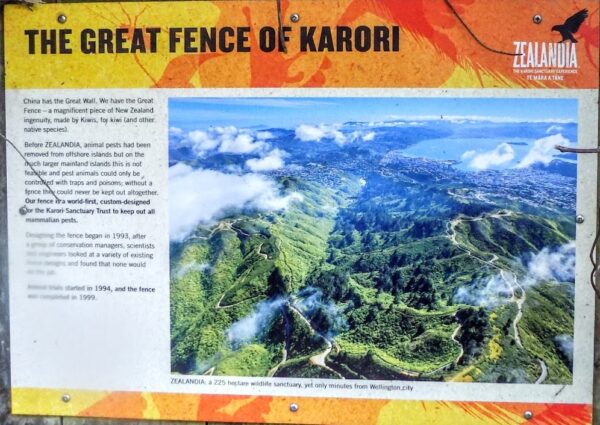
The predator resistant fence encloses 225 hectares of forest and freshwater ecosystems. This is part of a broadly ambitious 500 year project that aims to restore the valley to its condition before humans arrived although the inclusion of Te Māra a Tāne in the renamed sanctuary acknowledges Māori heritage and their values with respect to ecological guardianship. Māra translates as field or garden and Tāne is the Māori god of the forest, whom we met briefly in the previous post.
Previous posts in both this category and in those recounting my trip to Australia have touched upon the impact of human predation and human introduced invasive flora and fauna of the unique ecosystems of the two continents and this has been sadly true in Aotearoa principally because of its relatively diminutive size.
No fence is perfect and any fence can be damaged by accidents such as falling trees. Still, Zealandia’s specially designed fence has been remarkably successful since its completion in 1999 particularly in regard to mammalian predators.
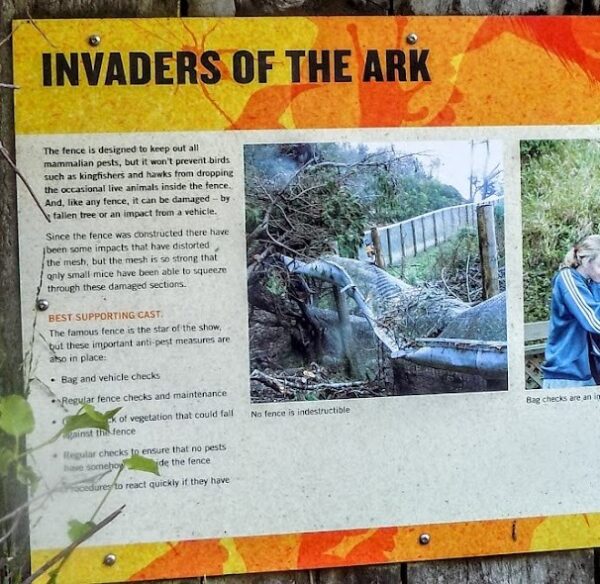
According to the sign in the photo above, the only mammalian predators that have managed to find there way into the sanctuary have been mice that squeezed through fence damage and occasionally a live animal dropped by an avian predator.
The summer knows
The first native we spotted on our arrival was this putangitangi
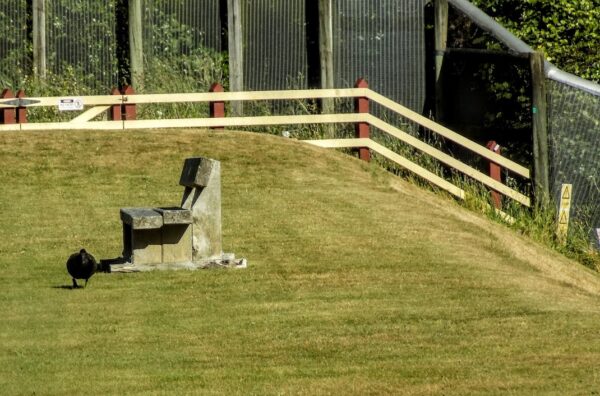
(paradise duck) – the largest duck native to Aotearoa.
After passing through some layers of biosecurity and reading some signs identifying some of the native species, we got our first look at this man-made lake that,
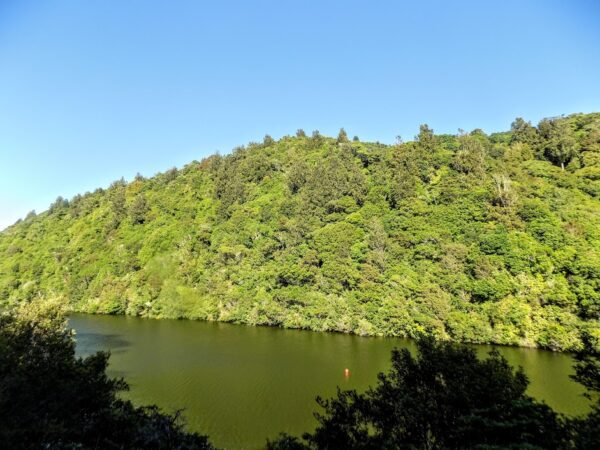
at first blush, seems inconsistent with the sanctuary’s mission. That is, why have a man-made lake if the aim is restoration to a pre-human state? The answer is that the lake was part of a reservoir that served as part of Wellington’s water supply and even after the dam’s decommissioning the sanctuary’s developers saw it as an important aspect of the habitat and, thus, decided to leave the lake intact.
Once inside, what struck me immediately was the rich diversity of birdsong – something I can’t replicate in this medium. We saw several species of birds such as this snacking kākā
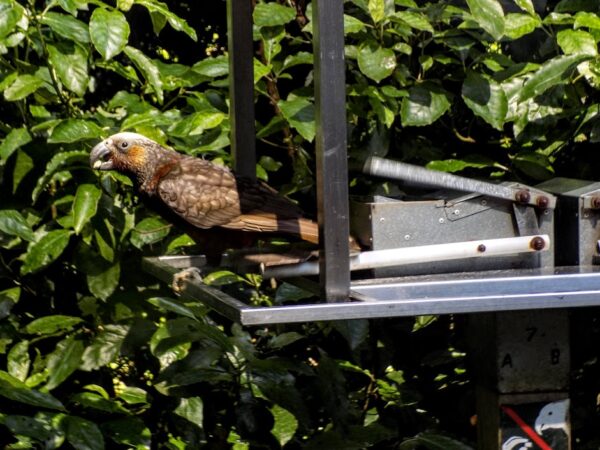
but we heard what seemed to be scores more. I can only tell you that my contemporaneous notes mention birdsong thrice and usually with a ‘WOW’ or at least an exclamation point.
The summer’s wise
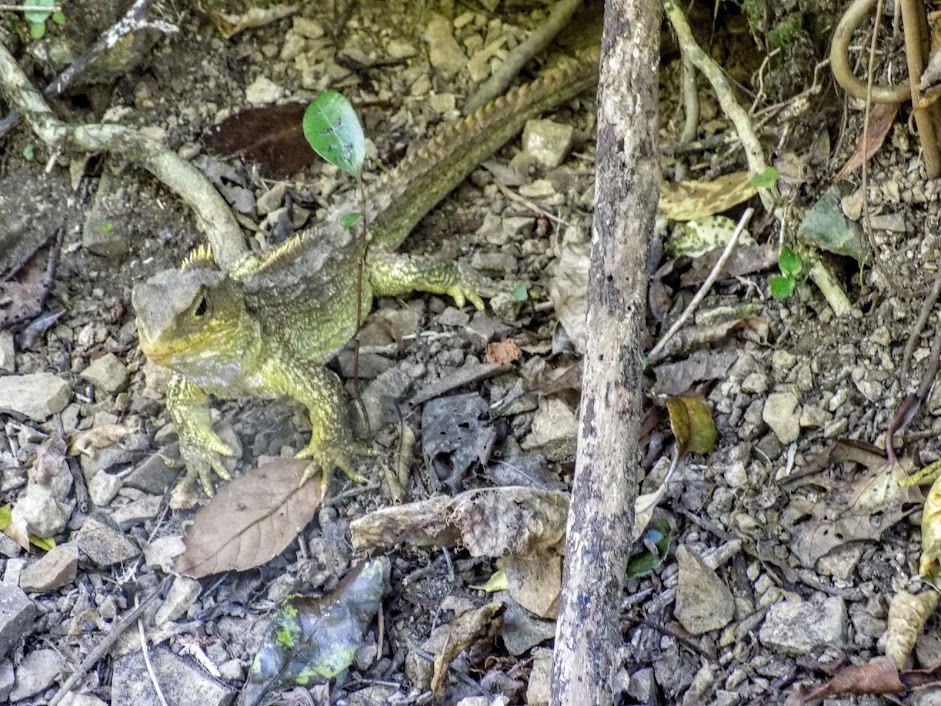
I’ll note two more elements of our time in Te Māra a Tāne. The first is our encounter with a tuatara – Aotearoa’s largest reptile. You need have no concern. Unlike the saltwater crocodiles of Australia that can grow to as much as seven meters and weigh 1,000kg, tuatara rarely grow any larger than 800cm and their weight tops out at about 1,500 grams.
Why should I get excited about seeing a small grey-green nocturnal tuatara? For Māori, tuatara are sacred in part due to one of their particular anatomical features – their “third eye.” This parietal eye on the top of their head is covered by scales and is sensitive to light. For Māori this gives the creature special knowledge of ancient wisdom and spiritual insight. While tens of thousands of tuatara live on Takapourewa (Stephens Island), none remained on Te-ika-a-Māui until 2005 when the South Island iwi Ngati Koata allowed the first of two translocations to Te Māra a Tāne where they have reestablished a wild population.
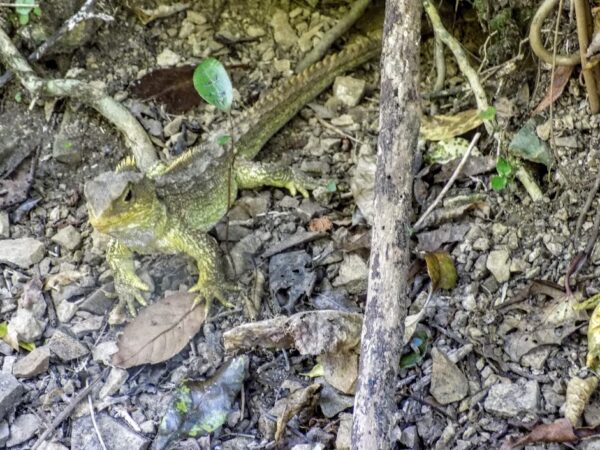
But there’s yet another reason to prompt a sense of wonder. Tuatara belong to the order Rhynchocephalia – a commonplace order in the Mesozoic Era that began more than 200 MYA and ended with the mass extinction of the dinosaurs 65 MYA. In the Holocene Epoch of the Cenozoic Era tuatara is the only living member of that order. A living fossil, if you will.
Since I started our morning with a photo of the largest duck endemic to Aotearoa, I thought I should balance it with this photo
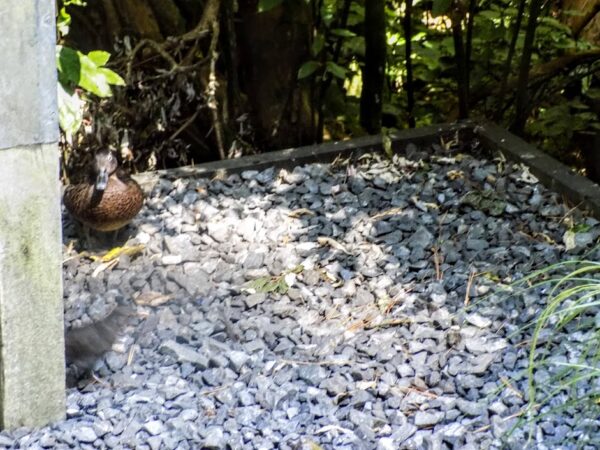
of a pateke – the country’s smallest native duck.
And so she takes her summer time
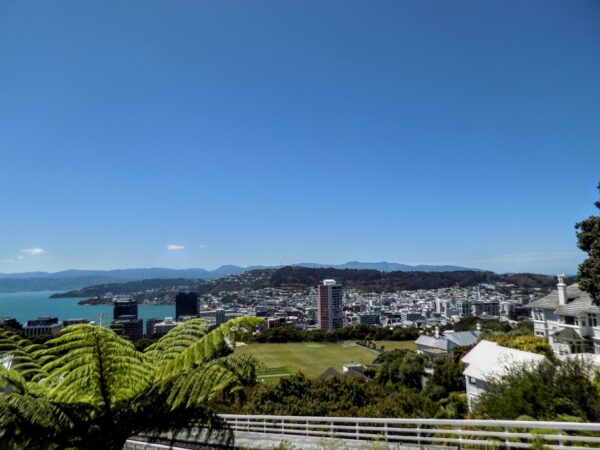
When we left Zealandia Te Māra a Tāne we made a brief stop at the Wellington Cable Car – a stop that suited me quite well because it’s not really a cable car, it’s a funicular and regular readers know how much I enjoy a good funicular ride. We had a few minutes at the top of the line at Kelburn – from which spot we had some lovely views of the city
before boarding and riding to the lower end at Lambton Quay whence we’d walk a kilometer or so to our lunch at the Karaka Café, have a brief guided visit to Te Papa Tongarewa: Museum of New Zealand, and have a free afternoon before gathering for our MASH (Memories and Shared Highlights) session before our final dinner at the hotel.
When first I saw our lunch would be at the Māori and Pacifica owned and operated Karaka Café,
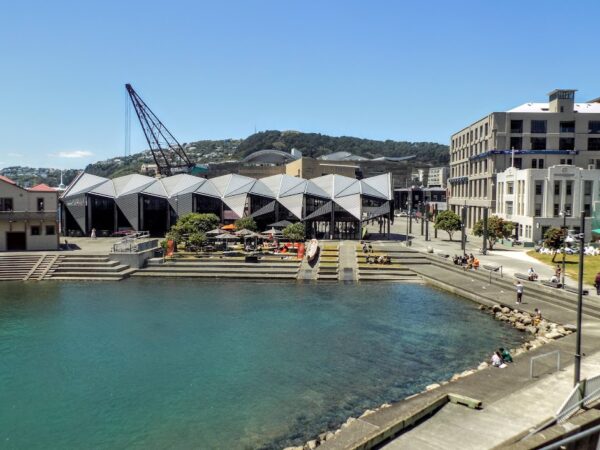
I felt a slight shiver of excitement hoping for the chance to sample some traditional Māori fare. Alas, such was not to be, The only item on the pre-selected menu that fit my diet was Ika O Te Rā – AKA the Fish of the day. I ordered mine grilled instead of deep fried. The plate still included fries and slaw. I did order kawakawa tea to accompany the lunch. While I enjoyed the slight lemony flavor this isn’t really tea. It’s a tisane or herbal infusion. (All true tea is made from leaves harvested from the Camellia sinensis plant – an evergreen shrub belonging to the Theaceae family. And don’t let anyone tell you otherwise.)
And if you’ve learned your lesson well
Looking at the photo above, the building in the foreground is the Karaka Café and directly behind it you can see the top of Te Papa our final RS stop for the day. (There was no Te Mama around that I could find but maybe she’s only there on Monday, Monday.) Since RS planned to release for the afternoon, our guided tour was more an orientation than one of any depth. I’m certain some in our group explored this very worthwhile museum on their free afternoon but I had other plans for mine and I wasn’t focused on what our guide told us. However, here’s one note that’s relevant for the day. The map in the photo below
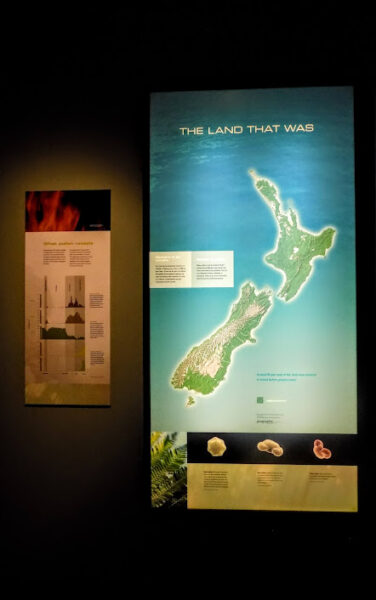
has the following text:
When settlers from the Eastern Pacific arrived about 800 years ago, about 5 percent of the country was grassland. The rest was indigenous forest, wetlands, or mountains. Today, 51 percent of the land is used for growing introduced grasses.
I think this shows what a long road remains in front of the hopes expressed at Zealandia Te Māra a Tāne of restoring even small ecosystems to their status before humans arrived.
While you’re waiting to learn how I spend my last afternoon in Aotearoa New Zealand’s capital city, here are the photos you haven’t yet seen.
-
It’s just a shot away – Prizren
March 6, 2026 -
Some things looking better, baby – Getting into Kosovo
March 4, 2026 -
Here, where the sky is falling – Kukës
March 2, 2026 -
That’s when we fall in line ’cause we got Berat
February 27, 2026 -
Walking on the big stuff – a climb to Tragjas
February 25, 2026