Somewhere, beyond the sea
Sometimes I get so caught up in planning a trip that I miss some aspects of that task that should be obvious. This was the case when I booked the Qantas flight I was about to board in Wellington. I’d gotten on a roll booking the Qantas flights from Sydney to Hobart, Hobart to Melbourne, and Melbourne to Auckland and let my momentum carry me onto a Qantas flight from Wellington to Sydney and thence to Honolulu. It never crossed my mind that I might be able to book a flight from Wellington on Air New Zealand.

[From Air New Zealand]
The flight would have taken me from Wellington to Auckland and from Auckland to Honolulu in about eleven-and-a-half hours. The two Qantas flights needed more than 13 hours without accounting for the layover in Sydney. All of this is to tell you that I’m about to spend a lot of time overflying the Pacific Ocean before we reach Hawaii and if you’re going to fly along with me, you need to buckle up because there’s a lot of information headed your way.
While I plan to take full informational advantage of the idle time I’m facing between my Wellington departure and Hawaii arrival, I want to relate one brief story about an event that occurred once previously, and, to my great astonishment, effectively repeated itself on the flight to Sydney. As happened between Melbourne and Auckland, near the end of this flight, a member of the cabin crew approached my seat, handed me this note thanking me for chatting with them.
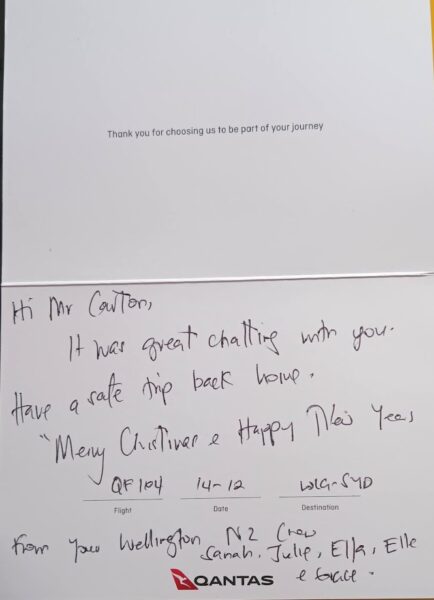
This time my gift was the first class travel kit.
(One housekeeping note: I would normally be inclined to type the name of this island chain as Hawai’i. However, I find this mispronunciation by my TTS program bothersome enough that I will use the more conventional spelling and will likely apply that to the entirety of the islands’ geography. Thus, Oahu rather than Oah’u.)
I know beyond a doubt
(I’m not James Michener)
In 1959, James A Michener published Hawaii – the first of his epic historical novels. The opening chapter titled “From the Boundless Deep” contains vivid poetic language that I may quote but that I’ll make no effort to duplicate. And I’ll note that while Michener’s descriptions remain broadly accurate, he wrote them before there was much understanding of plate tectonics and hotspot volcanism. If you prefer a literary description of the processes that formed the Hawaiian Islands and the arrival of life there, I have no better recommendation than skipping mine and reading his.
Since I’ve discussed plate tectonics (the scientific theory explaining the division of the Earth’s lithosphere into several large rigid plates and how their movement is responsible for many geologic phenomena) in other posts throughout this blog, I’m going to focus on hotspot volcanism in writing about Hawaii’s geologic history.
(Hotspots)
Although it’s not an infection, you can, in some ways think of a geologic hotspot as analogous to one on your pet. On your pet, a “hot spot” describes a localized area of skin inflammation and infection, often characterized by a red, itchy, and sometimes oozing or pus-filled lesion. Medically, they’re called acute moist dermatitis or pyotraumatic dermatitis.
Stretching the analogy, a geologic hotspot would probably be more subdermal since it’s a region within Earth’s mantle where unusually hot material rises and forms volcanoes on the overlying crust. But one might think of the magma bubbling inside these volcanoes (or I should say I did) as analogous to the oozing pus-filled lesion on your cat or dog and the accumulation on the crust as a sort of scab. Geological hotspots are relatively stationary, and as tectonic plates move over them, chains of volcanoes can form.
[From USGS]
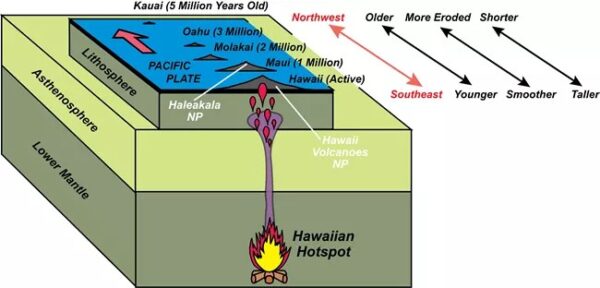
As you can see from the diagram above, the Pacific Plate is moving northwest over the stationary hotspot. It’s racing along at a rate of about 2-4 inches per year or 32 miles in a million years. (Believe it or not, this is comparatively fast relative to Earth’s other plates that crawl along at 1-2 inches per year.) As the plate moves over the hotspot, carrying the old volcanoes with it, the hotspot is perfectly happy to make new volcanoes. This creates a chain of islands and seamounts, in this instance, the Hawaiian–Emperor seamount chain. Hawaii, the southeasternmost island, is currently over the hotspot and is volcanically active (at least occasionally). The islands to the northwest are progressively older, less active, and have experienced more erosion.
When we think of the Hawaiian Islands, it’s likely that we envision them as stretching from Kauai in the northwest to the Big Island of Hawaii as the southeastern terminus because that fits with our human experience of them. From that perspective, Kauai is the geologically oldest of the main Hawaiian Islands having emerged above the sea about 5,100,000 years ago (MYA). It was followed by Niihau (4,900,000 years ago), Oahu (3,500,000 years ago), Molokai (1,500,000 years ago), Maui (1,000,000 years ago), and the Big Island which is the youngest at between 400,000 and 500,000 years old.
However, if we expand our view, we can see from the Google Maps satellite image below that the chain extends much farther to the northwest.
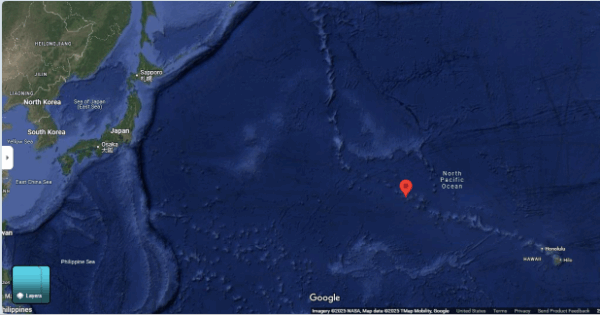
The marker is at Kure Atoll nearly 1,600 miles from Hawaii and generally considered the northernmost island that remains above sea level in the chain. (You can see Hilo on Hawaii in the lower right of the map.)
This process is ongoing. A new submarine volcano, Kamaʻehuakanaloa (formerly Loʻihi) is currently forming southeast of the Big Island.
(How did it happen in the first place?)
On the flight from one island with unique flora and fauna to another that fits that description equally well, I began to wonder how that came to be. Evolution in isolation is, of course, an easy answer and, in the case of Aotearoa New Zealand I’d expect that to be the main factor. But, some 85,000,000 years ago, New Zealand was part of the supercontinent Gondwana that already had a wide array of plant and animal life.
Kure Atoll, at 28 million years old the oldest remaining surface island in the Hawaiian chain, wasn’t even a glimmer in Earth’s parental eye when Aotearoa was breaking away from Gondwana. So Aotearoa carried its own life away from Gondwana and that life evolved into the unique species that populate the islands.
But each of the Hawaiian Islands were bubbling up from the seafloor each slowly accumulating layer upon layer of magma until it could, at last, break the ocean’s surface. Let’s zoom out a bit an let this Bing maps view show us how isolated Hawaii is from any major landmass.
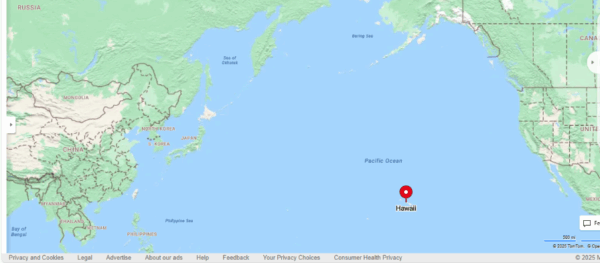
Given the two factors of isolation and volcanic construction, life in Hawaii had to start from scratch. So how did that happen?
If I could fly like birds on high
Before humans arrived, plants and animals reached Hawaii using wind, waves, and wings. In shorter words, the three W’s. We can look at them one by one.
(Wind)
Many small organisms, such as mosses, lichens, ferns, and fungi, produce spores or seeds light enough to be carried thousands of miles by wind currents. Once the basaltic lava had sufficiently cooled, it began to weather and break down opening cracks and crevices that become micro habitats. It’s likely that the pioneer microorganisms were lichens.
These microorganisms slowly break down the basalt into soil that, in turn, becomes incrementally more hospitable for subsequent colonizers like mosses and ferns.
(Waves)
Ocean currents transported seeds, plant fragments, and even small animals attached to floating debris or vegetation mats. All of these arrivals would have been hearty enough to survive long ocean bound journeys before finding refuge, perhaps accidental refuge, in Hawaii. Still, the process was arduous and slow. Only a tiny fraction of arriving species successfully established populations. For example, new insect species established themselves roughly every 70,000 years, flowering plants every 105,000 years, and birds about every 1,200,000 years.
(Wings)
Migrating birds overflying the nascent islands carried seeds stuck to their feathers or in their digestive tracts. These could have germinated after being deposited on the islands. Some birds themselves might have arrived by being blown off course from their normal migration routes and, though disoriented, found enough food sources on the islands to establish a presence there. For example, Hawaiian honeycreepers evolved from a single ancestral finch species that managed to reach the islands and remain there.
We’ll meet beyond the shore
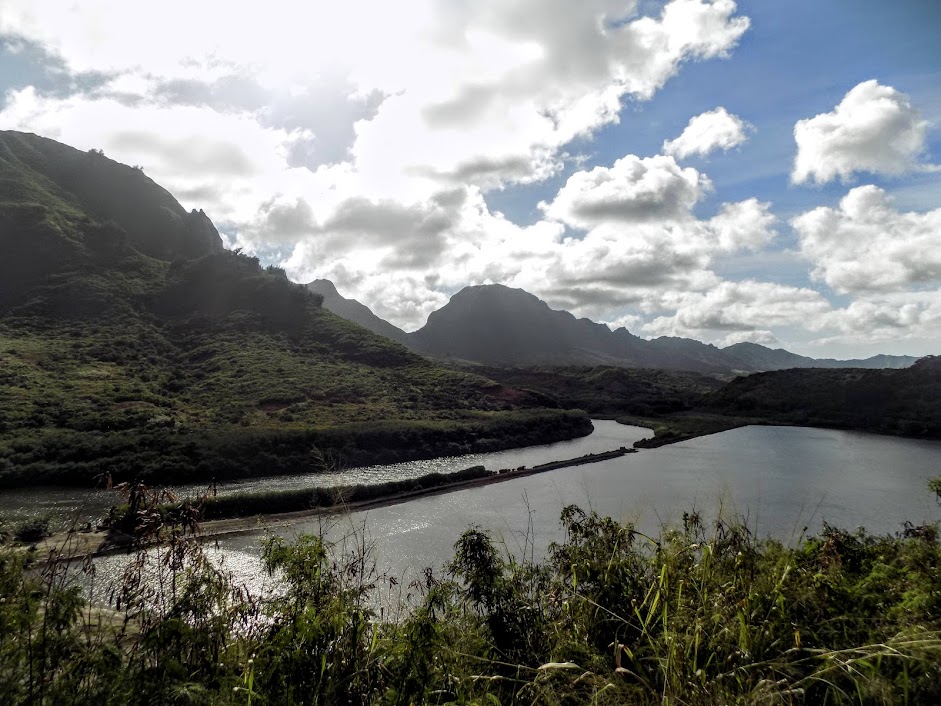
I texted my friends K & P as I was passing through Inouye Airport in Honolulu and they congratulated me on completing my journey to all 50 American states. For me, it wouldn’t become official until I reached Kauai a few hours later and actually spent money and had a meal. Here’s a little of what I saw on my way from the airport at Lihue to my hotel just outside of town.
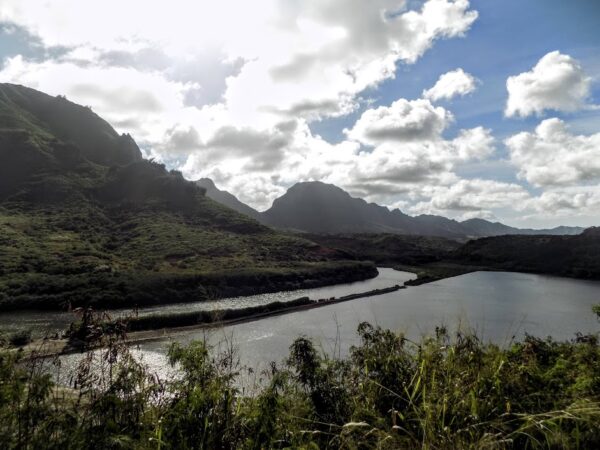
In the next post, I’ll tell you a little more about Kauai and wrap up this travel / first day before my adventure truly begins.
-
It’s just a shot away – Prizren
March 6, 2026 -
Some things looking better, baby – Getting into Kosovo
March 4, 2026 -
Here, where the sky is falling – Kukës
March 2, 2026 -
That’s when we fall in line ’cause we got Berat
February 27, 2026 -
Walking on the big stuff – a climb to Tragjas
February 25, 2026