Sometimes I wonder what I’m a-gonna do – Pioneers and the bush
If you like it then you better Pūtaringamotu
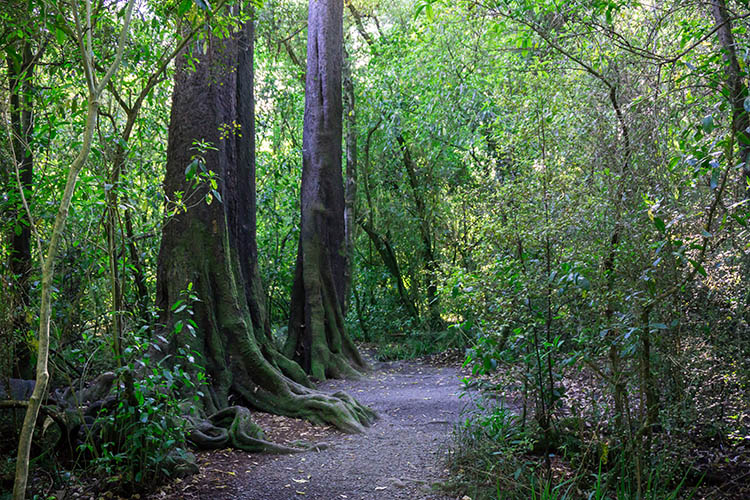
After our rushed tour of the International Antarctic Center, we headed off for another rushed tour of the Riccarton Bush or Pūtaringamotu. William and John Deans emigrated from Scotland to New Zealand in 1843 with land allocated to them by the New Zealand Company near Nelson and Wellington. Finding the land unsuitable, they applied for permission to farm near Pūtaringamotu on the Canterbury Plain close to what would, some years later, become the town of Christchurch. They received land grant on the condition they did not settle near Māori plantings.
Using wooden pegs in place of the nails that had been left behind at Wellington, William Deans and Samuel Manson built their first house, with three compartments for the three families.
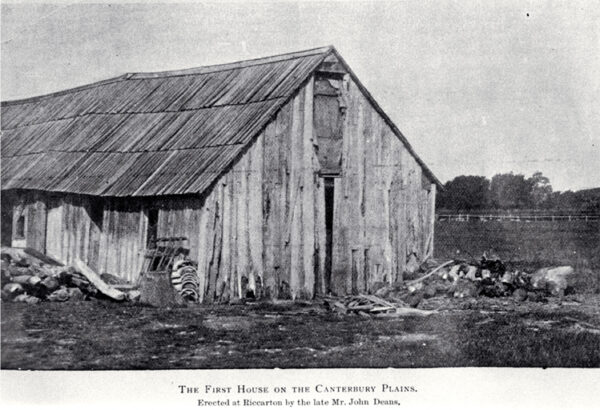
[From Christchurch City Libraries – Public Domain]
William and John then bargained with the local Māori owners to lease more land and on 3 December 1846 they signed a 21-year lease for land running six miles in every direction from Pūtaringamotu. They brought in more cattle and sheep stock selling their produce in Akaroa and Wellington, and their wool in London.
After some additional land trading with the New Zealand Company, they signed an agreement on Christmas Day 1848 agreeing that their 400-acre farm would be named Riccarton after their home parish in Scotland. They also named the nearby river Avon to honor their grandfather. The Deans brothers were permitted to retain half of the Pūtaringamotu bush with the remaining half being ceded to the Canterbury Association to provide timber and firewood for new settlers.
When William and John Deans first settled in Riccarton in 1843, the bush covered approximately 22 hectares. When they signed the 1848 agreement, their half of the remaining bush was a bit less than seven hectares.
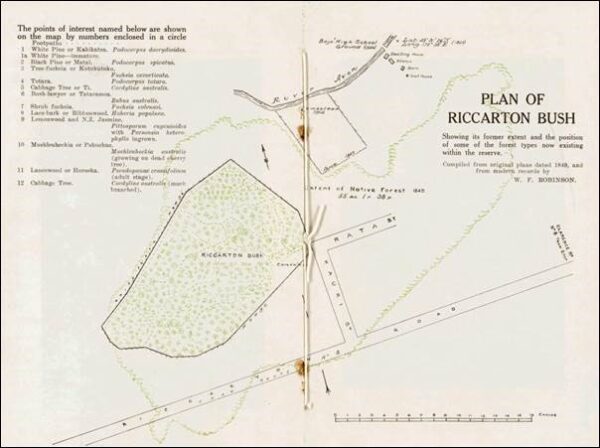
[From Christchurch City Council]
Christchurch City on the South Island’s Canterbury plain was planned by the Canterbury Association – at the time still headquartered in England. Their aim was to transplant cross section of English life in Canterbury. Thus, the predominantly English settlers brought not only their own social structures but other reminders of home. Typically, these included invasive livestock, wild birds and other animals, coupled with English style gardens comprised of invasive flora.
Needing timber and firewood, the Christchurch settlers had cut down all the standing timber in their half of the bush by July 1851 leaving only what the Deans family had preserved. Papanui Bush, some 5km northwest of today’s city center was completely cleared by 1861 and other patches of bush at Hoon Hay, Halswell, Tai Tapu, Woodend, Rangiora, Ohoka and Tuahiwi had almost disappeared by 1870.
The remaining bush was preserved by the foresight of John Deans and the management skills of his widow Jane. Dying of tuberculosis at age 34 John,
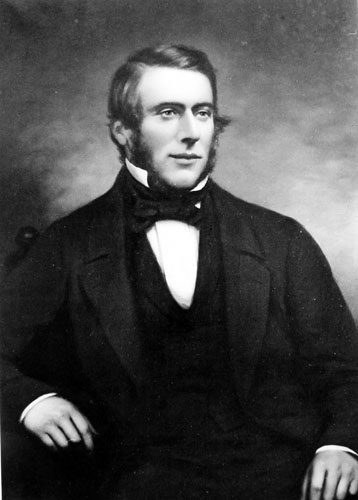
[From Wikipedia – Public Domain]
on his deathbed asked Jane to make certain that Riccarton Bush was preserved forever.
Jane,
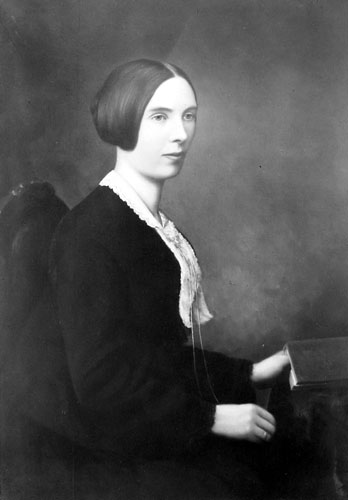
managed the farm until her infant son came of age. She also began the construction of Riccarton House in 1856.
Jane died in 1911 and in 1914, the Deans family presented the remaining 6.35 hectares of Riccarton Bush to the people of Canterbury under the condition that it be preserved in perpetuity. The Riccarton Bush Act of 1914 established a Board of Trustees and the land was opened to the public on 24 February 1917. The Christchurch City Council bought Riccarton House from the Deans family in 1947 thereby extending the area around the bush. From the air, it looks like this.
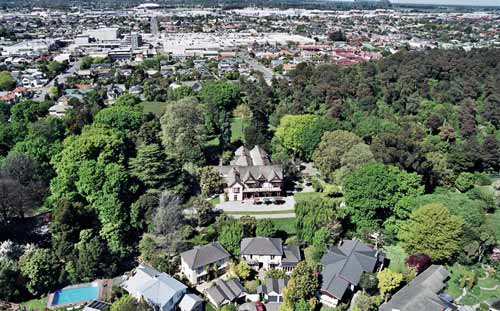
[From Te Ara – the Encyclopedia of New Zealand]
As had been the case with our tour of the International Antarctic Centre, the naturalist who served as our guide apologized several times for the brevity of his tour stating that we needed to be finished in sufficient time to have our tour of Riccarton House followed by our dinner and evening’s storytelling. We passed through a predator proof gate and, while my notes don’t indicate that we saw any native wildlife (other than perhaps a bird or two), we did get close looks at native climbing plants and ferns, we saw a variety of trees
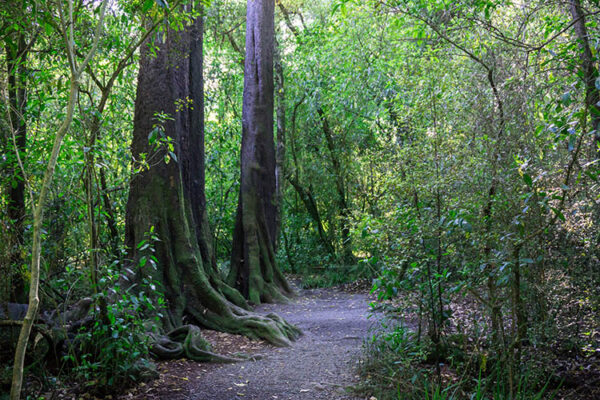
– kahikatea that were (between 400 and 600 years old), totara, matai, kowhai, and hinau.
Deans Cottage & Riccarton House
Samuel Manson William and John Deans built their pioneer cottage from timber cut in Riccarton Bush and pit sawn into boards. It was the Deans’ first home at Riccarton and its original site was near the Kahu Road Bridge.
In 1947, the Christchurch Rotary Club restored it and, in 1970, the city, with the help of the Riccarton Rotary Club moved it from this site to its present location site between the main house and Riccarton Bush.
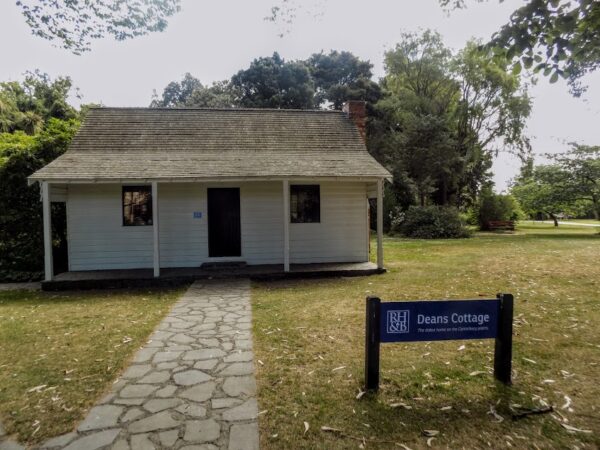
Jane commissioned the first section of Riccarton House in 1856 and the two-story section of this house remains as part of the east wing of the present structure. She added a second section in 1874 and a third, more substantial addition in 1900 mainly to accommodate her son’s growing family.
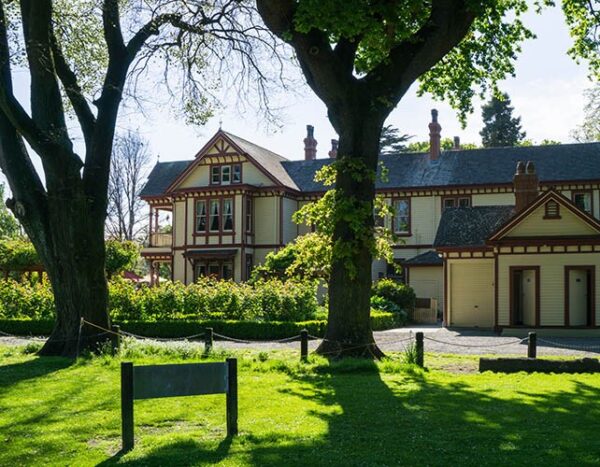
Our house tour was equally brief and, frankly, for me, one element that could have been cut from the day. I have enough knowledge of American pioneer life that I didn’t particularly need to trace the pioneering history of a family that settled in Christchurch – even a prominent one.
Storytime
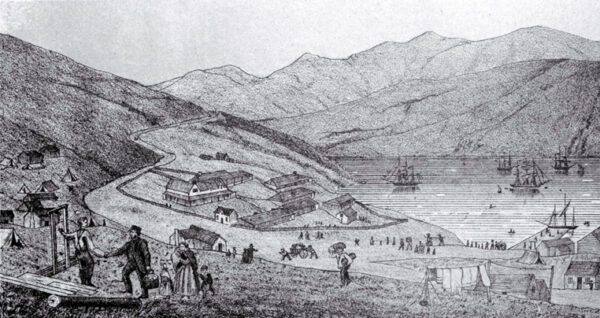
After dinner, (my notes say fine but nothing special) we had one last item on our schedule. An hour or an hour and a half of one-woman storytelling by Margaret Copland giving us “Portraits of the Pioneers.” Assuming a variety of voices, personalities, and accents, she entertained us with engaging stories of the early European settlers including some who were her direct ancestors and, I think might have arrived on one of the First Four Ships at Port Lyttleton.
[From Christchurch City Libraries].
Even though it wasn’t particularly late, by this time, the day had taken a bit of a toll and, honestly, I might have dozed off for bits of her stories.
-
It’s just a shot away – Prizren
March 6, 2026 -
Some things looking better, baby – Getting into Kosovo
March 4, 2026 -
Here, where the sky is falling – Kukës
March 2, 2026 -
That’s when we fall in line ’cause we got Berat
February 27, 2026 -
Walking on the big stuff – a climb to Tragjas
February 25, 2026