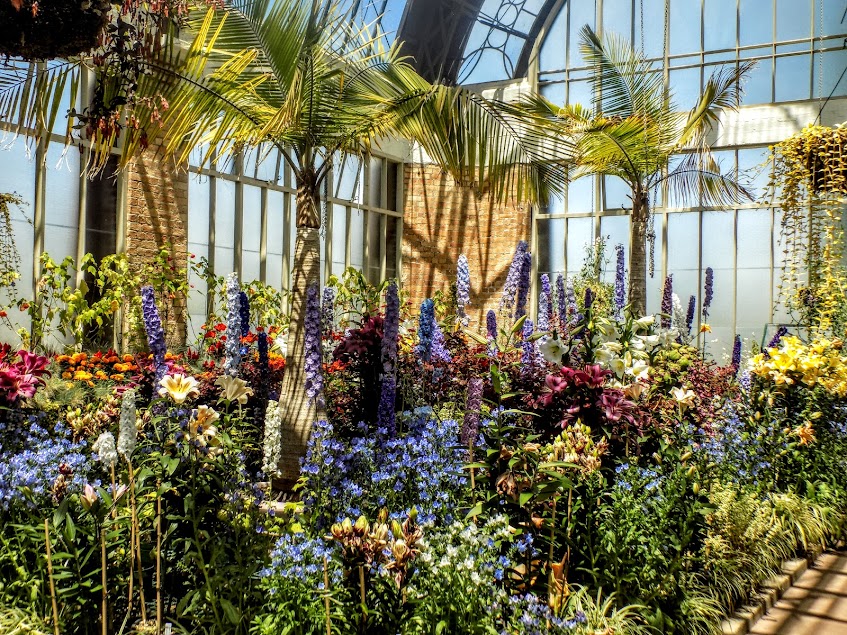
See the curtains hanging in the window – Auckland day 2
Following a short break after our interesting and engaging lecture on the history of Aotearoa New Zealand, our RS leaders had allotted half an hour to make the 10-minute walk to the Viaduct Basin where we’d split the group in two with each half boarding its own sailboat for a one-hour cruise in Auckland’s harbor that took us to the Auckland Harbour Bridge and back. The box truss bridge spanning Waitemata Harbour, called the coathanger by some local wags,
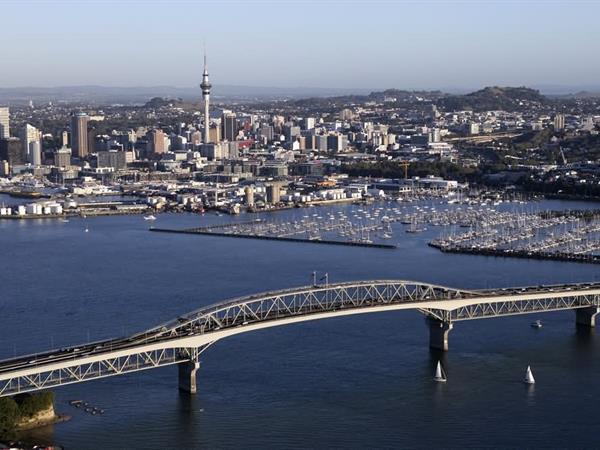
[From Swiss-Belhotel]
has enough of a vague visual echo of the famous steel arch bridge spanning Sydney Harbour for people to complain that it’s a pale copy of that icon that opened more than two decades before Auckland’s.
The cruise was pleasant enough as was the banter from the sailboat crew. It provided some fine views of Auckland’s CBD
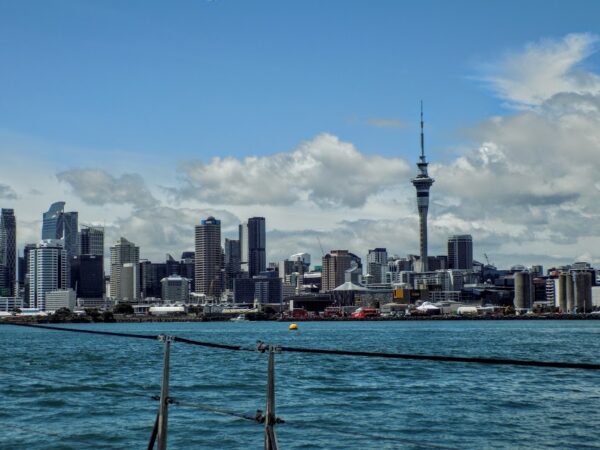
and an interesting experience of true sailing using the wind exclusively. Never particularly comfortable on boats, I ultimately found it little more than a way of filling an an hour before our scheduled trip to the Auckland Domain Wintergarden and Auckland War Memorial Museum.
Wintergarden? But it’s summer
In 1843 Governor Robert Fitzroy designated the 75 hectare space previously set aside as a government owned recreational space as a public park reserve and he called it Auckland Park.
(Of course the area that the local iwi called Pukekawa had long been of significant cultural and historical importance to whatever iwi controlled it because it sits atop an extinct volcano and serves as a strategic lookout over Waitematā Harbour. The hill called Pukekaroa, which lies within the park, is known both as the “hill of bitter memories” because of the battles that occurred there and as a place where peace was negotiated such as the agreement between the Northern and Waikato iwi. The hill is home to a sacred tōtara
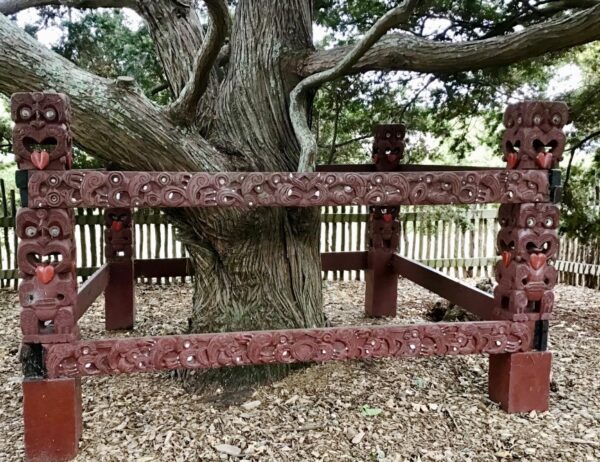
tree planted in 1940 by Kiingitanga leader Princess Te Puea Herangi, perhaps to mark the first centenary of the Treaty of Waitangi or as a separate gesture of cultural significance representing her broader efforts toward reconciliation and community development since her Tainui iwi did not attend the Treaty centennial celebrations at Waitangi.)
The Public Domains Act of 1860 established the boundaries of what came to be called Auckland Domain. Over the last third of the 19th century, the Domain saw its use expand to having sports fields and gardens but also to hosting cultural and scientific events such as observing the 1872 Transit of Venus.
According to one official site,
The Domain Wintergardens combine New Zealand’s natural and cultural heritage, consisting of structures displaying a variety of native and exotic flora in the Auckland Domain.
You can see some of both in the two photos below.
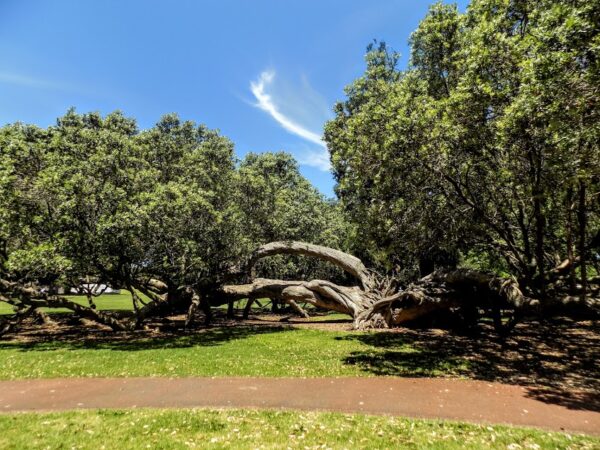
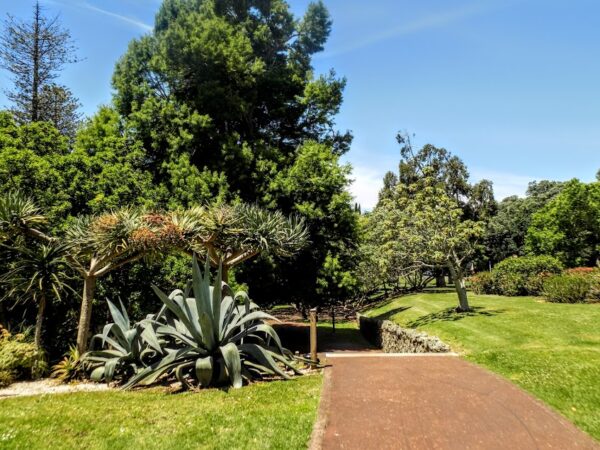
Profits from the Industrial, Agricultural, and Mining Exhibition of 1913-1914 that was held on the site were used to build a Temperate – or Cool House in 1916-1921 for the year-round display of flowering plants.
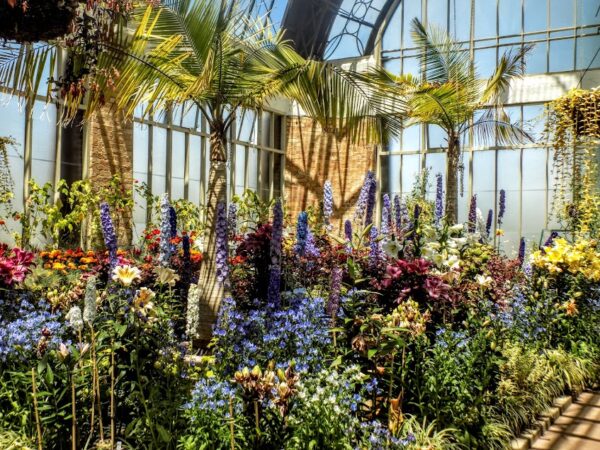
The park and buildings were designed by William Henry Gummer and Charles Reginald Ford, who were among the leading architects of their day. The Temperate and Tropical houses are barrel-vaulted steel and glass structures enclosing a courtyard.
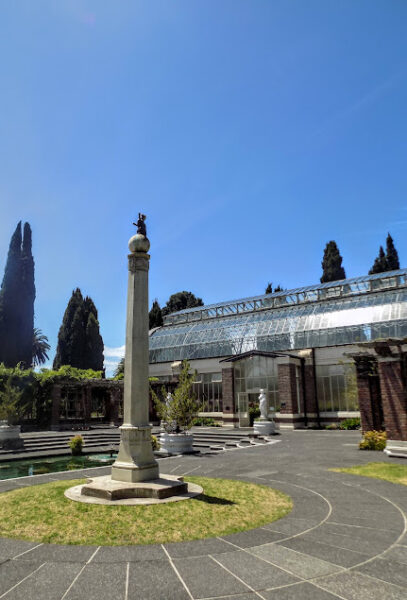
The statues were contributed by a local businessman – William Elliott – and added in the 1930s.
Nationally significant representations of early twentieth-century garden design, the Domain Wintergardens are considered to be among the best-preserved examples of their kind in Aotearoa New Zealand and reflect the attitudes toward the natural world at that time. They are, like the Clock Tower at the university, Category I listed heritage structures of national importance.
The Auckland War Memorial Museum
Even if you’re a lover of outdoor activities and could spend your days sailing around Waitematā Harbour and wandering the grounds of Auckland Domain, I think you’d find it worthwhile to spend a few hours of your time there exploring the Auckland War Memorial Museum. Although it has a long history (at least for the city of Auckland), it’s had its neo-classical home atop Pukekawa Hill only since 1929.
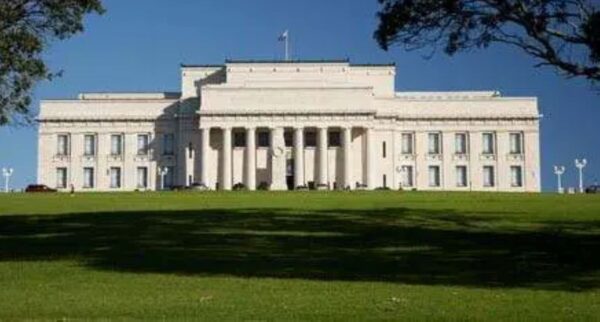
The museum began its life in 1852 in a small cottage on Grafton Road, known as “Old Government Farm House” or “The Governor’s Dairy” with a focus on collecting specimens highlighting New Zealand’s natural history, and displaying weapons, clothing, and implements from New Zealand and other Pacific Island cultures.
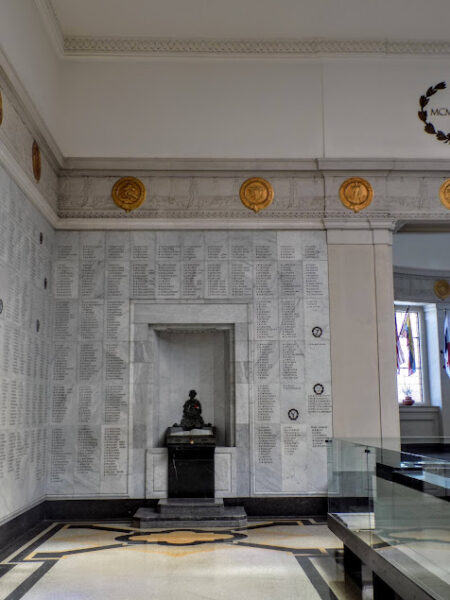
Because of the collection’s growth, the museum had moved twice before the government decided to build it a new home in the 1920s. The plans were combined with creating a memorial to New Zealand’s soldiers who had been killed in the First World War. As would have been common practice at the time, the site atop Pukekaka Hill was likely chosen without consulting the Māori or even the local iwi. Construction on the current building began in 1925. It opened in 1929 with a semi-circular expansion built between 1956 and 1960 to create more museum space and to include memorials for the nation’s casualties of World War Two. There are memorials both outside
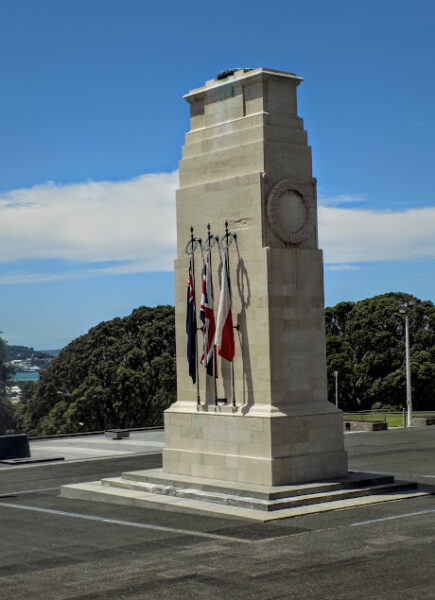
and inside the building.
In a 1957 Reader’s Digest article, Allen Saunders wrote “life is what happens when you’re busy making other plans” (apologies to those who attribute it to John Lennon) and I’m sure when RS scheduled our tour of the War Memorial Museum, they didn’t plan on it coinciding with a visit by the prime minister of Czechia. But such was the case. The museum guides had to alter their plans because security had closed (or at least temporarily closed) certain areas of the museum for security. (I’m confident our presence created heightened security because I can imagine little greater threat to Prime Minister Fiala than a group of septuagenarian and octogenarian American tourists.)
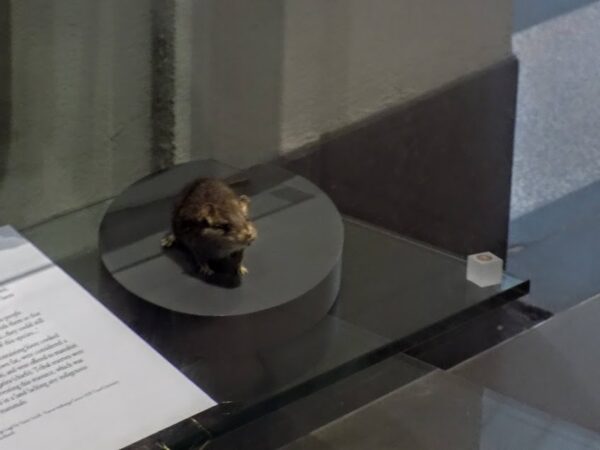
Fortunately, we had plenty to see and explore beginning with a kiore (one of the non-native mammals the Polynesian settlers brought with them),
the three ancestral carved posts (pou) representing the tribal composition of Auckland Museum’s Taumata-a-iwi – a sort of advisory board on Māori issues –
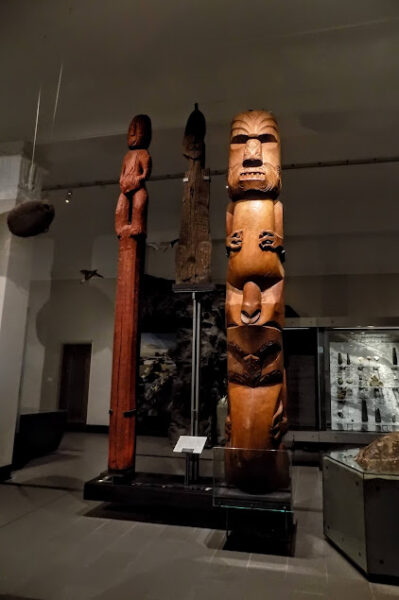
and a reconstructed giant moa.
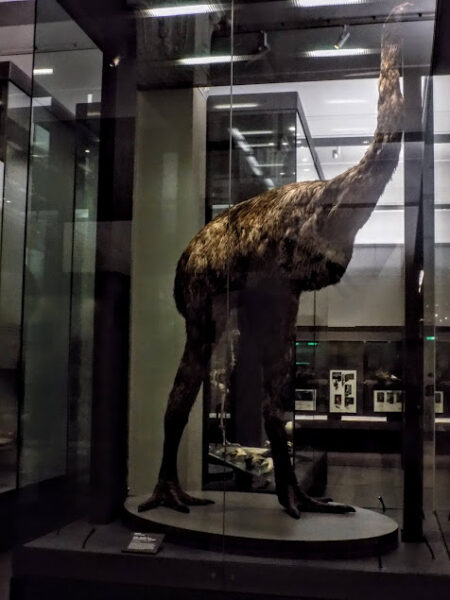
(Like many of Aotearoa’s endemic birds, the moa was flightless because it faced no terrestrial predatory threat until the Māori arrived. In a relatively short time – between 100 and 200 years, they had hunted the bird to extinction. {This is another notable difference between the Māori and Australia’s First People. The Australians might have hunted some of that continent’s megafauna such as the Thylacoleo to extinction though if they did, they needed at least 17,000 years to do so.} The moa is an interesting example of reverse sexual dimorphism wherein the females were significantly larger – about half a meter taller and 150 – 200 kilos heavier – than the males of the species.)
The museum isn’t limited only to natural history. It doesn’t shy away from the history of conflicts both intertribal between the local iwi and then with the colonizing British. We’ll take a look at that, the Treaty of Waitangi, the Musket Wars of of 1806-1845, and the New Zealand (or Land) Wars of 1843-1881 in the next post.
-
It’s just a shot away – Prizren
March 6, 2026 -
Some things looking better, baby – Getting into Kosovo
March 4, 2026 -
Here, where the sky is falling – Kukës
March 2, 2026 -
That’s when we fall in line ’cause we got Berat
February 27, 2026 -
Walking on the big stuff – a climb to Tragjas
February 25, 2026