Saw you at the fall – Picture on a closed circuit
Road Scholar had a busy morning planned for us but their ownership of the day would end with lunch at the Thistle Inn. Following this we had (wonder of wonders) a free afternoon and evening. Here’s the RS itinerary:
08:50 Coach to Parliament.
09:30 Guided visit of Parliament.
11:00 Visit the Supreme Court.
12:30 Lunch at the Thistle Inn.
After lunch four of us would be off to the WĒTĀ Workshop and the day would end with supper on our own. Unlike the dynamic of the RS group in Australia there was no inclination in this group to share this penultimate evening meal. Nearly everyone had made plans for themselves. For now, Let’s return to the morning.
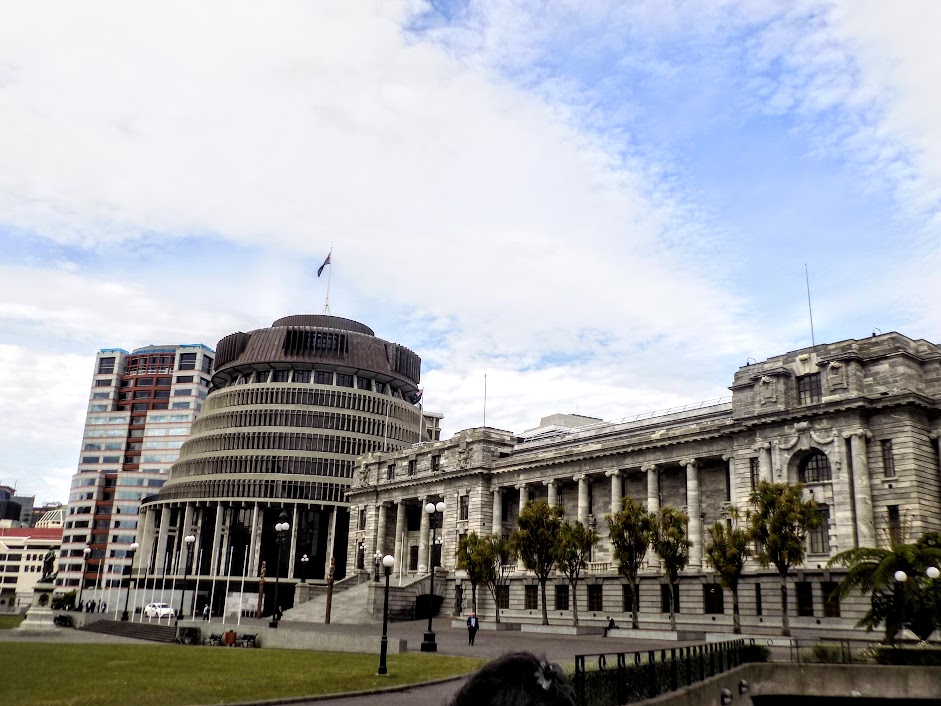
We’ll start with Parliament House and the Beehive – in Māori Ngā whare Paremata.
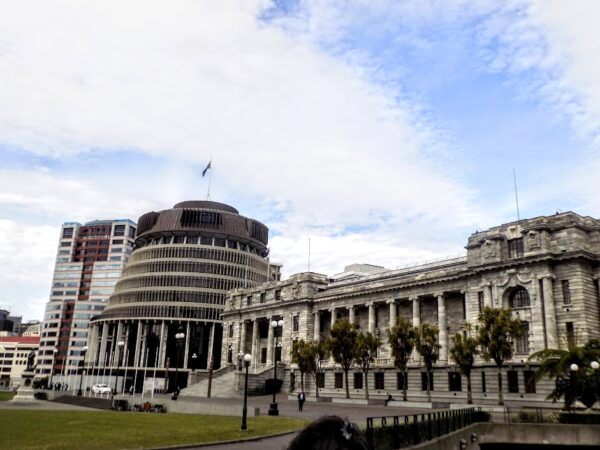
The building on the right is the Parliament House and on its left you see the Executive Wing commonly called the Beehive.
In the previous post I noted that the capital moved from Auckland to Wellington in 1865 initially occupying Wellington’s Provincial Council Chambers that were built in 1858. The body got its first permanent home in the 1880s in this three-story Gothic Revival building designed by Thomas Turnbull.
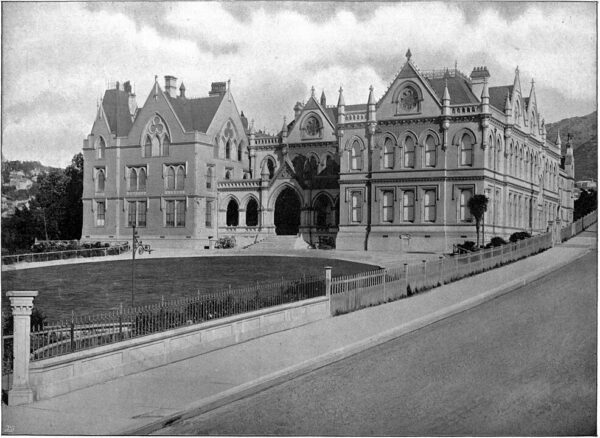
[From Wikipedia – Public Domain]
Then, the official website tells us,
At 2 a.m. on 11 December 1907, Parliament’s nightwatchman thought he heard rain on the roof. It was, in fact, a fire. By sunrise, the fire had destroyed the buildings and many national treasures. Even Bellamy’s restaurant and the Lobby, Parliament’s social hub, were gone. Only the library remained.
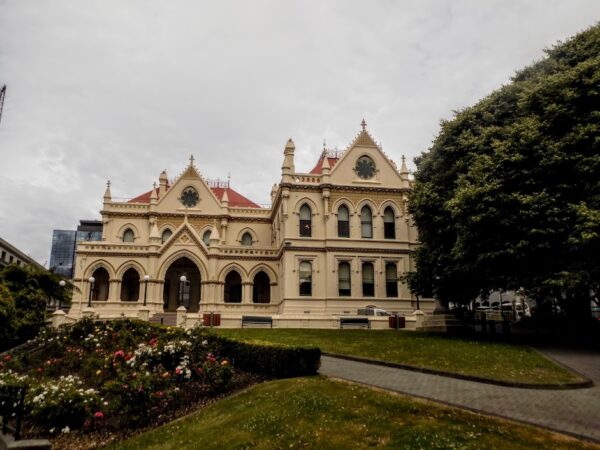
This fireproof addition had been added in 1899.
Construction on the current building (seen above) began in 1914 with the members of Parliament (MPs) using the old Government House that occupied a site near the Beehive as their temporary facility. (This building had fallen into some disuse when a new residence for the governor-general – who is the representative of the monarch – was built in 1910.) However, the old Government House had deteriorated so badly that the MPs moved into Parliament House in 1918 even though the building wouldn’t be completed until 1922.
Buzzing about
We started our tour in the Beehive (called this because of its shape and design) which is the Executive Wing of the parliamentary complex. While the building houses the National Crisis Management Centre in its basement, an educational space, a banquet hall, the parliamentary catering service, traditionally known as Bellamy’s, and the Parliament’s Visitor Centre whence all public tours depart, its primary function is to house the offices and meeting rooms for the Prime Minister and Cabinet Ministers.
Entering the building, visitors are greeted by this powhenua
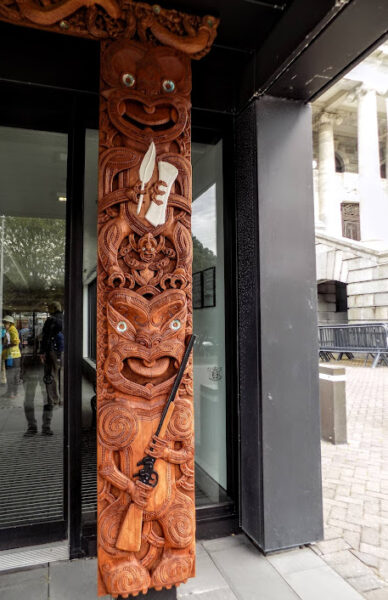
that I interpreted as representing the Musket Wars.
After clearing security and seeing some of the public areas of the Beehive we crossed into the Parliament House where security was even more intense. This is where it all happens. Committees meet in committee rooms such as Māui Tikitiki-a-Taranga or the Māori Affairs select committee room where bills are discussed and marked up to move on to The Chamber.
The Chamber is where the House of Representatives sits to debate bills and consider parliamentary business and, in fact, were in session giving a third reading to a bill that would allow landlords to oust tenants with 90 days notice but without specifying or requiring any reason to do so.
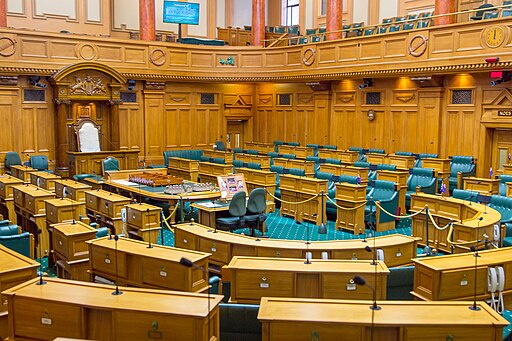
[From Wikimedia Commons Office of the Clerk of the House of Representatives of New Zealand, CC BY 4.0]
Note that I wrote the bill was on its third reading. Several steps are necessary before a bill is passed and can become law. The first is introduction which is an administrative process making the bill publicly available and announcing it in the House. No bill exists until it’s introduced.
Next is the first reading. (Reading is a term dating to the time when bills were read aloud in Great Britain’s House of Commons.) This is the first time the House can debate a bill and it can occur no sooner than three days subsequent to its introduction. The House then votes to pass the bill to a “first reading.” If it fails at this point, the bill is dead. If it passes, it’s sent to a select committee for closer examination.
The select committee will generally take six months to review the bill, hold public hearings, and propose amendments. They submit a reprint of the bill with or without amendments and an explanation of any proposed changes.
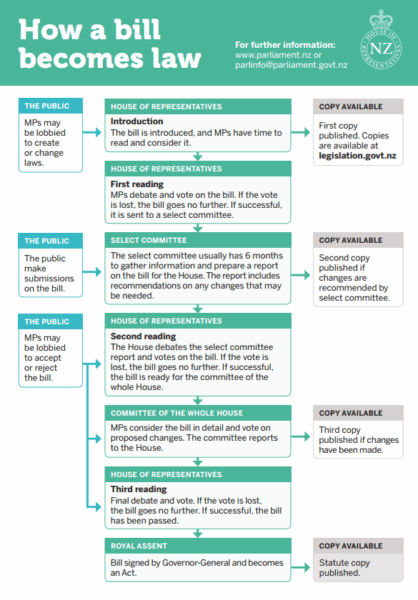
[From Parliament.nz]
No sooner than three days after the select committee submits its report to the House, it can be read and debated a second time. The House will then vote on any individual amendments that were not unanimously supported by the select committee. If approved by the House, they become part of the bill. Any unanimous amendments are automatically incorporated into the bill. After debate (sometimes prolonged debate), the House holds a second vote on the entire bill. If it fails at this point, it is dead. If it passes, it’s reprinted showing any changes.
Then comes the third reading. This includes a debate on the bill’s final form but is generally a formality . As Parliament’s website notes, “Bills are rarely rejected at this stage.”
The debate on this particular bill was continuing when we left but we learned the following day that this proposal from the ruling coalition passed in spite of aggressive questioning and evasive or non-existent answers from the departmental minister (I presume the Ministry of Housing and Urban Development) by the minority party. However, the bill was still not technically a law. A bill isn’t law until it receives Royal assent. This is the signature of the sovereign or their representative the Governor-General currently Cindy Kiro.
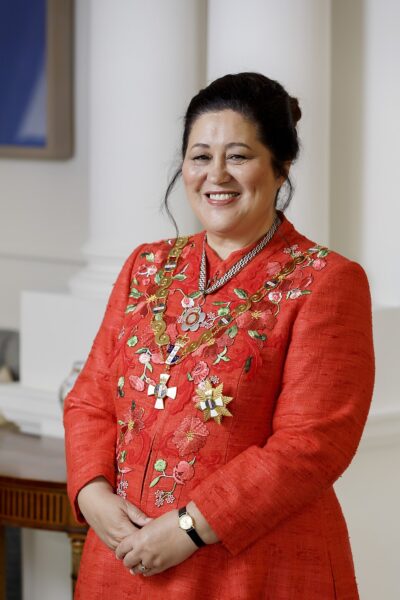
[By New Zealand Government, Office of the Governor-General – ,CC BY 4.0]
Next stop, the Supreme Court
We left The Chamber, collected all the things we’d had to leave behind at security, and set off on our short 300 meter walk to Te Kōti Mana Nui or the Supreme Court of New Zealand. On our way, we were given permission to cross the street by Kat Sheppard
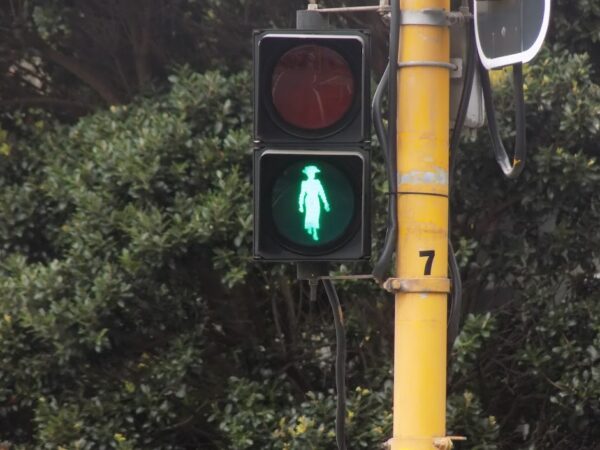
often considered the most prominent suffragist in the history of Aotearoa New Zealand.
In the United States, the Supreme Court decides issues of constitutionality. Its task is determining whether laws and their subsequent manner of application comport with the provisions of the U S Constitution. Since Aotearoa has no formal constitution, this is clearly not the function of this Supreme Court. It’s purpose is serving as the final court of appeal for Aotearoa – a function served by the Judicial Committee of the Privy Council in London until this court’s establishment on 1 January 2004.
According to a publication of the court, its establishment had “simple objectives”. These are:
to improve access to justice at this level and to allow important legal issues, including those related to the treaty of Waitangi, to be resolved with a clear understanding of New Zealand’s past and present.
Here’s a lawyer explaining how the system works.
The court has five or six judges appointed through a specific consultative process and are generally promoted from either the Court of Appeal or the High Court. They serve until a mandatory retirement age of 70. There’s also a process to appoint acting judges should a sitting judge recuse themselves or be otherwise unavailable.
While it’s possible that certain documents or case details can be restricted under suppression orders or privacy rules, all sessions of the court are open to the public and streamed on television monitors when the court is in session. The court is so dedicated to adhering to this policy that, not only is there a gallery for public seating
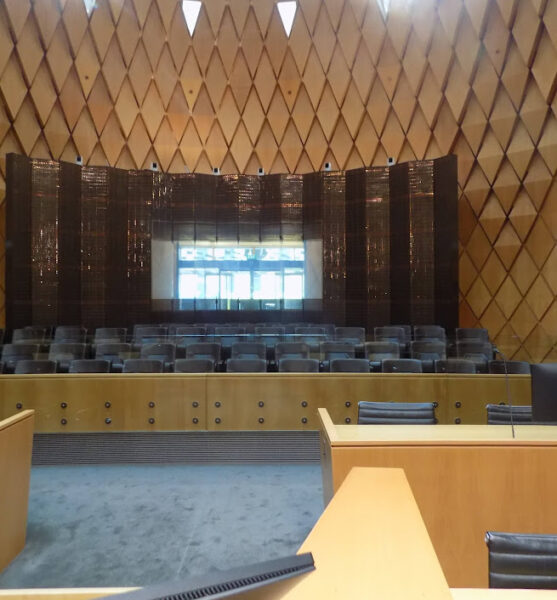
but, as you can see in the photo, people walking past on Lambton Quay can look into the courtroom through the foyer. Or the people inside can look out.
There’s more to come about this day but you’ll have to wait for the next post for that and I promise that your lessons on Aotearoa’s political and judicial systems are done. Meanwhile, here are a few more pictures.
-
It’s just a shot away – Prizren
March 6, 2026 -
Some things looking better, baby – Getting into Kosovo
March 4, 2026 -
Here, where the sky is falling – Kukës
March 2, 2026 -
That’s when we fall in line ’cause we got Berat
February 27, 2026 -
Walking on the big stuff – a climb to Tragjas
February 25, 2026