Roll out those lazy, hazy, crazy days
Sunday, 1 December 2024 marks not only the beginning of summer for most of the citizenry of Aotearoa but is also the official start date of my second Road Scholar (RS) tour. Most Kiwis use meteorological season dates rather than the astronomical dates commonly used in my home country. That is, their season begins on the first of the month in which either the solstice or equinox falls rather than on those dates themselves. So, happy first day of summer Road Scholars.
An easy beginning
This first day of the RS New Zealand trip set the tone for most of the days ahead. In contrast with the Australia trip I’d just finished, there was nothing hurried about this first day nor, with one notable exception, would there be about most of the days that follow. As I’d discovered yesterday, the breakfast buffet had smoked salmon – something I’d missed at all or nearly all the Australian hotel breakfasts and the heavenly choir sang gloriously every time I rode the elevator to the top floor with not merely a lovely view but
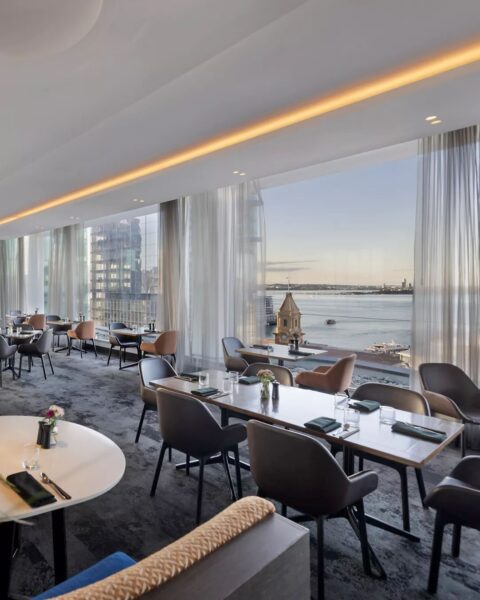
where I could load my plate with one of my favorite morning proteins. My notes say that I met many of the 23 travelers who constituted this RS group in this informal setting before the 10:45 official “Welcome and Orientation” in the hotel meeting room and that everyone in the group seemed to be quite well-traveled. I also almost immediately sensed that, at least for me, the dynamic of this group would differ somewhat from that of the Australian Train Trekkers.
We spent about an hour in the conference room introducing ourselves a bit more formally and getting an overview of the coming two weeks and receiving our Whisperers from B, our group leader. We had a bit of a break before we returned to the hotel restaurant for a buffet lunch after which we’d reconvene in the hotel lobby for our Auckland orientation walk.
While we’re waiting
Although the group will have a formal lecture on the history of Aotearoa Monday morning (and I’ll write about that in detail later in this journal), I think this break in our Sunday schedule is an opportune time to get a brief overview of Māori settlement in Tāmaki Makaurau meaning “the place desired by many” – something Auckland, by far Aotearoa’s largest city, has proven to be.
As I noted in a previous post, there’s some controversy regarding the time Māori first arrived on Aotearoa from Hawaiki but I’ll take a middle ground and say that Kupe – The Great Navigator
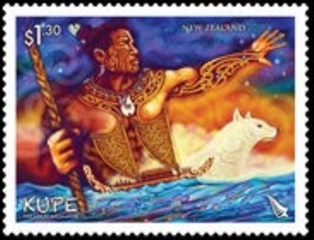
[From NZPost]
landed at Hokianga Harbor in his waka hourua or voyaging canoe some 300km north of Tāmaki Makaurau 1,000 years ago. Over the ensuing few centuries, the seven main waka hourua arrived in Aotearoa. These were the Tainui, Te Arawa, Mātaatua, Kurahaupō, Tokomaru, Aotea, and Tākitimu. The iwi Ngāi Tai, descended from the Tainui canoe, were among the first to establish themselves in the region. (Iwi is the largest traditional social unit in Māori culture. In today’s iterations, it’s generally equated to tribe. Each iwi typically consists of smaller subgroups called hapū {a kinship group consisting of several whānau} and whānau or extended families descended from a common ancestor.)
In the late 16th or early 17th century, a Māori leader Te Hua-o-Kaiwaka united a related group of three iwi into a confederation called Waiohua. By the 1720s, Ngāi Tāhuhu and Te Kawerau ā Maki were considered either allies to Waiohua or hapū who were part of the union. Then, in the mid-18th century, Ngāti Whātua displaced Te Wai-o-Hua from the northern part of Tāmaki Isthmus through a series of conflicts and battles. Ngāti Whātua are the dominant iwi in Tāmaki today. I’ll return to this history later in this journal. For now, let’s take
a walk around Auckland.
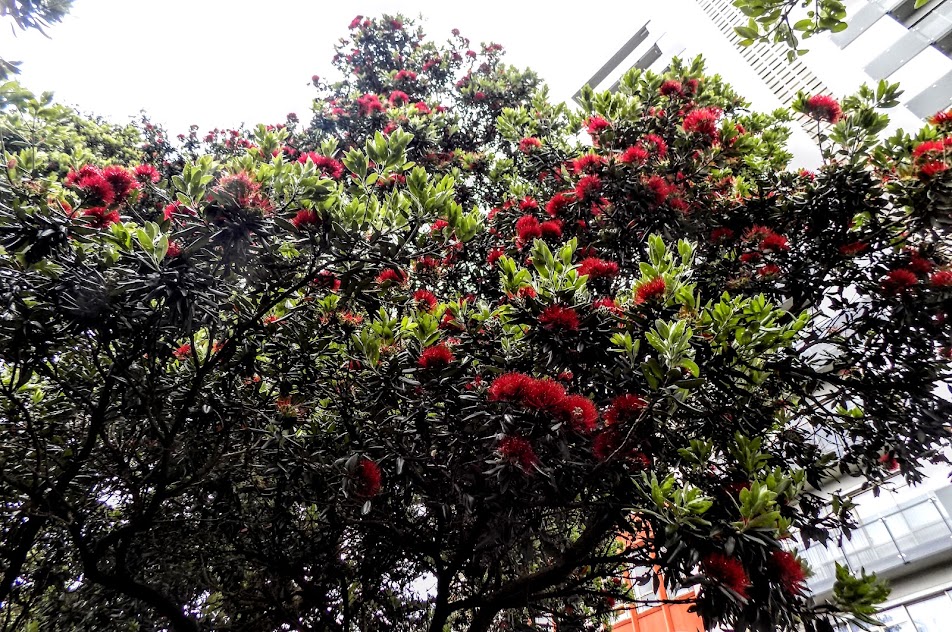
If one considers the colors red and green as symbolic colors of Christmas, then you’ll understand how and why the Pākehā (people of European descent) would consider the pōhutukawa tree their native Christmas tree. For much of the year, this native coast evergreen looks like this.
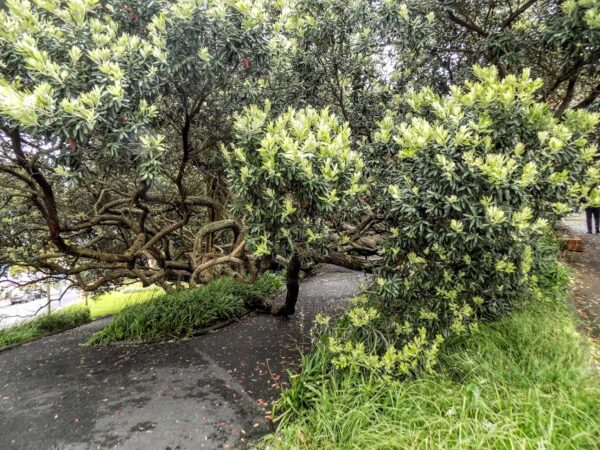
However, in early summer, when it blooms, it can look like this.
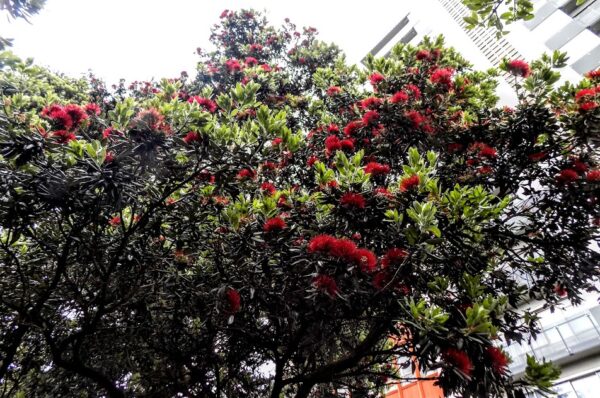
The closer the season gets to Christmas, the thicker the flowers generally become. (The pōhutukawa is also sacred in Māori culture where it’s called rākau rangatira and I’ll discuss its importance in a later post.)
I have to credit our site coordinator, whose name I neglected to note, for making this walk a nice balance of useful information interwoven with historical data and personal anecdote. We walked past the former Government House and onto the campus of the University of Auckland where I took this photograph of the clock tower.
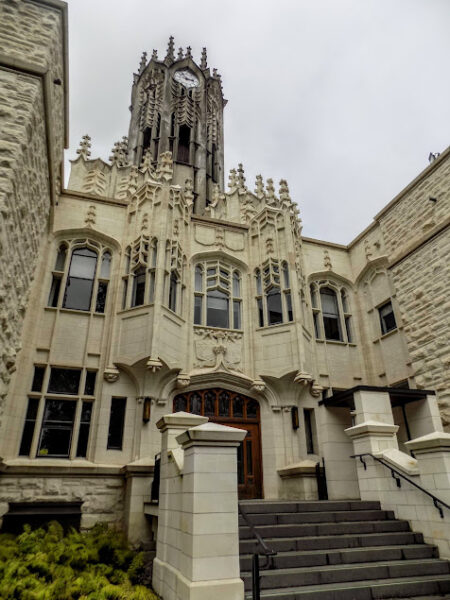
Designed by American architect Roy Lippincott in a broadly Art Nouveau style but incorporating motifs from Aotearoa’s native bush it initially offended some people. Upon its completion in 1926, it was derided by some as “Māori gothic.” When we walked past it in December 2024, it was considered a Category 1 historic place by Heritage New Zealand – a designation it has held since 1983.
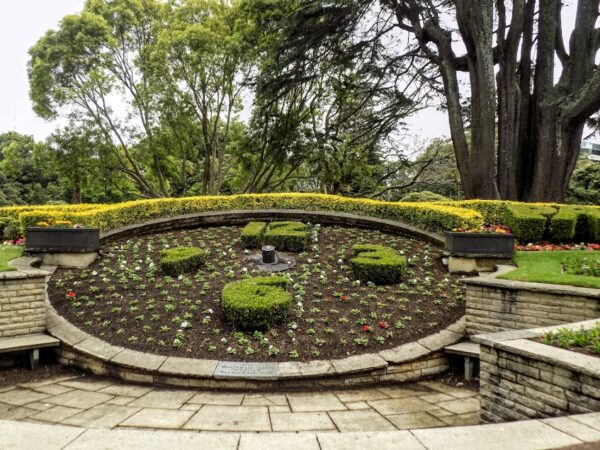
We then walked into nearby Albert Park that had a differently constructed – if non-working – clock.
On our return toward the hotel, we crossed Jean Batten Place which reminded me that I needed to find out about the woman called “New Zealand’s most famous aviatrix” and who is the subject of this photo I hurriedly snapped outside Auckland’s airport.
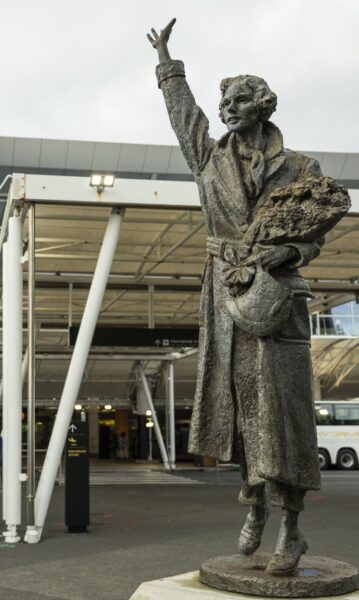
If you’re not from Aotearoa or an aviation savant of sorts you’re probably as clueless as I was about her accomplishments.
Batten had achieved worldwide fame in the 1930s for her aeronautic accomplishments that included becoming the first woman to fly solo from Australia to England in 1935 and later that year making the first solo flight from England to Argentina by a woman.
On 5 October 1936, she set out from England’s Lympne Aerodrome with two goals in mind – setting a new record for the shortest flight time from England to Australia and becoming the first person to complete a flight from England to New Zealand.
She accomplished the first when she landed in Darwin on 11 October five days and 21 hours after her departure breaking Jimmy Broadbent’s previous record by nearly a full day. After several delays in Australia, she accomplished the second when she landed at the Mangere Aerodrome on 16 October a few minutes past 17:00. Not only had she set a record of eleven days, 45 minutes for a direct flight from England to New Zealand that would stand for 44 years, completing the crossing from Sydney to Auckland in ten-and-a-half hours was also a new record.
As had been the case in Sydney, RS opted to allow us a free afternoon in Auckland on the tour’s first day – the day on which we were likely least familiar with it. I wandered around the CBD a bit, took some more photos, and returned for a rest to the hotel as I was still suffering from a bit of low level traveling burnout and needed to do as much as possible to refresh my mind and spirit for the weeks of travel that lay ahead.
-
It’s just a shot away – Prizren
March 6, 2026 -
Some things looking better, baby – Getting into Kosovo
March 4, 2026 -
Here, where the sky is falling – Kukës
March 2, 2026 -
That’s when we fall in line ’cause we got Berat
February 27, 2026 -
Walking on the big stuff – a climb to Tragjas
February 25, 2026