
Notes on the XIII Winter Olympiad (Lake Placid and me – addendum two)
Wonder of wonders
Those of us of a certain age likely have one vivid memory of the 1980 Winter Olympics and it came from what is now called the Herb Brooks Arena but at the time had the more prosaic appellation of the 1980 Rink at the Olympic Center. That is, of course, the hockey game dubbed the Miracle on Ice.
Throughout the 1970s the Cold War tensions between the United States and its NATO allies and the Soviet Union and the Warsaw Pact countries was bubbling with increasing intensity. The situation threatened to boil over when the Soviets invaded Afghanistan on 24 December 1979 and within weeks President Carter began levelling sanctions beginning with a grain embargo. Soon thereafter Carter also announced broader sanctions including suspending high-technology exports.
In 1980, most of the athletes competing for the western bloc played under at least a veneer of amateurism while the governments of many eastern bloc countries employed their athletes – often in their armed forces – in a manner that allowed them to train year-round taking shamateurism to a new level. The American team, comprised mainly of college students, was the youngest in US Olympic history, averaging 21 years old. And athletics was then, as it often is today, used as a propagandistic tool.
The USSR was the overwhelming favorite entering the tournament. They had won four consecutive gold medals amassing an Olympics record of 27-1-1 while having outscored their opponents by a collective 175-44. Two weeks before the start of the Lake Placid Games, the US and USSR played an exhibition that ended in a 10-3 Soviet win.
When the teams met in the semifinal, no one expected the stunning final score of USA 4 – USSR 3. Al Michaels, announcing the game for ABC, made one of the most famous calls in sports broadcasting history.
Happening at one of the tensest times of the Cold War, it would be difficult to understate the cultural impact of the American victory. It has been dramatized in the 1981 television movie Miracle on Ice, again in the 2004 film Miracle, was the subject of the 2001 HBO documentary Do You Believe in Miracles, and the ESPN 30 for 30 episode Of Miracles and Men.
Many have forgotten that the USA had to beat Finland to win the gold medal. That score was USA 4 – Finland 2. With the proverbial elephant now out of the room, let’s take a deeper look at the Games of the XIII Winter Olympics.
Some basics
Thirty-seven National Olympic Committees (NOCs) sent 840 men and 232 women to compete in 38 events at the Lake Placid Games. US Vice President Walter Mondale opened the Games on 13 February 1980 at the Lake Placid Equestrian Stadium. That same venue would host the Closing Ceremony on the 24th of that month. The mascot for the Games was Roni the Racoon. (I could find no evidence that Roni was related to Rocky.)

Depending on your parsing method, either the German Democratic Republic or the USSR led the medal count. The GDR’s 23 total medals led all other NOCs with the USSR one behind and the USA finishing third with 12. Though it only claimed a single gold medal, Norway was the only other competitor to win at least 10 total medals. However, while the East Germans edged the Soviets by a single medal in the total count, the USSR had a 10-9 edged in gold medals over the GDR. The most remarkable medal total probably belonged to Lichtenstein. The tiny Alpine nation won two gold and two silver medals and I’ll have a bit more to say about that below.
Standout performances
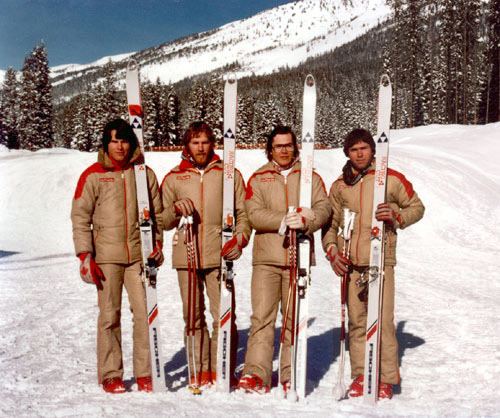
Although he won only a single bronze medal in the men’s downhill, it would be an oversight to overlook Steve Podborski and his achievement as one of the “Crazy Canucks.” This group of Canadians became known for their fearless and aggressive style of attacking downhill skiing that seemed to result in a win or a crash.
[From Alchetron.com]
Alpine Skiing became part of the games in 1936 and, in the nine competitions leading up to Lake Placid, no North American man had ever won any Olympic medal. Podborski broke that barrier.
Sweden’s Ingemar Stenmark is generally regarded as the most successful Alpine skier of all time with 86 World Cup race wins in his two specialties of slalom and giant slalom cementing him as the GOAT. (As of this writing, Austria’s Marcel Herscher is a distant second with 67.) His two gold medals at Lake Placid only cemented his reputation.
Pairing up
If there was any event in which the USSR might have been more heavily favored than ice hockey it would have been the pairs figure skating and, in this event, there would be no surprise.
Born in Moscow in 1949 Irina Rodnina began skating as a health measure that her parents hoped would help her overcome a childhood in which she contracted tuberculosis that led to 11 separate bouts with pneumonia. In 1964, Coach Stanizlav Zhuk paired Rodnina with 17-year-old Alexei Ulanov. The pair made their first appearance in the 1969 World Championships where they won the first of Rodnina’s 10 consecutive World Pairs Titles in which she competed. (Rodnina was pregnant and didn’t compete in the 1979 event which was won by Americans Randy Gardner and Tai Babilonia.)
Rodnina and Ulanov won Olympic gold in 1972 but their partnership ended when Ulanov married fellow pairs skater Ludmila Smirnova. Zhuk then paired Rodnina with Alexander Zaytsev, three years her junior, but she carried on without missing a step, lift, or landing. Rodnina and Zaytsev won the first of their six consecutive World Championships in Bratislava in 1973 as well as Olympic Gold in 1976 in Innsbruck.
The world expected a showdown between the US and Soviet teams but Gardner suffered an injury in training that forced him to withdraw. Rodnina and Zaytsev skated to an easy victory and she became the first female skater to win a gold medal at three consecutive Olympics since Sonja Henie.
On the slopes and on the ice
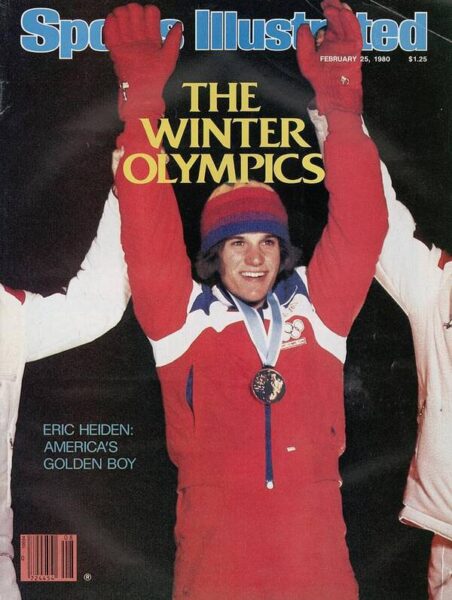
Perhaps the two most remarkable achievements came from the skates of American Eric Heiden and the skis of Hanni Wenzel. If Heiden surpassed expectations, Wenzel shattered them.
Entering the 1980 Olympics, Heiden was, without question, the dominant force in speed skating. The three-time defending World All-Around and World Sprint Champion, Heiden was set to compete at all five distances from 500 to 10,000 meters.
Heiden began his Olympic quest in the 500-meters – an event that might be considered his specialty and won his first gold medal on 10 February by the huge margin of 3/10 second in an Olympic record time of 38.03. He set another Olympic record less than a week later winning gold in the 5,000-meter race. His third gold medal and third Olympic record came in the 1000-meter race on the 19th and he followed that by winning gold on 21 February in the 1,500-meters. All that remained for his unprecedented gold medal sweep was the 10,000-meter race. Heiden not only captured the gold, he set both the Olympic and World records in doing so. If Al Michaels had called that last race, he would have been justified in repeating his call from the previous night, “Do you believe in miracles? Yes!”
[From Lake Placid Legacy Sites]
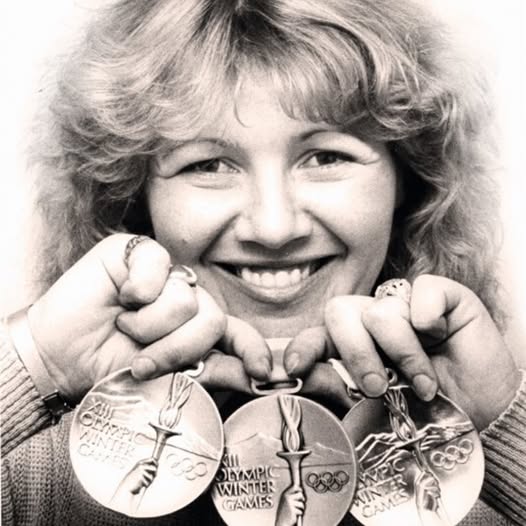
And then there’s Hannelore “Hanni” Wenzel. Born in Germany in late 1956, Wenzel’s family relocated to Liechtenstein when she was but a year old. By the time of the 1980 Games, Wenzel was far from an unknown quantity in Alpine Skiing. She had finished first and second in the previous two World Cup standings and had won the lone Olympic medal in Lichtenstein’s history claiming bronze in the 1976 slalom.
Entering all three Alpine events, she earned a silver medal in the downhill, placed first in the giant slalom, and capped off her stunning week by winning the gold medal in the slalom as well.
[From Lichtenstein Olympic Committee Facebook]
Here are some facts about her home country. Lichtenstein’s population in 1980 was estimated at 25,000 and in 2023 the country had a population of less than 40,000 making it the smallest country by population to claim an Olympic Gold medal. All 10 of Lichtenstein’s Olympic medals were won in the Winter Games, making it the only country with that achievement. (For perspective, 43 athletes, including seven in the winter games, have won 10 or more medals.) Wenzel’s two gold medals represent her country’s entire total and adding her pair of silver medals she can lay claim to 40% of Lichtenstein’s total. A remarkable achievement, indeed.
One more remarkable and often overlooked aspect of these games remains but if you want to learn what it is, you’ll have to wait for the next post.
-
It’s just a shot away – Prizren
March 6, 2026 -

Some things looking better, baby – Getting into Kosovo
March 4, 2026 -
Here, where the sky is falling – Kukës
March 2, 2026 -
That’s when we fall in line ’cause we got Berat
February 27, 2026 -

Walking on the big stuff – a climb to Tragjas
February 25, 2026