Notes on the VII Olympiad (Antwerp and me – addendum one)
Barely more than two weeks before the Games of the V Olympiad closed in Stockholm on 22 July 1912, the Olympic Committee had awarded the Games of the VI Olympiad to Berlin. The capital of the German Empire defeated bids by Amsterdam, Brussels, Budapest, Cleveland, and Alexandria which was seeking to become the first African city to host the Games. But, while 1916 would remain the year designated for the VI Olympiad, World War I intervened and there would be no competition.
The Armistice ending the war was signed on the 11th hour of the 11th day of the 11th month in 1918 at a time when the world was enveloped in a devastating pandemic caused by the H1N1 virus. Before it came to an end in late 1919 or early 1920, the Great Influenza epidemic sometimes called the Spanish flu pandemic had infected an estimated one-third of the world’s population of approximately 1,500,000,000 and it had killed 50,000,000.
When it came time to announce a city to host the renewal of the Games for the VII Olympiad, the Olympic Committee held a special meeting and selected Antwerp as a tribute to Belgium’s suffering and resilience during the war just ended. It was a Games that Pierre de Coubertin hoped would be above politics and would, in its dedication to peace, promote international reconciliation and the Olympic ideals of unity and understanding among nations. It was with this in mind that he designed the now familiar flag with its five interlocking rings that made its debut at the Games in Antwerp.
But, as has often been the case, de Coubertin’s vision had no exemption from the politics of the time. One outcome of the war was the dissolution of the Austro-Hungarian, German, Ottoman, and Russian Empires. This resulted in the creation of nine new countries – Austria, Czechoslovakia, Estonia, Hungary, Latvia, Lithuania, Poland, Turkey, and Yugoslavia. (The countries in red had the misfortune of having lost the war and the winners held them responsible and barred them from participating. Although newly formed, the countries in lime managed to send small contingents of athletes. The USSR, also newly formed, chose not to participate.)
The Belgians didn’t have long to prepare because the IOC didn’t formally award them the Games until 5 April 1919 and the Games would open less than 20 months later – on 20 August 1920. It was a daunting task for the small, densely populated, war-ravaged country that had been the first country Germany invaded in 1914. Some estimates put the civilian death toll from the combination of German atrocities, the flu, and other causes at more than 100,000. When combined with their battlefield deaths, Belgium lost nearly two percent of the country’s total population.
But the population wasn’t the only casualty of the war. Some of the most intense and prolonged battles occurred on Belgian soil. Historians count at least 10 major battles with the most devastating and noteworthy likely being the first and second Battles of Ypres. The first battle in October and November 1914 marked the beginning of trench warfare in the area and the second some six months later was the first time the Germans used poison gas on a large scale.
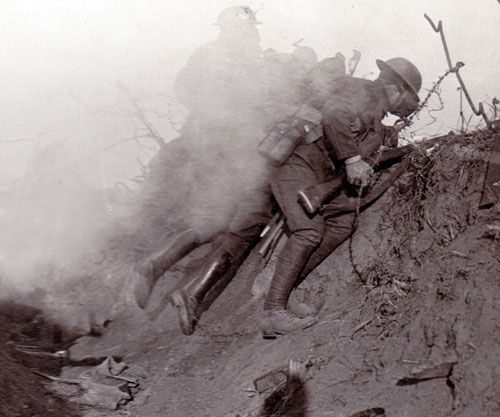
[From City of Parramatta]
The battle around Ypres gave rise to one of the war’s most famous and tragic poems,
In Flanders Fields
by John McCrae:
In Flanders fields the poppies blow
Between the crosses, row on row,
That mark our place; and in the sky
The larks, still bravely singing, fly
Scarce heard amid the guns below.
We are the Dead. Short days ago
We lived, felt dawn, saw sunset glow,
Loved and were loved, and now we lie,
In Flanders fields.
Take up our quarrel with the foe:
To you from failing hands we throw
The torch; be yours to hold it high.
If ye break faith with us who die
We shall not sleep, though poppies grow
In Flanders fields.
[From The Poetry Foundation]
While much of the world agreed with the decision to honor the wartime suffering and deprivation the Belgians faced, perhaps hosting the Olympics so soon after the war’s end was not the most well-considered choice the world and the IOC could have made. Facing the challenges of a decimated population, crumbled and crumbling infrastructure, and a ravaged economy, the Belgians soldiered on as tenaciously as they had through the war to be able to stage the Games.
Antwerp had a total of 19 venues where 2,622 athletes from 29 countries would compete in 156 events. Of those, two – the Olympisch Stadion and the Stade Nautique d’Antwerp or Nautical Stadium – were purpose built for the games. One other, the Ice Palace was adapted for Olympic use and hosted figure skating and the first Olympic ice hockey tournament.
The Olympic Stadium, also called Kielstadion because of its location, had a capacity of 30,000 of which 20,000 were standing room tickets.
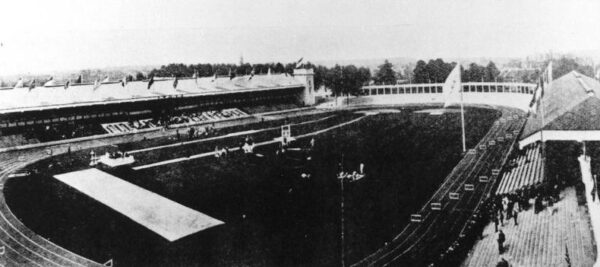
[From Wikiwand]
It officially opened on 20 May 1920 but construction still wasn’t complete when the Games started on 20 August. It hosted the opening and closing ceremonies, events in athletics, equestrian, field hockey, football (final), gymnastics, modern pentathlon, rugby union, tug of war, and weightlifting. However, the track was incomplete and many of the races were conducted in muddy conditions.
The competitors in the Nautical Stadium faced even greater challenges. The Belgians hadn’t built a pool. Rather, they added a wooden frame in an existing waterway that had once served as part of the city’s defenses.
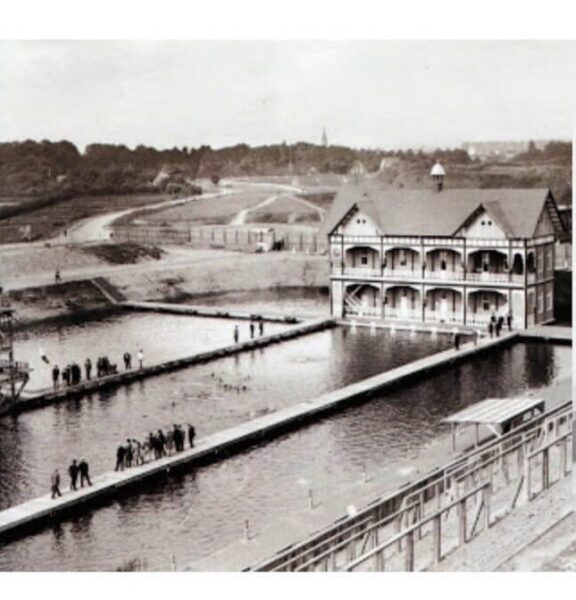
[From the collection of ISHOF]
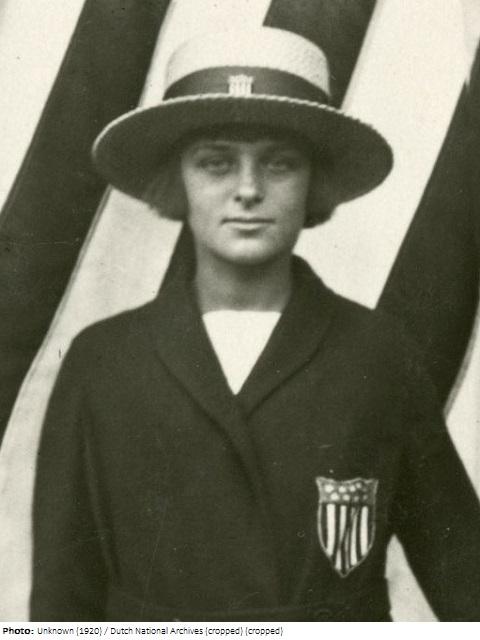
In a 1994 interview with Doctor Margaret Costa for the LA84 Digital Library, Aileen Riggin who,
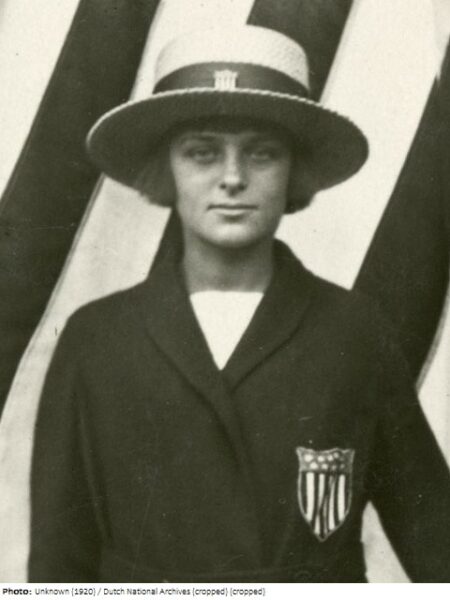
at 4’8” tall was the smallest athlete at the games, and who won the three-meter springboard at age 14 becoming the youngest Olympic champion to date recalled her experience,
We were heartsick when we saw it. […] A 50-meter pool was not asking too much, but of course Belgium did the very best they could. This was right after the war.
It was so cold that many swimmers had to be rescued from hypothermia. They were unconscious, and some of them were really in a bad way and had to be dragged out.
Another American, hurdler Walker Smith, shared his recollections for the same project. He recalled sleeping on cots without mattresses in dormitories housing 10 to 15 men per room and being given only a roll, coffee and “one little sardine” for breakfast while otherwise having to buy their own meals. However, the athletes might have been faring a little better than the general population because the country faced such significant food shortages it was still receiving international food aid.
The local population couldn’t afford to buy tickets to the events and, having faced four years of war and a two-year-long flu pandemic, travelers to the Games were also few. In all, it’s estimated that the economic loss from staging the Games was a staggering 600,000,000 francs.
With all the challenges there was still room for competitive excellence. Here are a few notable achievements.
Paavo Nurmi, who became known as the “Flying Finn” and who would dominate middle and long-distance running for most of the next decade, had a spectacular Olympics debut, winning three gold medals (10000m, individual cross-country, and team cross-country) and a silver in the 5000m.
Italian fencer Nedo Nadi won an unprecedented five gold medals across individual and team events in foil and saber.
Sweden’s Oscar Swahn, competing in his third Olympics was part of the silver medal winning team in the Running Target, Double Shot, Team, Men event. What made his achievement unique wasn’t that his son Alf was also on that team but that, at age 72 years 279 days, he became and remains the oldest Olympic medalist in history.
Since the United States dominated the competition winning 41 gold medals (Sweden was second with 19) and 95 overall, it’s worth looking at some of those achievements as well. We can start with Duke Kahanamoku who defended his 1912 100-meterfreestyle title and won a second gold medal in the 4x200m freestyle relay.
Charley Paddock, whose legacy would be inaccurately revived in the 1981 movie Chariots of Fire, won the only two gold medals of his Olympic career taking the top spot in the 100 meter sprint and as part of the 4×100 meter relay team.
John Kelly Sr won a brace of gold medals in single and double sculls. His son, John, Junior would compete in four Olympic games from 1948 through 1960 winning a bronze medal in the single sculls in 1956. John, Jr later became president of the AAU, the USOC, and the International Swimming Hall of Fame. While John, Junior had a noteworthy career and John Senior is considered a legend in his sport, I think it’s fair to say that his daughter Grace achieved a level of fame that outshone that of her father and brother.
I found the story of American swimmer Ethelda Bleibtrey quite interesting. You can learn why in the next post.
-
It’s just a shot away – Prizren
March 6, 2026 -
Some things looking better, baby – Getting into Kosovo
March 4, 2026 -
Here, where the sky is falling – Kukës
March 2, 2026 -
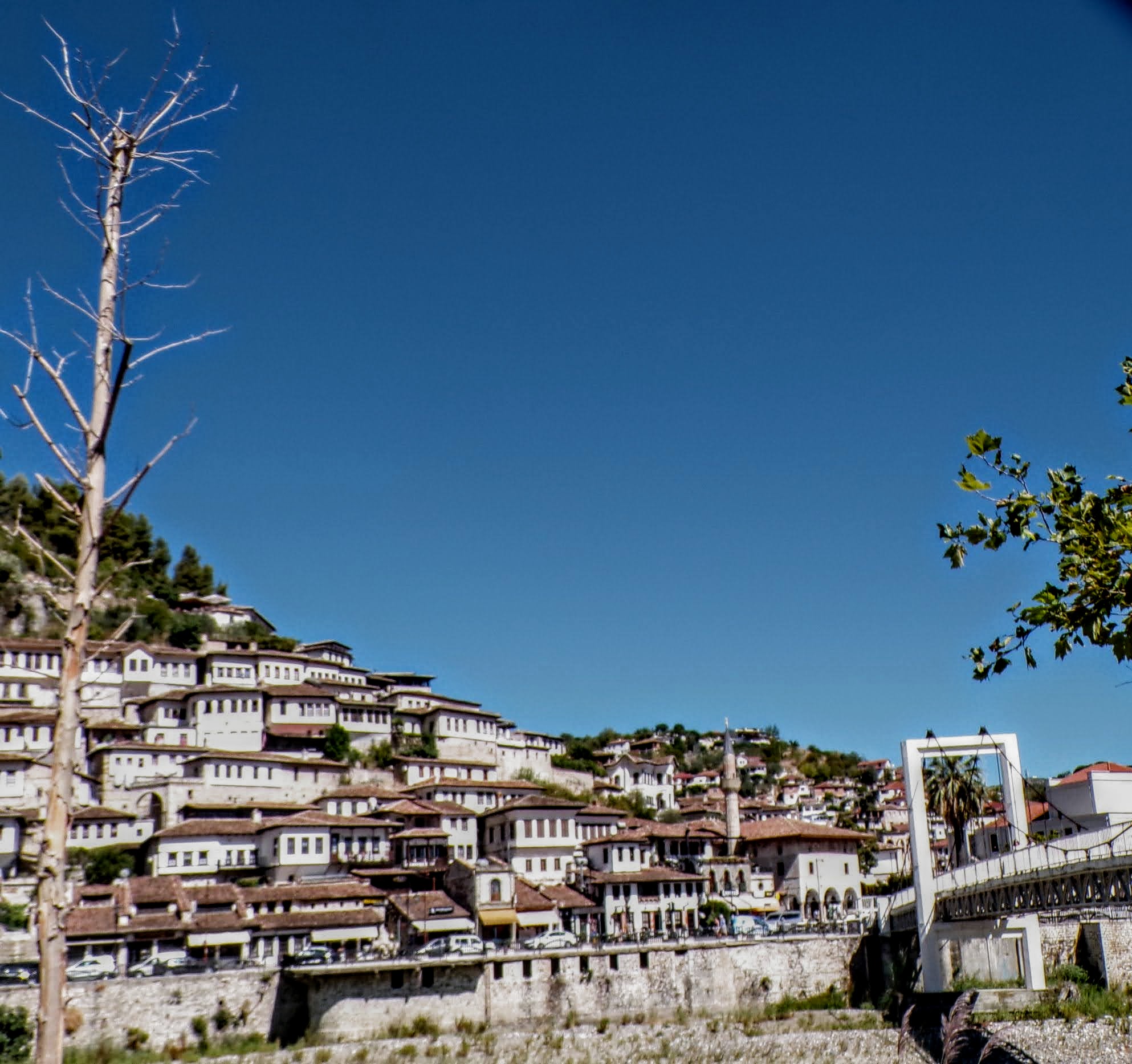
That’s when we fall in line ’cause we got Berat
February 27, 2026 -
Walking on the big stuff – a climb to Tragjas
February 25, 2026
2 responses to “Notes on the VII Olympiad (Antwerp and me – addendum one)”
Thanks Todd, I didn’t know much about Belgium before this.
Two things stood out to me that I was familiar with however.
The Spanish Flu. My grandmother use to talk about it.
Co-workers gone the next day after working with them just the day before.
Neighbors there in the morning, gone by dinner time.
Paavo Nurmi THE Flying Finn. I read some Olympic history about him once.
Cleveland? How could that city not be selected.
And then this line – given only a roll, coffee and “one little sardine” for breakfast.
I don’t think so. I sometimes have 3 breakfasts in morning.
Good stuff my friend.
Obrigado. Mr. Shell. I’m always looking for the good stuff. I didn’t realize how devastating that flu was until I did some research. I’m surprised I don’t remember any of my grandparents talking about it.