Notes on the III Winter Olympiad (Lake Placid and me – addendum one)
Despite the weather, despite the economic depression, despite a limited number of NOCs and athletes, Franklin Delano Roosevelt, the governor of New York officially opened the Games of the Third Winter Olympiad at the newly constructed Olympic Stadium in Lake Placid New York on 4 February 1932. One first-time Olympic sight greeted the governor – a female flag bearer. Of course, since Great Britain sent a team comprised of only four women figure skaters, a woman carrying the Union Jack should have come as no surprise.
Controversy!
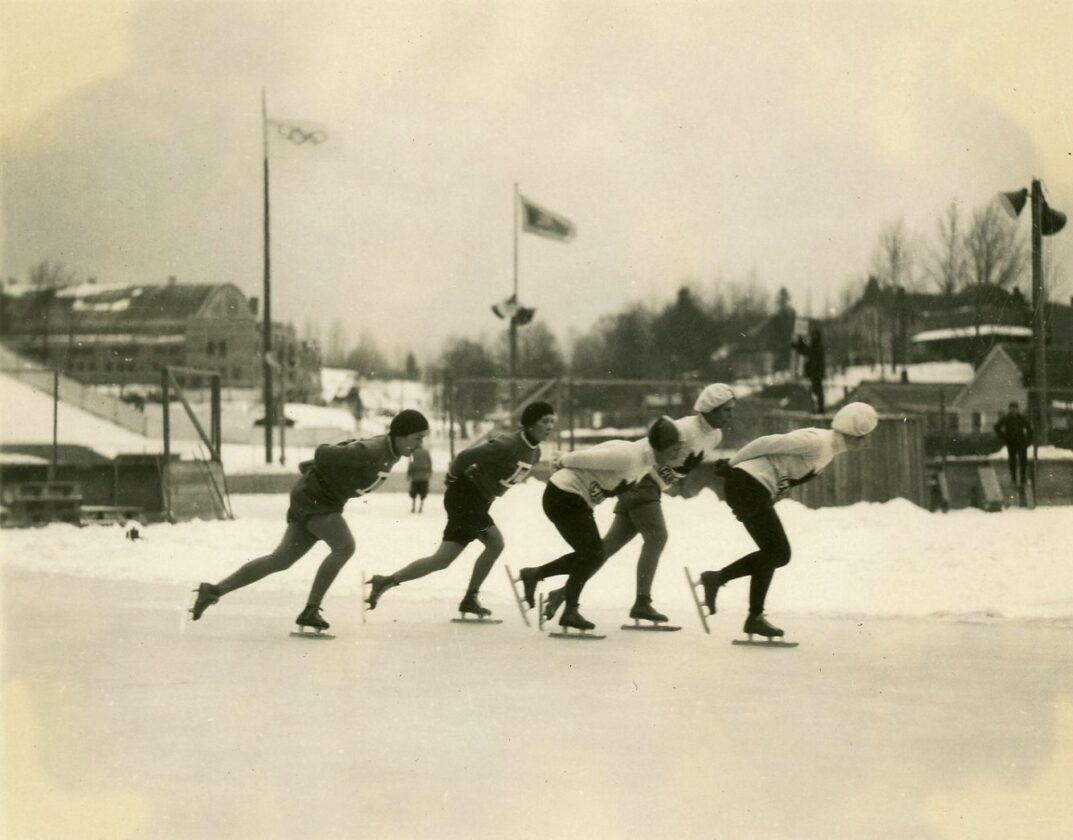
Once the competition began, it would generate plenty for spectators to admire and for bloggers to write about nearly a century later and that would include a speedskating controversy. For the first time in the history of the Games, the sport employed the American group race method in which the athletes raced head to head against the other competitors.
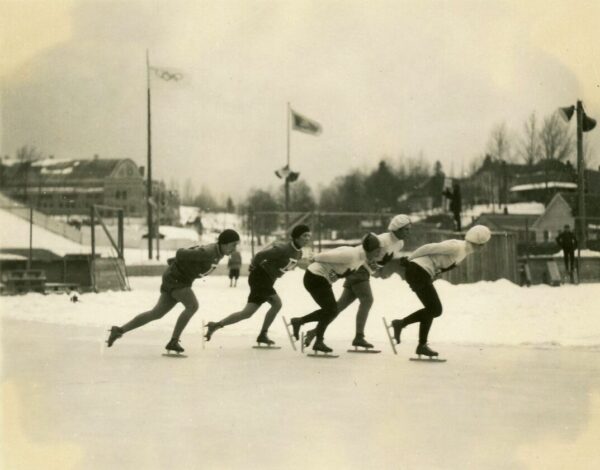
[From Lake Placid News]
The two previous Games used the European system of heats where two participants compete against each other and the clock. This remained the case until the XXIII Winter Olympic Games in PyeongChang in 2018.
The pack style confounded the Europeans but made heroes of two U.S. skaters. Jack Shea returned to his hometown from Dartmouth, delivered the Athlete’s Oath, and won the 500 and 1,500-meter races. Brooklyn native Irving Jaffee (whose name is doubtless beside his childhood friend and neighbor Hank Greenberg in the pamphlet handed out at the end of this clip)
won the other two events, the 5,000 and 10,000 meters. A few years later, unemployed during the years of the Great Depression and struggling to feed his family, Jaffe pawned the gold medals for $3,500. He later tried to redeem them at the pawn shop but found it had closed and the medals were gone. He never saw them again.
Other noteworthy outcomes
In figure skating, Sweden’s Gillis Grafström failed to win a fourth consecutive gold medal when Austrian Karl Schäfer won the title. (If you’re wondering how Grafström was aiming for a fourth consecutive figure skating gold medal at the third Winter Olympics, the answer is that until 1920 the Summer Games had competitions in both figure skating and ice hockey.) Sonja Henie won the second of her three consecutive gold medals in the women’s competition. When she won her first fold medal in 1928 at age 15 years and 10 months, Henie became the youngest Olympic figure skating champion – a distinction she held for 70 years until Tara Lipinski won the gold medal in Nagano.
Only teams from Canada, Germany, Poland, and the United States competed in the Ice Hockey tournament. In pool play, the teams played each other twice. In order to fill out the schedule, the Lake Placid organizers set up a series of “gala games” between the four national teams and two clubs – Montreal-based McGill University and Lake Placid Athletic Club. A combined USA-Canada side defeated the Lake Placid Club 3-2.
For the first time the Games featured an indoor venue. The newly constructed Lake Placid Arena hosted six of the pool games and the final in which the U S and Canada played to a 2-2 tie. The Canadians finished with five wins and one tie for a total of 11 points earning them a fourth consecutive Olympic gold medal. (Remember, ice hockey was part of the Summer Games through 1920.)
And then along came Eddie
In the history of the modern Olympics as of the date of this writing, only 128 athletes have taken part in both the Summer and Winter Games, and of those 128, just six have won a medal while competing in different sports at both competitions. Of those six, only Eddie Eagan won gold medals in two sports. Here’s how it happened.
Like many Olympic athletes, Eddie Eagan’s life has an interesting narrative arc. Born in Denver in April 1897, he developed an interest in boxing as a teen. Following his high school graduation, he enrolled at the University of Denver. During his lone year there, he won the western middleweight boxing title. He left school to enlist in the Army and would eventually fight not only as an artillery lieutenant with the American Expeditionary Forces (AEF) in the First World War but where he also became the AEF middleweight champion.
Returning to the U S after the war in 1919, Eagan enrolled at Yale University and became the AAU heavyweight champion. While there, Eagan began reading the serialized stories of Frank Merriwell – the creation of Gilbert Patten writing under pseudonym Burt L Standish. Merriwell was a mythical character who excelled at football, baseball, crew, and track at Yale while solving mysteries and righting wrongs.
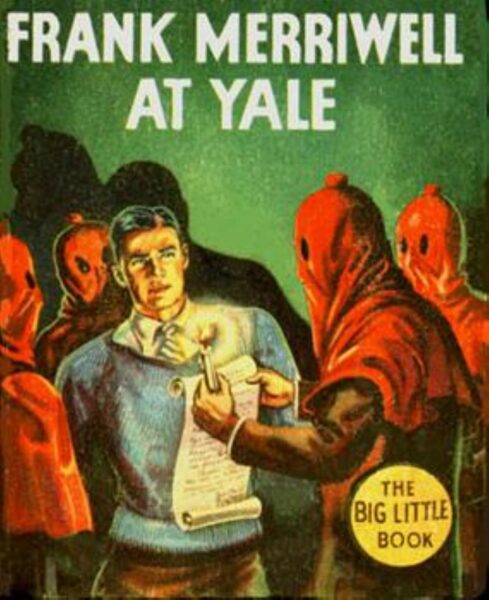
In at least one instance, Patten has a classmate say of him, “He never drinks. That’s how he keeps himself in such fine condition all the time. He will not smoke, either, and he takes his exercise regularly.”
Eagan later wrote in his autobiography that he had taken that description to heart and had modeled his behavior after Frank Merriwell, “To this day I have never used tobacco, because Frank Merriwell didn’t. My first glass of wine, which I do not care for, was taken under social compulsion in Europe. Frank never drank.”
While still at Yale, Eagan was part of the 288-member delegation the Americans sent to compete in the 1920 Olympics in Antwerp. Boxing in the light-heavyweight division, Eagan defeated Thomas Holstock of South Africa, Harold Franks from Great Britain, and Sverre Sørsdal of Norway in the final to win the gold medal.
Following his 1921 graduation from Yale, he enrolled in Harvard Law School but left there to complete his degree as a Rhodes Scholar at Oxford. In England he won that country’s Amateur Boxing Association heavyweight title in 1923. He competed at that weight in the 1924 Paris Olympics but lost his first match to Britain’s Arthur Clifton.
Likely thinking his athletic career had ended, he returned to the United States. In 1927 he married Margaret Colgate, whose family founded Colgate-Palmolive. He would be admitted to the New York State Bar Association in 1932 but three weeks before the Lake Placid Games, he received a telephone call from Jay O’Brien of the United States Olympic Bobsled Committee telling him that the four-man bobsled team was a man short and asking if he would join as the fourth. Casually, as though he’d been invited to be the fourth player in a round of bridge, he reportedly turned to his wife and said, “Guess what? I’m on the U S bobsled team now!”
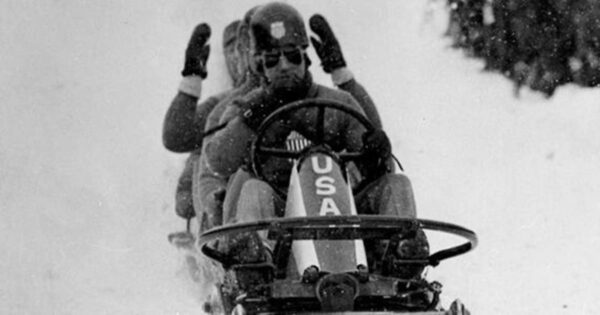
To that point in his life, Eagan had never set foot in a bobsled. As it turned out, his natural athletic ability was sufficient to help the US team win gold in the four-man competition. By being part of a winning gold medal team, Eagan became the first and remains the only person in the history of the Olympics to win gold at both the Summer and Winter Games in different disciplines.
But Eagan wasn’t quite ready to slide into comfortable obscurity. After his admission to the New York bar, he began a career in private practice before spending five years as an Assistant United States Attorney for the Southern District of New York. At the outbreak of World War II, he joined the United States Army Air Forces serving in the Air Transport Command. Throughout the course of the war, Eagan visited nearly every place the Army had planes. He retired with the rank of lieutenant colonel and was awarded ribbons for combat in all three theatres of operations.
After the war, Eagan was appointed chairman of the New York State Athletic Commission serving there until 1951. And, in one final footnote to the Eddie Eagan story, on 13 December 1948 he began a trip around the world. Flying only on scheduled airlines, he made 18 stops and completed the circumnavigation of the globe in a record time of 147 hours and 15 minutes. He beat the previous record by 20 hours and 15 minutes.
Next up, a return to Lake Placid in 1980 for the Games of the XIII Winter Olympics.
-
It’s just a shot away – Prizren
March 6, 2026 -

Some things looking better, baby – Getting into Kosovo
March 4, 2026 -
Here, where the sky is falling – Kukës
March 2, 2026 -
That’s when we fall in line ’cause we got Berat
February 27, 2026 -
Walking on the big stuff – a climb to Tragjas
February 25, 2026