Melbourne – Human waves, conflicts, and Dreamings (Melbourne and Me supplement two)
Between 100 and 400. This would be a good estimate of the number of humans who arrived in the first migration to Australia 60,000 years ago or longer. It’s likely that by 30 to 35 thousand years ago that initial population had spread across the continent including to the southeast where the five language groups of the Kulin Nation became caretakers of Country. Two of those groups, the Wurundjeri and the Bunurong, resided in Country where Europeans would eventually establish the city of Melbourne.
How many is too many? How few is too few?
There is no census counting the number of Indigenous people living in the Yarra Valley when the British arrived in the 1820s. Estimates for all of Victoria range from 20,000 to 100,000 people and about 11,000 lived in the area that would become Melbourne. As had happened elsewhere, that number would decline rapidly cratering to less than 2,000 within just 30 years. To find the reasons underlying that decline, we need only, as Captain Renault said.
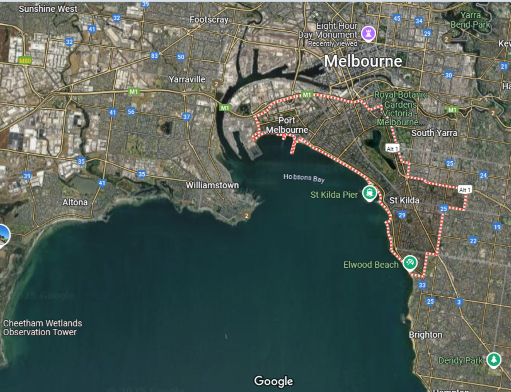
As European settlers claimed the land, they displaced the Indigenous people and disrupted their traditional economies and food sources. Displacement and war – the earliest of the Frontier Wars happened in 1803 in what is now the Port Phillip district and near Corio Bay some 90 kilometers away and a bit west-southwest of the edge of the Google maps image below.
And, of course, there was decimation by disease. But why? Australians weren’t the lone indigenous group decimated by European diseases. It’s a pattern we can see throughout the Americas as well. It might be reasonable to wonder why disease transmission seemed unidirectional. Surely there was disease in native communities so why didn’t Europeans contract Indigenous diseases at similar rates and suffer similar consequences? Here’s a probable explanation.
Europeans developed more robust immune systems because their long-term domestication of animals exposed them to more zoonotic diseases, the density of urban living conditions facilitated not only rapid disease spread but its antithesis – rapid immune system adaptation. Still further, the extent of their travel and trade also exposed them to more human pathogens. Here’s what the chain of infection looks like.

[From NHS UK]
Indigenous populations had limited exposure to both human and zoonotic pathogens. Aboriginal people in Australia had no domesticated animals though they appear to have had some sort of relationship with dingoes. However, those dogs weren’t domesticated in the conventional sense.
Even if we triple the high end of the estimated population of Victoria, the constituent communities of the various groups would have been considerably less dense than those found in European cities. And, while there was some trade and travel, most people stayed within their Country. Even within groups that shared linguistic and cultural connections such as those found in the Kulin Nation, each group had both identified and identifiable territorial borders marked by elements within the natural landscape. Crossing into neighboring Country without the appropriate Welcome was not socially permissible. This would have limited human to human pathogenic transmission.
This Batman might have been dark but he was certainly no knight
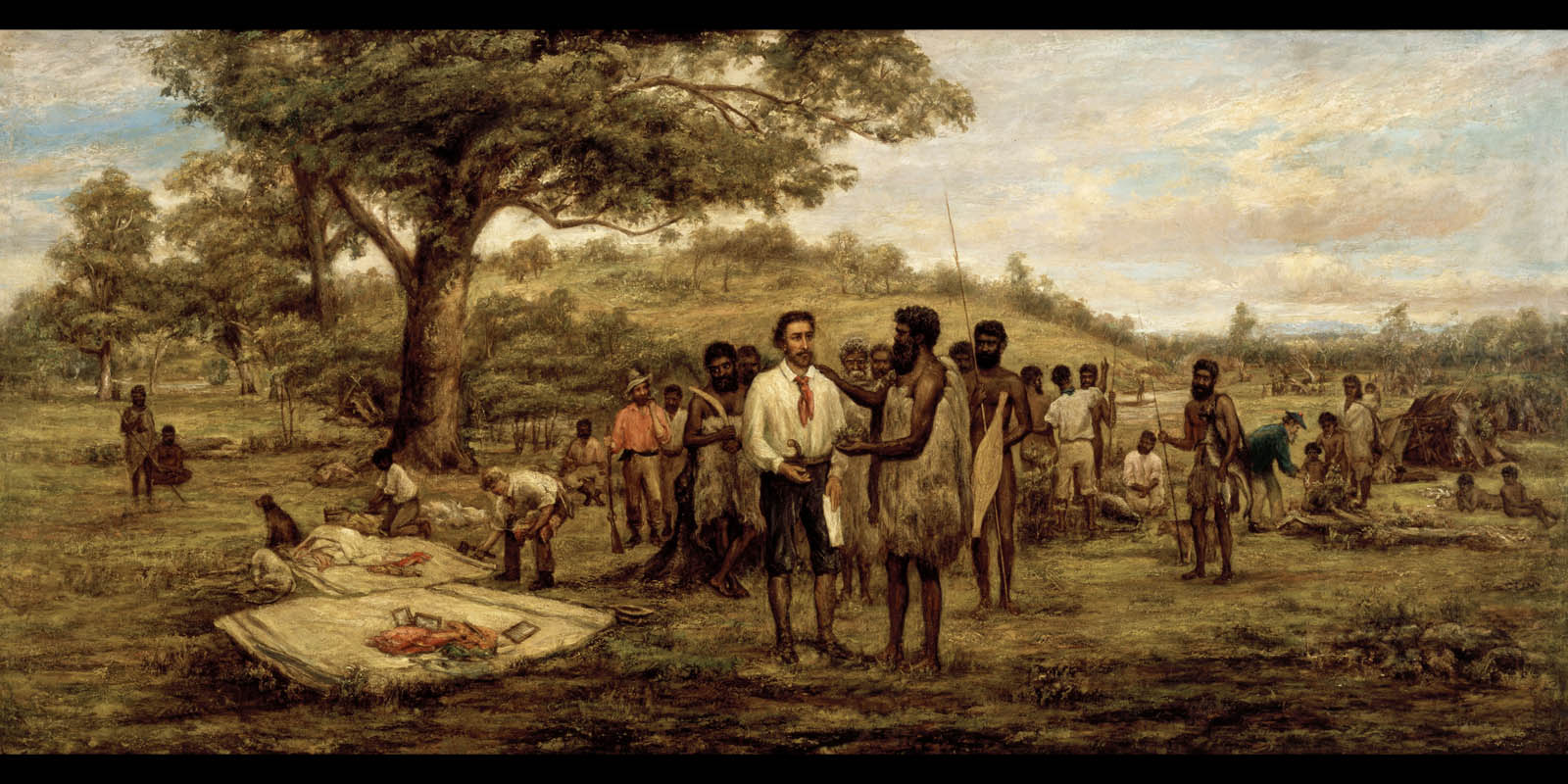
On 6 June 1835, John Batman met with Wurundjeri leaders of the Kulin Nation near Merri Creek (modern-day Northcote, Melbourne) to negotiate the “purchase” of some 240,000 hectares of land that included what is now Central Melbourne. There was a problem, though. Like all of Australia’s Indigenous people, the Wurundjeri people had no concept of land ownership. As I noted in the post old voices impelling me upward, The Australian Institute of Aboriginal and Torres Strait Islander Studies (AIATSIS) provides a definition of Country as seen by Australia’s Indigenous people,
Country is the term often used by Aboriginal peoples to describe the lands, waterways and seas to which they are connected. The term contains complex ideas about law, place, custom, language, spiritual belief, cultural practice, material sustenance, family and identity.
What’s likely is that the Wurundjeri viewed the negotiation
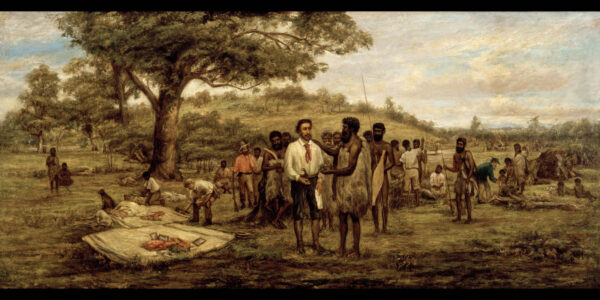
[From State Library of Victoria – Public Domain]
in which Batman offered blankets, tomahawks, knives, scissors, mirrors, flour, and shirts as a tandarrum or an exchange for safe passage. The translators that accompanied Batman likely exacerbated the cultural misunderstanding. Not only did none of them speak the Wurundjeri language, none of them were from the region.
Two months later, Governor Richard Bourke of New South Wales declared the treaty invalid. This didn’t restore Wurundjeri Country, however. Burke, who formalized the principle of terra nullius, declared that all Australian land was owned by the British Crown and could only be sold or distributed by it. In Bourke’s view, Batman was stealing land from the colonists not from the Aboriginal people.
How Bundjil brought peace to the Kulin
Bundjil the eagle (or eaglehawk) is a creator deity, culture hero and ancestral being of all the people of the Kulin Nation. This is a Dreaming story from the Bunurong people.
A long time in the past there was a period of long conflict among the people of the Kulin Nation. People argued and fought so much that they neglected their families and the land.
This lack of unity angered the sea so much that it rose until it had covered the plains threatening to flood the entire country. The people went to Bundjil and asked him to stop the rising sea. When the people agreed to change from fighting to respecting the laws and each other, Bundjil walked out to sea, raised his spear, and ordered the sea to stop rising which it did.
How Crow brought fire to the people – a Wurundjeri Dreaming
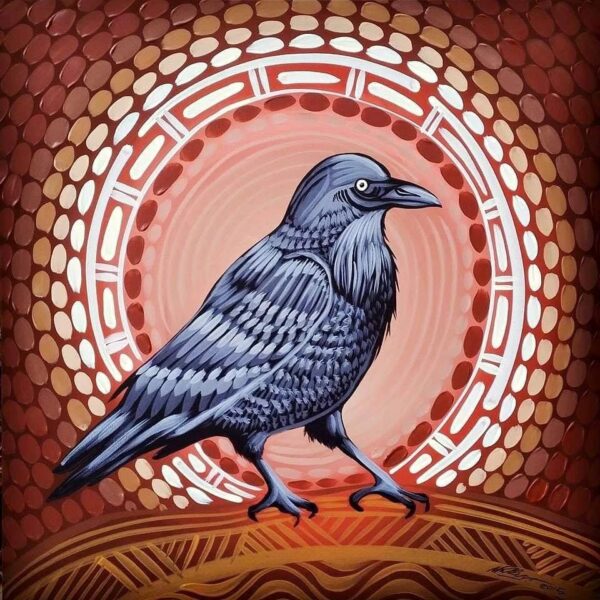
Long time ago fire was a jealously-guarded secret of the seven Karatgurk women who lived by Birrarung (the Yarra River). These women carried live coals on the ends of their digging sticks, allowing them to cook yams. One day Crow found a cooked yam and, finding it tastier than the raw vegetables he had been eating, decided he would cook his food from then on. However, the Karatgurk women refused to share their fire with him and Crow resolved to trick them into giving it up.
Crow caught and hid some snakes in an ant mound calling the women over telling them he had discovered that ant larvae were far tastier than yams. The women began digging, angering the snakes, which attacked. Shrieking, the sisters struck the snakes with their digging sticks, hitting them with such force that live coals flew off. Crow, who had been waiting for this, gathered the coals up and hid them in a kangaroo skin bag. The women soon discovered the theft and chased him, but the bird simply flew out of their reach and perched at the top of a high tree.
[From Fandom.com]
Bundjil the Eaglehawk, saw this and asked Crow for some of the coals so that he could cook a possum. Crow instead offered to cook it for him. Soon, a large group had gathered around Crow’s tree, shouting and demanding that he share the secret of fire with them. Frightened by the din, Crow flung several live coals at the crowd. Kurok-goru the fire-tailed finch picked up some of the coals and hid them behind his back, which is why to this day firefinches have red tails. The rest were gathered up by Bundjil’s shaman helpers, Djurt-djurt the Nankeen Kestrel and Thara the quail hawk. Some of the coals caused a bushfire that burnt Crow’s feathers permanently black and threatened to consume the entire land until Bundjil halted its spread. The Karatgurk sisters, meanwhile, were swept into the sky where they became the Pleiades. The stars represent their glowing fire sticks.
The magpie’s song (Wathaurong People)
Long time before today…
The sky covered the Earth and everyone had to crawl around in the dark. The proud and industrious Magpies worked to raise the sky so everyone could move about freely.
They gathered some long sticks and, working hard, they lifted the sky up. They placed the long sticks on small and big rocks and struggled to lift the sky even higher.
The sky split open, showing the beauty of the first sunrise. They were so overjoyed to see the light and feel the warmth of the sun’s heat, they burst into song. As they sang, the blanket of darkness broke and drifted away like clouds.
To this day the Magpies greet the sunrise with their joyful song.
Finally, a short creation story video. Here is the YouTube description: “Kirrit Barret, or Black Hill, is where the creation story begins for the Wathaurung people. On this sacred hill, Bunjil created the first two men from bark and clay.”
-
It’s just a shot away – Prizren
March 6, 2026 -
Some things looking better, baby – Getting into Kosovo
March 4, 2026 -
Here, where the sky is falling – Kukës
March 2, 2026 -
That’s when we fall in line ’cause we got Berat
February 27, 2026 -
Walking on the big stuff – a climb to Tragjas
February 25, 2026