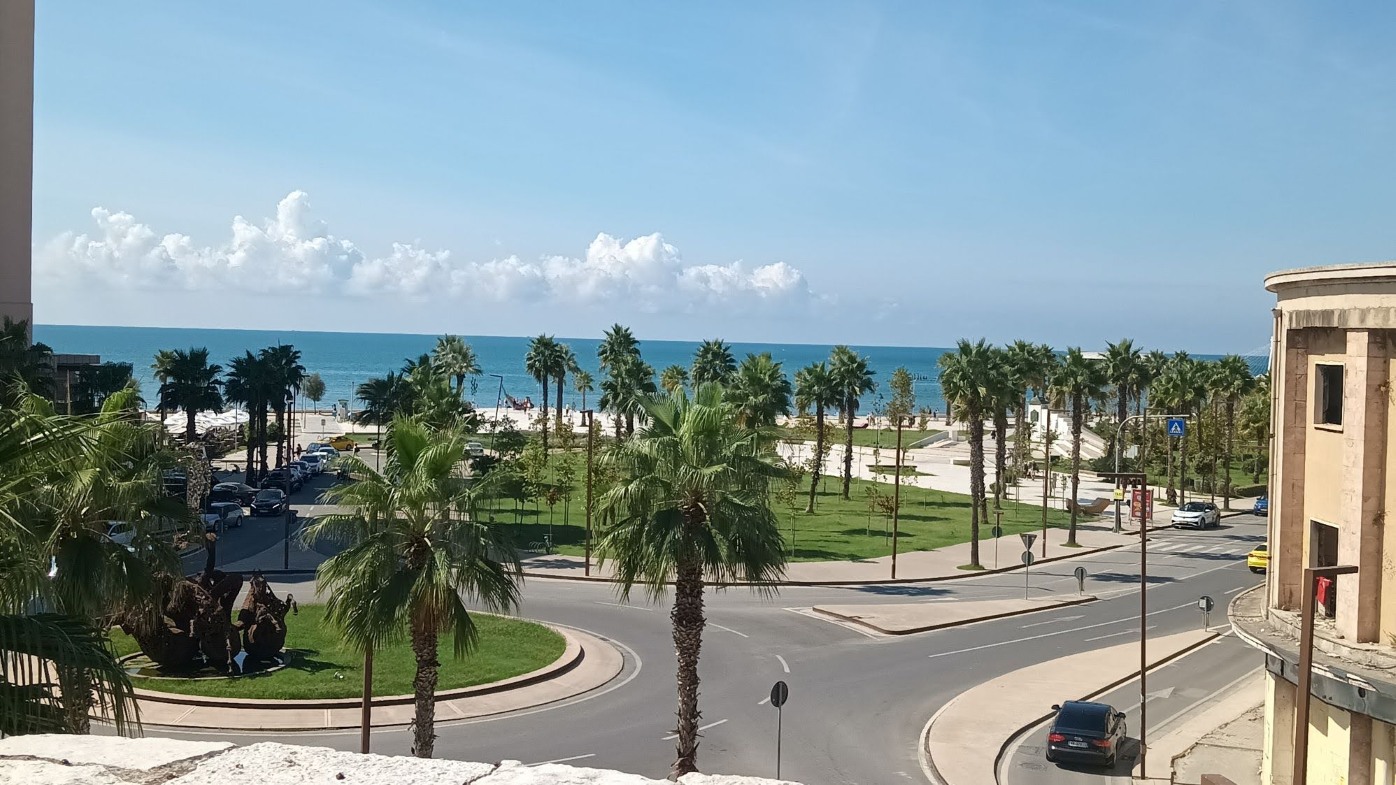
Maybe not under pressure but definitely under Durrës
Given how sumptuous last night’s dinner had been, I found the breakfast buffet at Mrizi i Zanave surprisingly modest. I enjoyed the use of many items I recognized from the previous night and, knowing that it minimizes food waste, it reminded me a little of the final dinner at Grand Hotel on Mackinac Island.
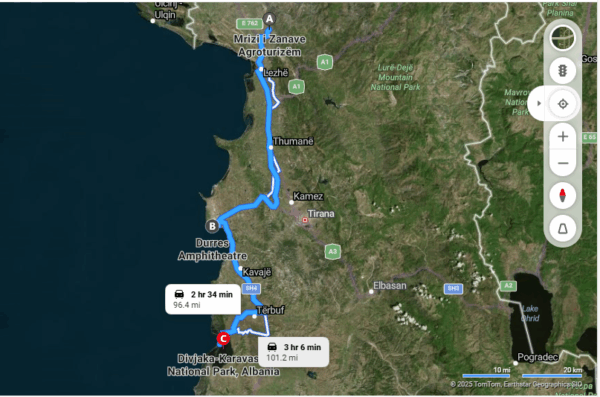
The first of two stops on today’s itinerary is the seaside city of Durrës and we’ll end the day at Divjaka-Karavasta National Park. This is our approximate route according to Bing Maps.
Durrës
While its population is only a bit more than 100,000, Durrës is Albania’s oldest city, its second largest, and was, at one time its most important. Working with the local Taulantii Illyrian tribe, Greek settlers from Corinth and Corcyra settled the coastal community in 627 BCE and called it Epidamnos. Establishing strong commercial ties throughout the region, Epidamnos quickly became one of the wealthiest Greek cities of the time. Sadly, successive settlements have buried most of the evidence of Hellenic occupation leaving that bit of Epidamnos’ history under Durrës. (As I often do, I’m stretching pronunciation for the pun. In Albanian, you’d stress the first syllable DOOR-es not the English duh-RESS.)
The Roman Empire captured Epidamnos in 229 BCE and renamed it Dyrrhachium. Long established as a commercial center, the newly named Dyrrhachium became the starting point for the Via Egnatia – a major Roman military highway stretching across the Balkans to its eastern terminus in Byzantium (Istanbul). Given its commercial and military importance, it would be unsurprising to find a Roman Amphitheater. And with our local guide, find it, we did.
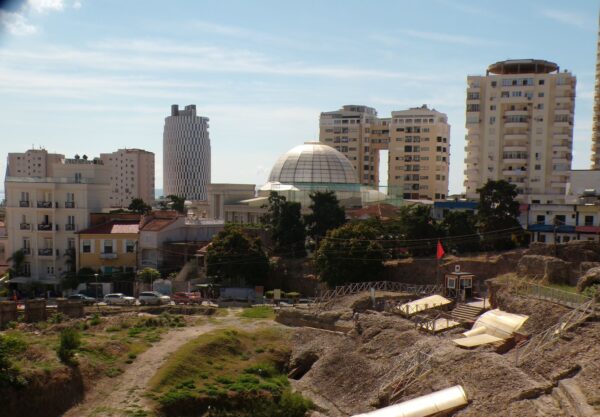
I’ve skipped ahead a bit to maintain the historical chronology rather than the chronology of our visit.
Our group began the day at the castle that was constructed in the late 5th century under the auspices of Byzantine Emperor Anastasius who was, in fact, a native of Durrës and, because he died childless, was the last ruler of the Leonid Dynasty. One of the most prominent remains of the castle is the Venetian Tower. (Recall that Albanian territory was serially occupied by different empires and regional powers and the Venetians controlled this area by the late fourteenth century.)
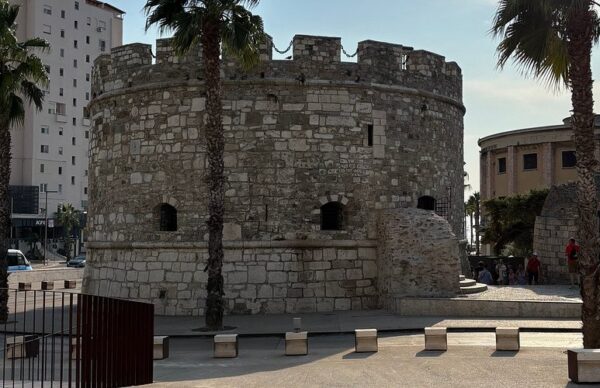
The tower and castle defended the city for centuries and was used as recently as 1939 in an ultimately unsuccessful attempt to thwart an Italian invasion. (The three machine guns and other small firearms wielded by 360 townspeople weren’t enough to fully withstand Italian tanks.) It now serves as an interpretative center.
We got a brief overview about the castle before our local guide walked us up the hill to the amphitheater and reported some of its history. As accurately as I could judge there was nothing selcouth about its use. I think the main point I took from her is that, given its status as Albania’s oldest city, it’s not easy to build in Durrës. All new construction and reconstruction projects must be monitored by licensed archaeologists or the Institute of Archaeology. Because of what’s under Durrës, protecting and preserving the city’s architectural and archaeological heritage leaves its citizens under duress and it’s not unusual for locals to engage in a bit of skullduggery to avoid compliance.
The Byzantine and the royal
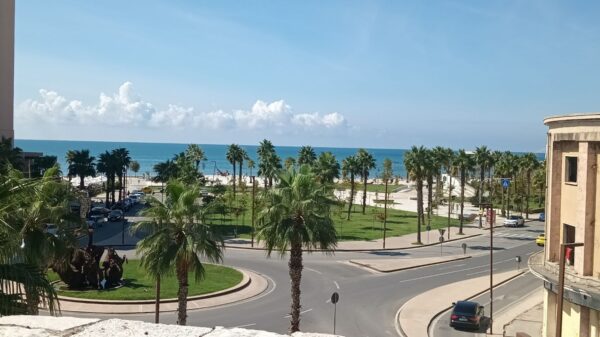
At the end of this brief tour, E directed us where and when to reconvene and gave us our parole to explore the city and find some comestibles. Since I’d retired early last night, I woke correspondingly early this morning. This provided some time to learn a little about Durrës and discover some places I might like to see. I started with the interpretive center in the Venetian Tower where, after the show inside, I stepped outside for views such as this one.
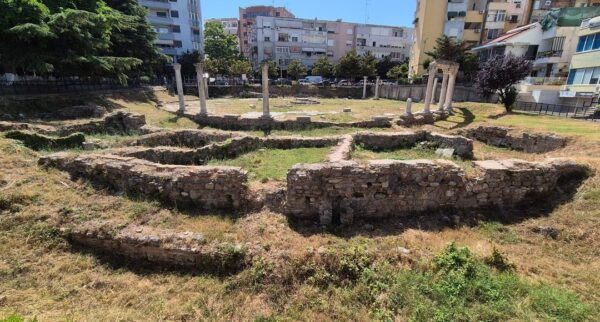
From there I took a short walk past the Sheshi Liria or Town Square to the ruins of the Byzantine Forum. Like the castle, Anastasius oversaw its construction in the early years of the sixth century. (Lest these major construction projects make you think he was a profligate spender, Anastasius was so frugal that at his death he left 23,000,000 solidi, or 320,000 pounds of gold in the imperial treasury for Justin, his chosen successor.)
The circular Forum, which would have had 40 Corinthian columns, is said to resemble Constantine’s Curved Forum in Constantinople. It would have played a central role in city governance.
The house that Zog built
Are you wondering who Zog is? The website History Today describes him as, “probably the strangest monarch of the 20th century.” Let’s take a small step back.
The Ottomans were the last of the great empires to rule Albanian territory controlling it for more than 500 years. The country gained independence in 1912 and I’ll have more to write about that when we reach Vlorë but for now, I’ll note that while the Albanians found some unity in their fight to oust the Turks, establishing a government proved more challenging. This should be understandable because their history was one of local governance and power. While they had a cohering sense of Albanian identity, from another perspective, they lacked any sense of Albanian nationhood.
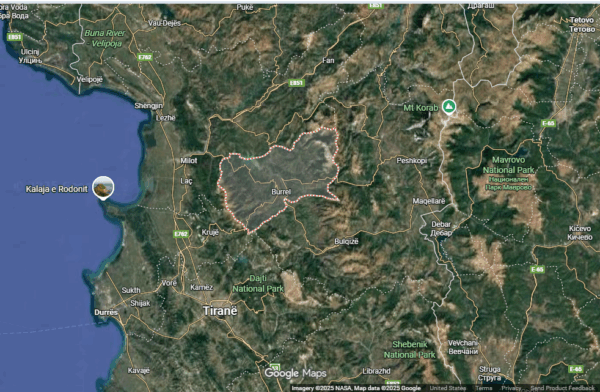
The man born Ahmed Muhtar Bey Zogolli represented the Mat district
[From Google Maps]
in forging and signing the Albanian Declaration of Independence in 1912. The First World War interrupted efforts to form a national government. Zogolli fought in that war as a soldier for the Austro-Hungarians. He returned to Albania in 1919 and began a political career serving as Governor of Shkodër (1920–1921), Minister of the Interior (March–November 1920, 1921–1924), and chief of the Albanian military (1921–1922) and, in 1922, Zogolli formally changed his surname to the more Albanian sounding Zogu.
After a brief period of exile in 1924, Zogu returned to power in Albania with the assistance of the Yugoslav Army. As prime minister, he thanked the Yugoslavs by ceding control over Sveti Naum and much of what is today the country of North Macedonia.
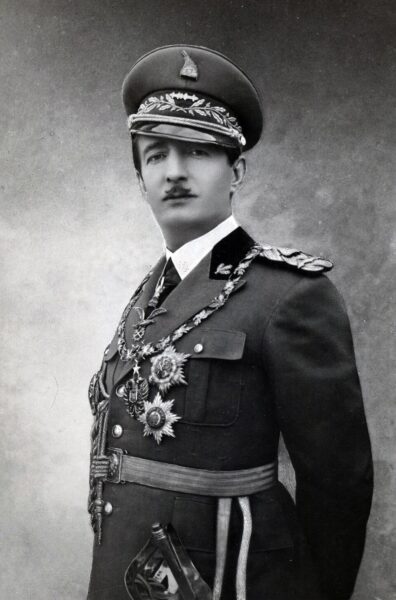
On 21 January 1925, Albania’s Constituent Assembly elected him to serve as the country’s first President. Early in his seven year term he pushed through a new constitution that vested him with such sweeping executive and legislative powers that he effectively became a dictator.
Viewing his country as a version of Anthony Hope’s fictional Ruritania, Zog sought to both modernize and Europeanize his young nation. He replaced Ottoman and Islamic Laws with a more European civil code thus emphasizing a Western European orientation in governance and social development. He promoted infrastructure modernization based on European models.
[From Wikipedia – Public Domain]
But these efforts came with two substantial costs. First, he wielded power ruthlessly like most dictators. Under his leadership, Albania was a police state. Civil liberties were all but nonexistent, the press was closely censored, and his political opponents often disappeared. The second was his need for external financial support to enact some of his more benign reforms. For this, he turned to Italy and closely allied himself with Benito Mussolini.
Then, on 1 September 1928, he declared himself King Zog 1 – King of the Albanians – although he was never formally crowned. He proclaimed a constitutional monarchy modeled somewhat after that of Belgium where the king claimed the throne and exercised Royal powers only after taking an oath before Parliament. Making a religiously tolerant and inclusive gesture that echoes through Albania today, Zog swore his oath on both the Quran and the Bible.
While he took some steps such as opposing demands to place Italians in charge of Albanian institutions, joining a customs union with Italy, nationalizing Italian-run Catholic schools, and, in 1938, opening Albania’s borders to Jews fleeing Germany, his efforts to resist Italy’s growing economic and military control over his Kingdom failed.
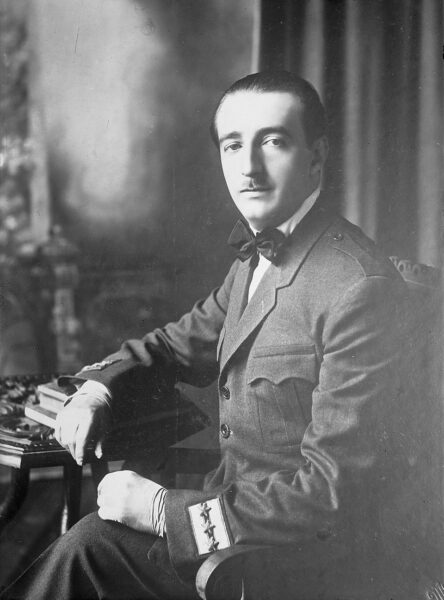
On 25 March 1939, Italy delivered an ultimatum demanding Albania accept Italian occupation. Zog refused, and on 7 April Mussolini’s forces invaded – rapidly overrunning the country. Zog fled the country, and Mussolini declared Albania an Italian protectorate, installing Italy’s King Victor Emmanuel III as the new Albanian monarch.
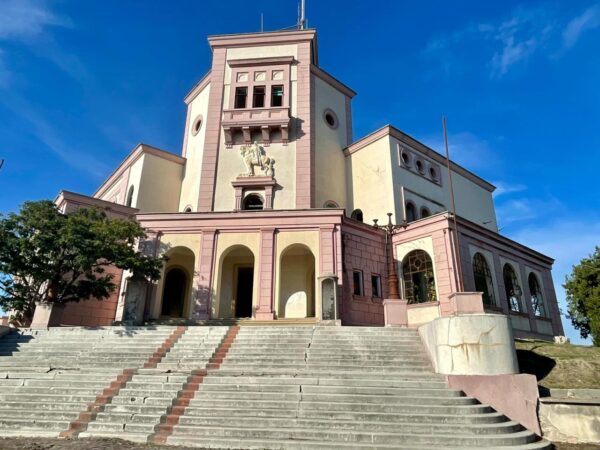
Before all this transpired, Zog 1 constructed a summer residence in Durres. He used it as the royal summer retreat and reception venue. Although closed to the public, I thought it might be worth the 850m walk from the Byzantine Forum to take a look. The walk was breathtaking – mainly due to the 70 meter ascent. regarding the villa, I’ll leave it to your judgement.
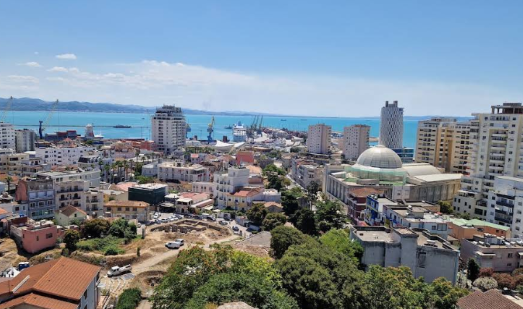
There was also a nearby viewpoint that enhanced the walk.
As for Zog, likely expecting an Italian invasion he began hoarding gold coins and precious stones intended as backing for Albania’s first paper currency. The royal family fled first to the Kingdom of Greece carrying with them most of the Albanian treasury’s gold. Their stay there was brief and was followed by stays in Istanbul, Paris, England, Egypt at the behest of King Farouk, and finally Paris again in 1955 where Zog lived until his death in 1961. His son Leka was pronounced King Leka of the Albanians by the Albanian diaspora – a title he continues to hold.
I’ll wrap up my day in Durrës and arrival in Divjaka-Karavasta National Park in the next post.
-
It’s just a shot away – Prizren
March 6, 2026 -
Some things looking better, baby – Getting into Kosovo
March 4, 2026 -
Here, where the sky is falling – Kukës
March 2, 2026 -
That’s when we fall in line ’cause we got Berat
February 27, 2026 -
Walking on the big stuff – a climb to Tragjas
February 25, 2026