It’s just a shot away – Prizren
After our short walk around the center of Pristina, our six person group returned to the van where we started back toward Albania but our day was far from over. In about an hour and a half we’d be stopping in the historic city of Prizren. If you’ve been reading this report sequentially, the city’s name should be familiar because it’s the place where 47 Ottoman beys met on 10 June 1878, formed the League of Prizren, and issued the Proclamation of Prizren or Kararname that intended to establish Albanian autonomy within the Ottoman Empire.
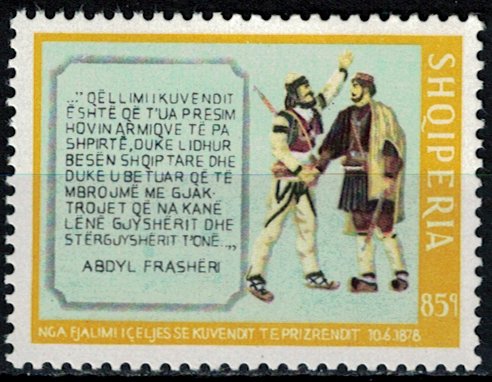
[Wikipedia – Public Domain]
But Prizren has a much longer history than that. And one that’s important – at least regionally.
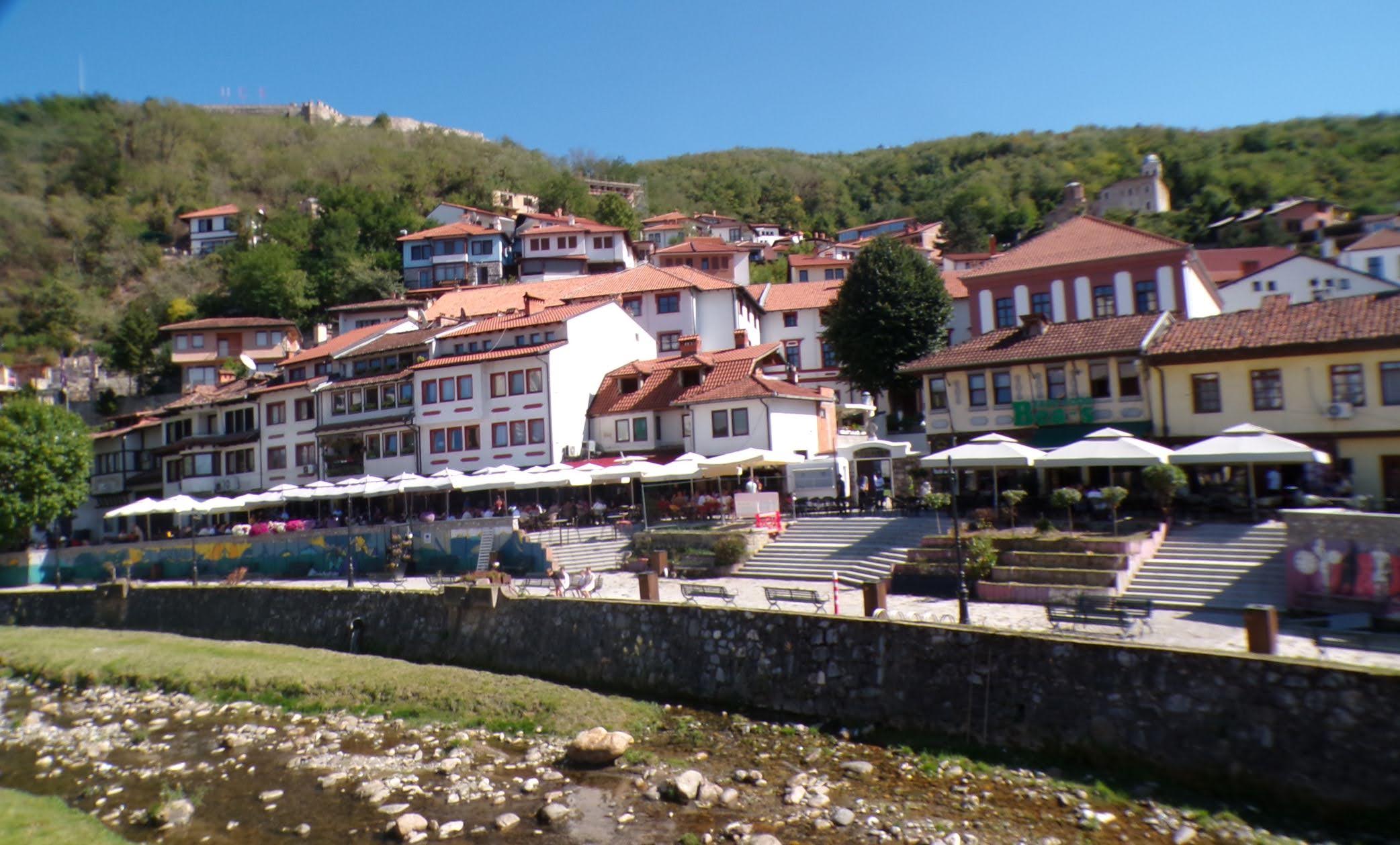
If you have been to Berat, Prizren makes a familiar impression as you approach the town center.
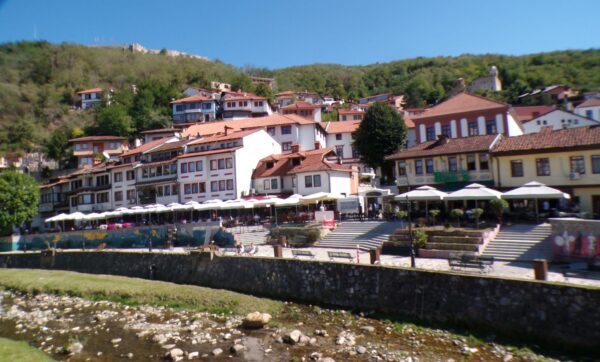
Yes, the roofs here are more red than brown and there are certainly fewer windows but it’s still evocative enough that it’s easy to see a connection.
The earliest evidence of human habitation in the area dates to the Eneolithic period about 5,000 years ago and the fortress overlooking the town shows evidence of continuous occupation from about 2,000 BCE. The fortress saw its first major reconstruction in the 6th century by Emperor Justinian 1 – a Roman Emperor who ruled from Constantinople. He used it as part of a chain of forts defending the Drin valley and linking coastal areas to Kosovo’s interior.
The first written historical mention of the town itself, appears in 1019 during the reign of Byzantine Emperor Basil II and it’s called Prisdriana or Prizdrijana.
The Byzantines controlled the fortress until 1219–1220, when the Serbian Nemanjić dynasty seized it and integrated it into their Via de Zenta trade route fortifications. Serbian rulers expanded it in the 14th century, using it as an imperial seat. Looming above the growing old town, the fortress guarded the important trading hub for Ragusan and other Balkan merchants. (I wrote about the Republic of Ragusa in my first visit to the region in 2016.)
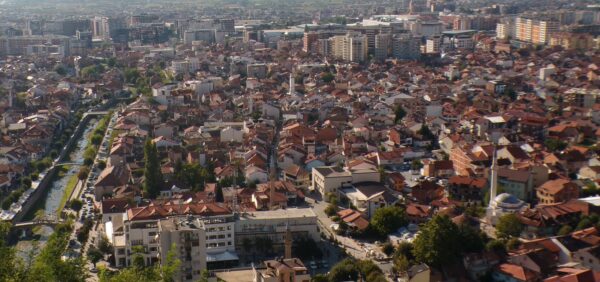
Ottomans captured it definitively by 1455, making it a stronghold within the Rumelia Eyalet.
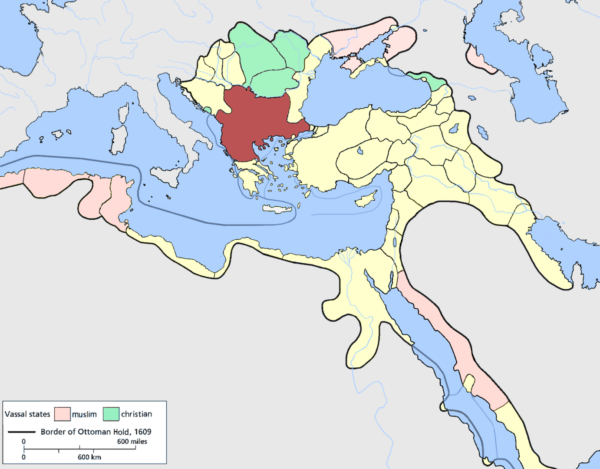
[From Wikipedia By Underlying lk – Own work, CC BY-SA 3.0]
In the 18th-century they expanded the walls and towers and added a hamam and a mosque. The castle functioned militarily until Serbia captured Prizren in the 1912 Balkan Wars. It then went unused until the Yugoslav government declared it a Monument of Culture in 1948. Subsequent excavations have uncovered its history.
While falling short of being a true palilogy, Kreshnik was something of a smellfungus in his portrayal of Pristina. Prizren, he repeatedly assured us, would be a more pleasant experience. At the time I attributed his attitude to the fact that, while he is Albanian, his hometown is closer to Prizren than it is even to Tirana. However, as I’ve learned more about the Kosovo War, I realized that for Pristina, the war was an ordeal but Prizren suffered relatively little by comparison.
The war inflicted significant harm on the capital. NATO airstrikes on oil depots and factories near the city severely damaged the city’s infrastructure. Additionally, widespread ground-level destruction by Yugoslav/Serb forces that targeted Albanian neighborhoods not only destroyed or severely damaged heritage sites, it also caused mass displacement.
NATO airstrikes caused no significant harm to Prizren’s old town or landmarks. The most notable destruction occurred in the Tuzus neighborhood on 26 May 1999. The neighborhood, in the southern part of the city
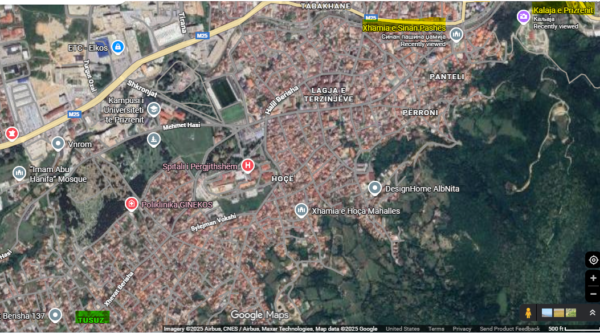
was a vital base for the KLA in the region. (It’s highlighted in green on the Google Maps screenshot and I’ve highlighted the Fortress and Shinan Pasha Mosque in yellow in the upper right.) Serb forces raided the neighborhood, killed at least 27 and perhaps as many as 34 ethnic Albanians, and burned over 100 homes in retaliation for KLA activity.
Thus, although the war ended more than a quarter century ago, Pristina is still recovering. In terms of physical destruction, Prizren had rather little to recover from. And the difference is clear.
After we’d descended from our climb to the Fortress, at K’s suggestion we went as a group to a restaurant in the old town called Hani i Vjeter where I gorged myself on chicken kebap and tave vegeteriane both of which K told me were authentic to the region. The group had been generally quiet to this point but lunch (and perhaps some beer) loosened our tongues a bit though we engaged in very little blatherskite. One surprising thing I learned was that M had been to all 50 US states. Now, I haven’t met many Irish people but I’m willing to go out on a limb and say that she is among a select few who have accomplished that.
K seemed to know the staff quite well so I have to assume we weren’t the first group he’d taken there. When it came time to pay our bills, there was a bit of confusion about who had ordered what for lunch but the truth is, it was so inexpensive I don’t think anyone cared very much. Nor do I think anyone cared if K got a small kickback for bringing in the group.
After lunch he allowed us some free time to shop and explore the city. For me, shopping was a rousing success as I was able to find both items some friends collect – a shot glass for my friend Dr BK and a refrigerator magnet for J.
As we rode in the van between stops, K stressed the Albanian nature of Kosovo and, as I noted in the previous post, more than 90 percent of Kosovo’s population is ethnically Albanian. They exclusively speak the Gheg dialect. (Albanian has two main dialects – Gheg and Tosk – with Tosk serving as the basis for standard Albanian.)
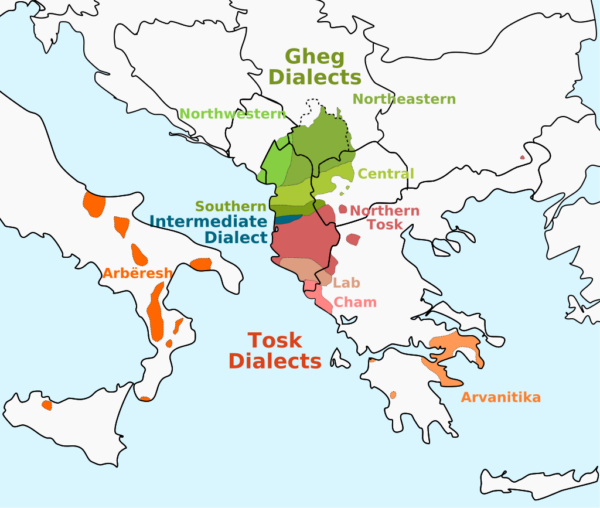
[From Wikipedia – ArnoldPlaton, CC BY-SA 3.0]
Google’s AI states that “they remain largely mutually intelligible” but K would insist that he understands Kosovars better than he understands Tiranësi. I point this out because not only did my souvenirs have the Albanian flag, it was on display in front of this shop.
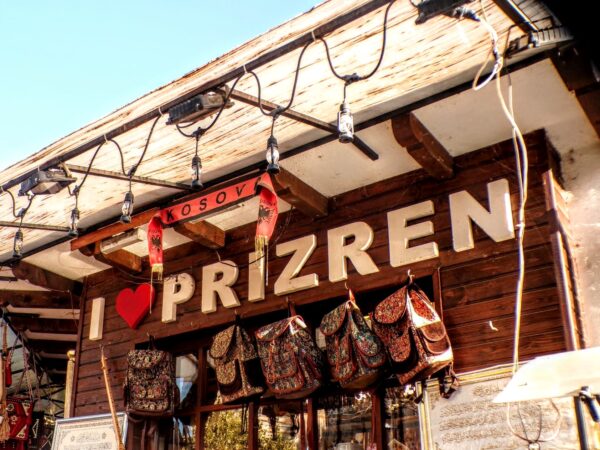
At times during the day, I thought K might be exaggerating the connection Kosovars share with Albanians but the presence of a Skanderbeg Square in Pristina, the plethora of Albanian flags dotting our route, and finally this tabernarious banner convinced me otherwise.
Given the way the day ended, I think K might have been less than thrilled with the amount of time he left us to shop and explore. It took us a bit longer to cross the border entering Albania than it did leaving but we encountered a pair of significant traffic jams and the ride that should have required about two and a half hours needed more than four. It was well past 20:00 when we finally arrived back in Tirana.
Meanwhile, if you’re interested in seeing the few pictures you haven’t seen yet, this is the link to follow.
-
It’s just a shot away – Prizren
March 6, 2026 -
Some things looking better, baby – Getting into Kosovo
March 4, 2026 -
Here, where the sky is falling – Kukës
March 2, 2026 -
That’s when we fall in line ’cause we got Berat
February 27, 2026 -
Walking on the big stuff – a climb to Tragjas
February 25, 2026