I’m a-gonna raise a holler – Blue Penguins and a blue Todd
Off to Christchurch – and a frozen Todd
Our flight from Rotorua was delayed and this put some time pressure on all the day’s remaining scheduled activities. Fortunately, our first scheduled stop was at the International Antarctic Centre. It is, as you can see from the Bing Maps screenshot below
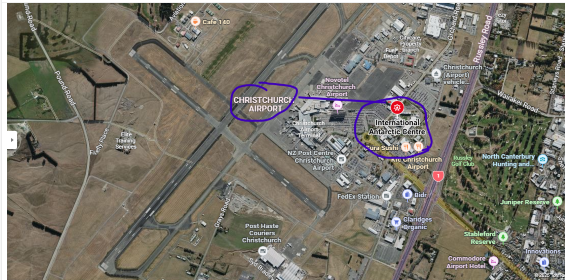
essentially part of the airport so once we collected our luggage we took our shortest bus ride of the trip.
While I didn’t know it at the time, for me, this would be, by far, the highlight of the day and even without that foreknowledge, I was disappointed when our guide told us more than once that he had to cut the tour short to allow us to keep to our schedule. I’ll touch on a few highlights but first, a bit of history on the exploration of Antarctica and
the race to the South Pole.
On 10 August 1910, Norwegian explorer Roald Amundsen set out in a southerly direction from Kristiansand on the expedition ship Fram. (Amundsen had initially planned to take the ship north but changed his plans when he learned that Robert Peary and Frederick Cook had claimed to have reached the North Pole in 1909.) On 6 September, he stopped in Madeira, an autonomous region of Portugal, before setting sail three days later for the Bay of Whales some 16,000km distant. When he docked there at a latitude of 78°41″ south on 14 January 1911, the Fram had sailed farther south than any known ship.
Meanwhile, Robert Falcon Scott, a British naval officer had set sail from Cardiff on the Terra Nova on 15 June 1910. He reached Melbourne, Australia in October of that year where he left the ship to continue raising funds while the ship sailed off to Lyttleton, New Zealand. (Just 12 kilometers to its south, Lyttleton is the port for Christchurch.) Scott made one further stop in Port Chalmers before setting sail for McMurdo Bay some 800 kilometers west and, perhaps crucially, 96 kilometers north of Amundsen’s starting point at Framheim Station on the Bay of Whales.
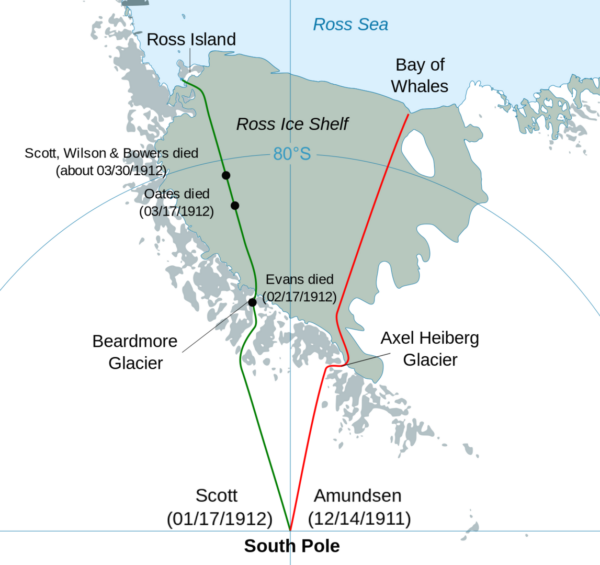
[From Wikipedia By Soerfm – Own work, CC BY-SA 4.0]
By reaching the South Pole, both men were attempting to achieve what Ernest Shackleton had failed to do on his Nimrod Expedition in 1908. Shackleton and his team had succeeded in becoming the first to scale Mount Erebus (the southernmost active volcano on Earth) but were forced to stop 112 miles short of the Pole.
Amundsen’s expedition departed Framheim Station on 19 October 1911 (Amundsen had recorded it as 18 October but he’d neglected to account for having crossed the International Date Line that had been established in 1884.) Scott left his camp some two weeks later on 1 November. As you can see from the graphic above, Amundsen reached the pole more than a month ahead of Scott and, while all of Amundsen’s team returned safely, neither Scott nor any of his men survived the return.
21st Century Antarctic – A gateway city
More than a century after Amundsen reached the South Pole, the Antarctic remains a place of both mystery and scientific importance as was cemented by the 1959 Antarctic Treaty. Of the 56 signatories, only Belarus doesn’t operate at least a seasonal research station on the continent. The treaty, “designates Antarctica as a zone dedicated to peace and scientific research, free from military activity and commercial exploitation” with the aim of promoting international cooperation setting aside disputes over territorial sovereignty, and ensuring the continent is used for peaceful purposes only. Prior to the treaty’s signing, Argentina, Australia, Chile, France, New Zealand, Norway, and the UK made territorial claims while the US and Russia maintain something called a “basis of claim.”
In 2025 the continent has 70 permanent research stations representing 29 countries. More than a third of those stations belong to Argentina (13) and Chile (12). The United States maintains three permanent stations (McMurdo, Palmer, and Amundsen-Scott South Pole).
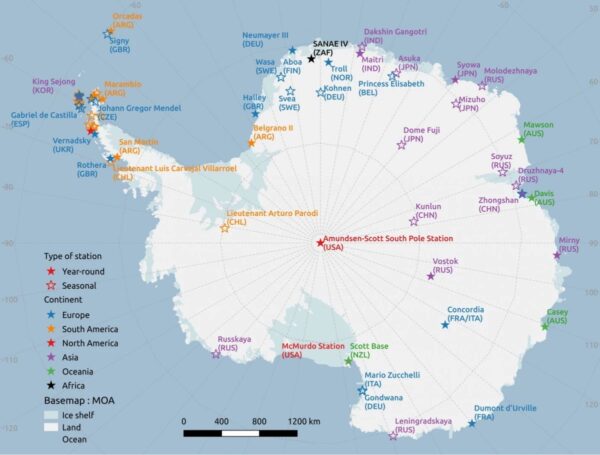
[The COMNAP Antarctic Bases Map Credit: Sophie Berger]
Aotearoa is the closest major landmass to Antarctica and Christchurch has a long connection with Antarctic exploration and research having served as the launch point for both Shackleton’s and Scott’s expeditions as well as being the logistical base for Operation Deep Freeze – a 1950s US sponsored Antarctic research program.
Depending on the aircraft used, it’s about a 5-7 hour flight to McMurdo Station. The International Antarctic Centre that we will soon tour supports operations and provides public engagement with Antarctic science. These are my highlights.
From Ice Voyage to ice cold
After our introduction to the Centre, including the chance to meet and pet some Huskies, we were invited into the 4D theatre to view the movie Ice Voyage. The film takes the audience on a science ship sailing to Antarctica and onto the continent itself. In addition to the expected 3D effects such as birds flying overhead, the fourth dimensions added include seats that rock and shudder as the ship encounters rough seas, spray and mist splashing against your face and 3D glasses, and the occasional wind gust. Our group responded vigorously.
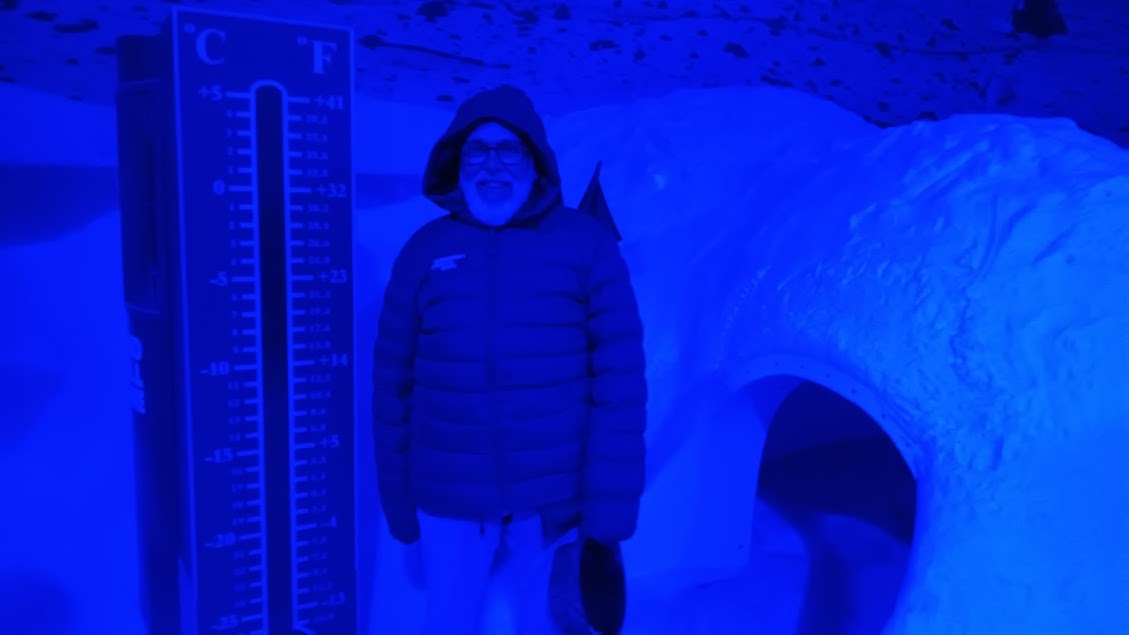
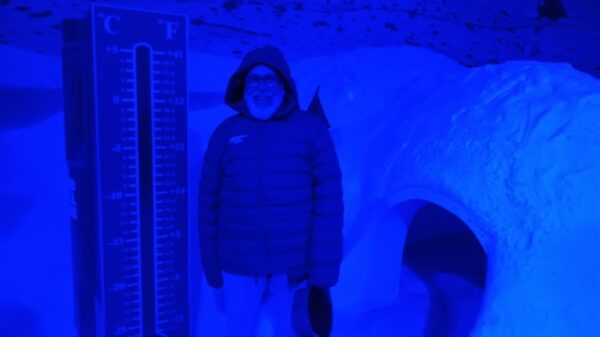
From there, we were invited to get a brief experience of Antarctic weather in the Storm Experience. The temperature when you enter the room is -8°. In short order, you experience a typical windstorm of about 20kph that drops the ‘feels like’ temperature to -18° and a falling temperature that makes you feel even colder. Here I am. (The Centre provides the outerwear.)
And here’s a four minute video of a larger group.
It’s not quite over, Baby Blue
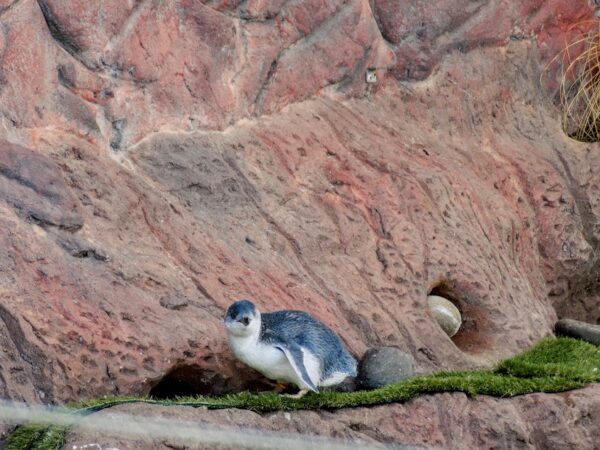
The last highlight I’ll note is our stop at the Centre’s Penguin Rescue. You see, these aren’t just any penguins, they’re kororā or Little Blue Penguins. As with many species, their numbers in the wild are diminishing due to climate change, pollution, habitat destruction, and introduced non-native predators. Swimming at a relatively slow speed of 2.5kph, this smallest among the 18 penguin species, are nocturnal on land living in sandy burrows that they leave at dawn to forage in shallow waters for small fish such as anchovies, sprat, or krill. The penguins at the Centre are all rescues and could not survive if returned to the wild. They’re awfully cute.
-
It’s just a shot away – Prizren
March 6, 2026 -
Some things looking better, baby – Getting into Kosovo
March 4, 2026 -
Here, where the sky is falling – Kukës
March 2, 2026 -
That’s when we fall in line ’cause we got Berat
February 27, 2026 -
Walking on the big stuff – a climb to Tragjas
February 25, 2026