I got sixty-four point four miles to go
Today’s activity is one that is, perhaps, the most highly touted on the lists of “Things to do on Maui” – especially for first-timers like me. I’m going to drive the Hana Highway – also called the Road to Hana. Here’s how the site Hawaii Guide describes it,
When it comes to driving the Hana Highway on Maui, it’s the journey, not the destination, that is the main attraction. There are few words that can describe the beauty of this drive with its cliffs cloaked in green and lush valleys bursting with waterfalls. Curves hug the coast and gaze over an ocean that stretches uninterrupted all the way to the Alaskan coastline. Couple that with black, red, and white sand beaches, a multitude of trails, and beautiful gardens and you’ve discovered the highway to heaven itself.
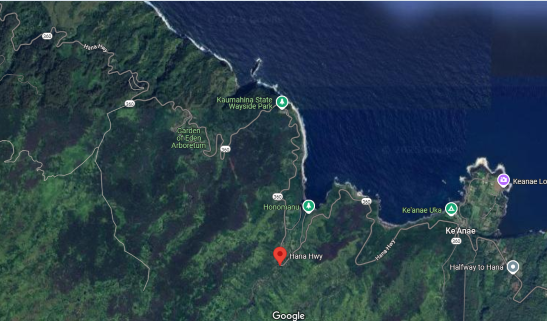
I made the drive but will not wax quite as rhapsodically as they do. This is, in part a result of the travel fatigue I’ve mentioned previously and also what eventuated from a poor decision I made. The road is known for its hairpin twists and turns and its 46 one-lane bridges. Here’s a satellite view of a section of Hana Highway from Google maps.
I got my hand out the window man I’m takin’ it slow
Old hands reading these journals know that before I start writing about my experience on the road to Hana, I’m going to provide a bit of its history.
The earliest formal path on this section of Maui’s east coast was the Alaloa. King Pi’ilani initiated its construction in the 16th century and his son Kihapiʻilani extended it into the Hana district. Initially, the 138-mile long path was 4-6 feet wide with travelers using vine ropes to swing across streams though not quite like this.
Spurred by the sugarcane industry, modern construction efforts began in the 1870s with the creation of an unpaved road alongside the Hämäkua Ditch. Piecemeal construction in the early 1900s by both sugarcane plantations and the government laid the groundwork for the full road that officially opened in 1926. Bridge construction continued into the 1930s but the road wasn’t fully paved until the 1960s.
Initially, the road primarily served residents and was used for transporting goods and visiting family. Only a few adventurous tourists attempted to navigate the one-lane bridges and dodge the myriad potholes but those who did achieved rare looks at lush rainforests, cascading waterfalls, and hidden beaches.
The latter half of the twentieth century propelled the Road to Hana into fame. With the road fully paved, guidebooks in the 1970s began promoting it as an accessible road for tourists to experience not only the natural wonders but also authentic Hawaiian culture through encounters with local farmers, artisans, and families living traditional lifestyles.
The 1990s brought an ecotourism boom and the explosion of social media in the present century combined to make the Hana Highway a must-see destination.
Got an ocean to the left
I consulted several sources preparing for my drive on the Hana Highway and all indicated that they considered some stops more worthwhile than others and, since I was planning to make the drive on my own, selectivity seemed to be a sound approach. One writer encouraged an early start because the road gets gradually more crowded with each passing hour. I heeded that bit of advice and was on my way well before 07:00 – the first decision with an unexpected, if not unintended consequence. And, as noted above the road is famous for its narrow bridges and hairpin turns that make driving it a rather harrowing and hair-raising experience. (I have to admit that after yesterday’s drive to Nakalele, the Road to Hana felt rather tame.)
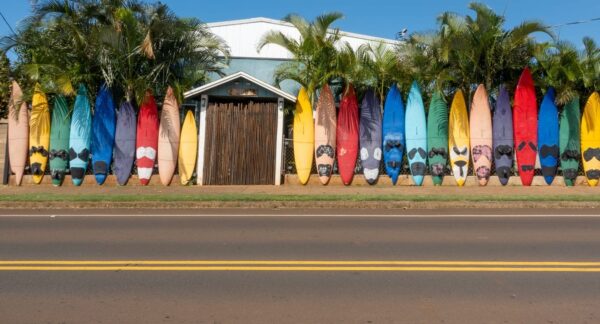
You can start your drive with a brief detour to Paia Town if you want to get a good look at its (relatively) famous surfboard fence. (There are other surfboard fences in Hawaii but this is an easy one to find.)
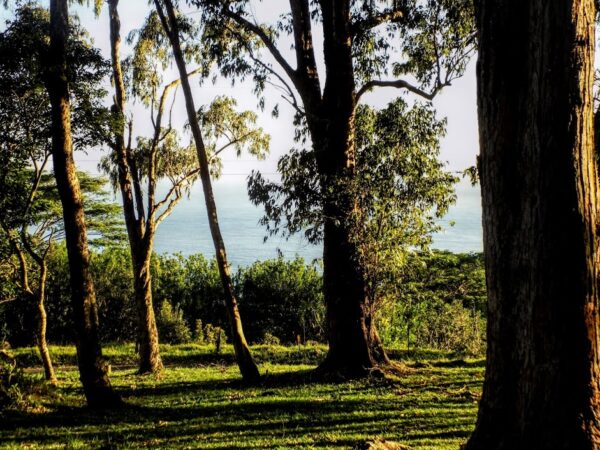
About half an hour after leaving the hotel, I passed mile marker zero on Hawaii 360 AKA the Hana Highway. While the vegetation is somewhat thick on both sides, the first few miles of the road are neither spectacular nor as twisty as it would later become and the road feels little different than many other coastal highways. Still, it afforded an occasional nice view of the ocean on my left.
As I drove along the road the foliage thickened and became so tunnel like that since I’d started so early, it blocked enough of the sunlight that the screen on my gps switched to night mode. On the other hand, there were times when I seemed to be driving directly into the brightest sunshine imaginable. The first two stops I planned to make were quite close together – the Waikamoi Forest Trail near mile marker nine and the Garden of Eden Arboretum less than a mile away. I’d bat one for two.
Wildflowers to the right
I’d chosen to stop at this trail because I thought it would be a nice chance to stretch my legs on a relatively short trail with two paths that maximizes out at about a mile-and-a-half if you walk both trails. It’s a nice rainforest walk.
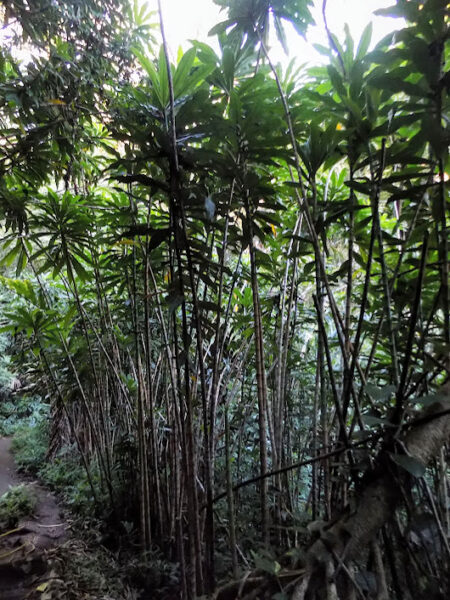
I’d chosen the Garden of Eden because the folks at Hawaii Guide call it, “one of our favorite stops on the Hana Highway.” Having taken their advice to start early, when I arrived a few minutes past 08:00, the privately owned arboretum hadn’t opened and there was a line of cars waiting for that event. Now I faced a bit of a dilemma. I’d purchased a 10:oo entry to Wai’anapanapa State Park that was about 22 miles distant but about an hour drive from my current location. Not knowing how far into island time the opening might be delayed, I cautiously backed out onto the road and continued my southeasterly drive.
When I reached the Halfway to Hana point at mile marker 18, none of the businesses there were yet open either. I continued on for just a few minutes to the Wailua Valley State Wayside Park. Here was a point where starting early had its advantages as two of the three spots in the tiny parking lot were free. Then it was a short walk up some stairs for some impressive views.
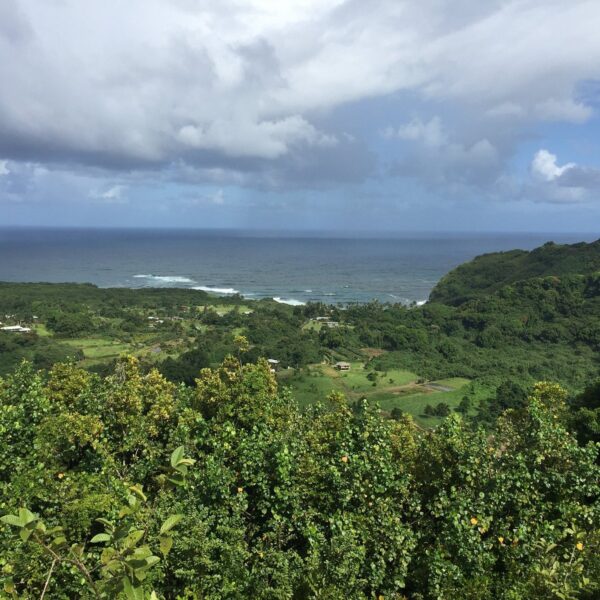
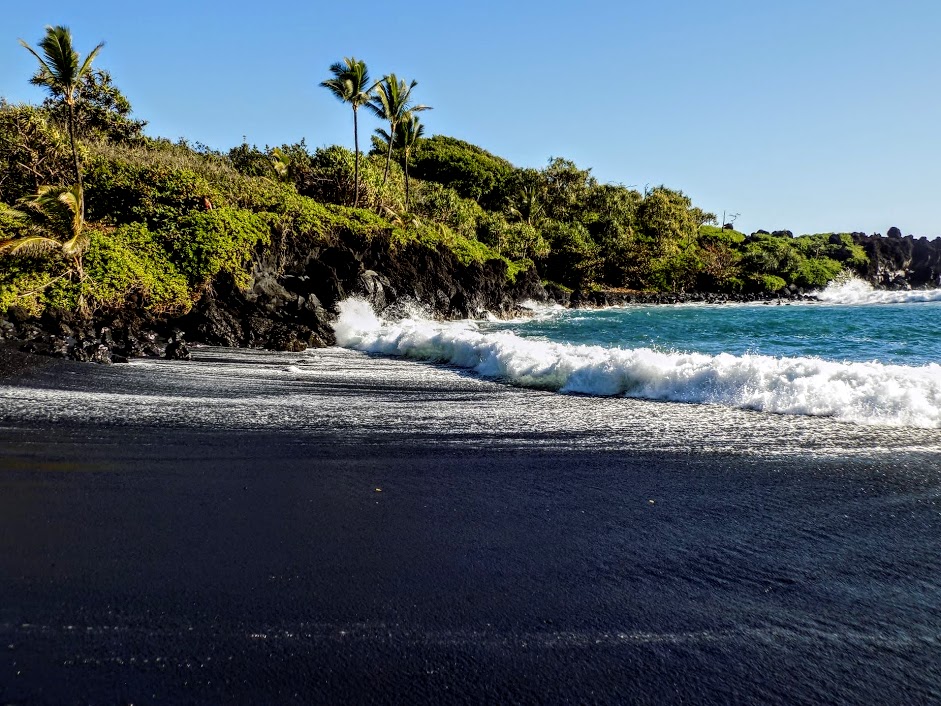
From there it was on to Wai’anapanapa State park. This was, for me as it is for many, a must stop and I needed to be certain I arrived in the window of time allowed by the pass I purchased. This is one of the spots that’s famous for its black sand beach
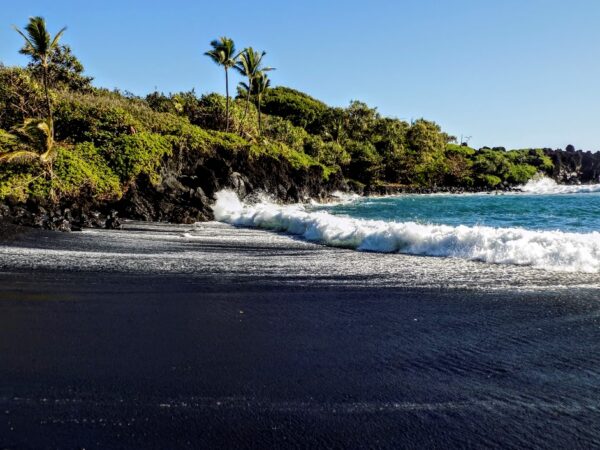
and this rare phenomenon alone makes it worthwhile. A quick internet search notes,
Globally, there are only about 20 notable black sand beaches, found in places with active or recent volcanic activity such as Hawaii, Iceland, parts of New Zealand, Greece, Japan, Tahiti, and some Caribbean islands. Because black sand beaches depend on volcanic eruptions to produce the lava that breaks down into black sand, they are much less common than typical quartz-rich white or golden sand beaches.
I’m on the road to Hana
I spent most of my allotted two hour window on the beach and had only about ten or fifteen minutes to drive to Hana where I had a light lunch and decided I’d had enough and would turn around and start back whence I came. Two factors played a major role in this decision. First was the travel burnout I’ve mentioned probably more often than necessary. Several waterfalls will appear on any list of recommended stops on the Hana Highway. For me, this was not a real attraction. Within the past two weeks, I’d seen the cascades in Milford sound and double and triple falls on Kauai. And I felt the same about all the lush greenery. I think the opening couplet of the third verse of this song captures my mindset.
The second factor had to do with driving the road alone. Although I didn’t find it nearly as nerve-wracking as the previous day’s drive, the Hana Highway still demands the driver’s full attention. And, not only does the driver miss some sights, it’s a little tiring so if you plan to do it, have a partner.
Other than having an overly sweet chicken dish at Tante’s I have nothing else to report about the day. There are some additional photos.
Next stop: the Big Island.
-
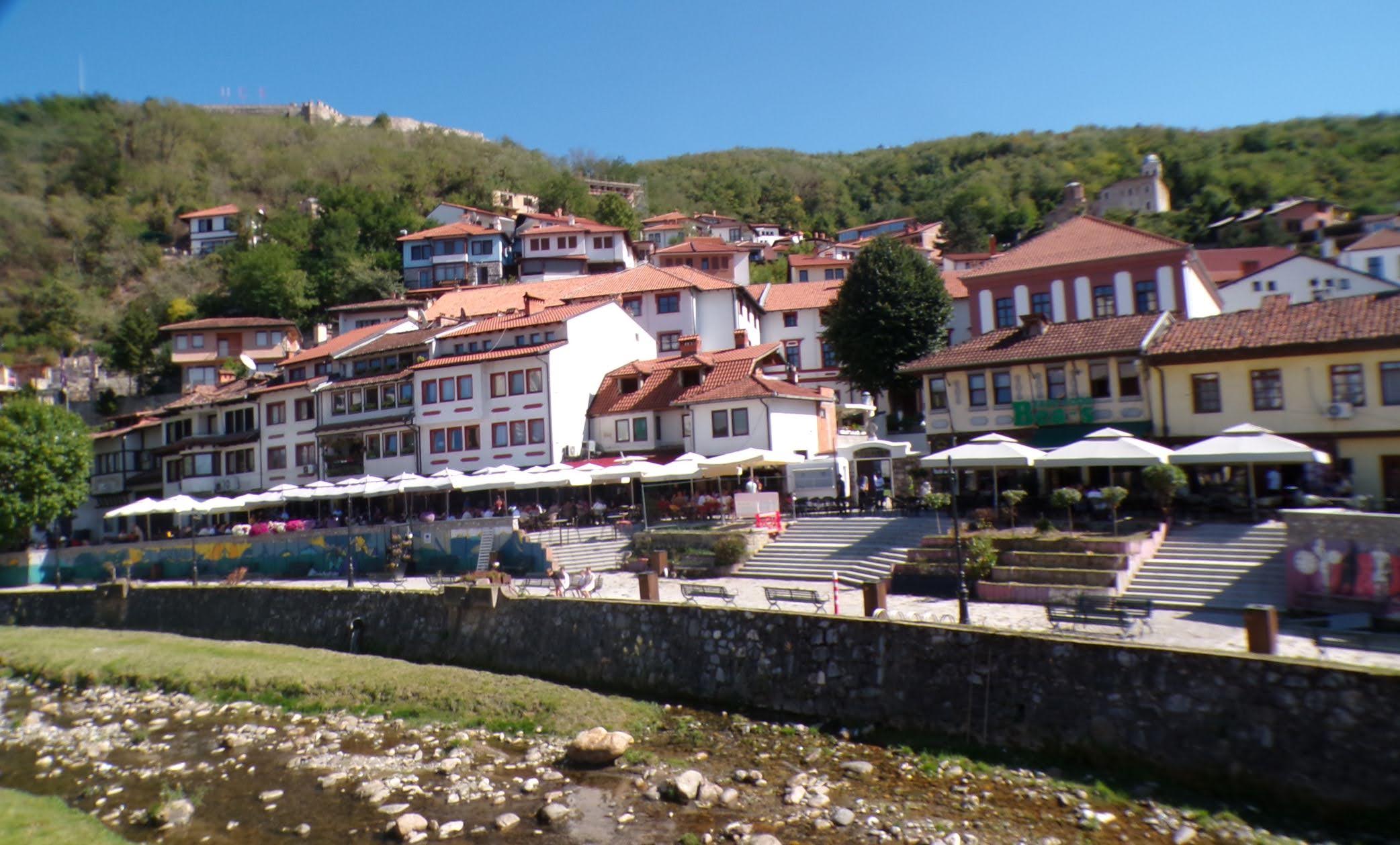
It’s just a shot away – Prizren
March 6, 2026 -
Some things looking better, baby – Getting into Kosovo
March 4, 2026 -
Here, where the sky is falling – Kukës
March 2, 2026 -
That’s when we fall in line ’cause we got Berat
February 27, 2026 -
Walking on the big stuff – a climb to Tragjas
February 25, 2026
2 responses to “I got sixty-four point four miles to go”
Is the black sand hot to walk on? Does anyone lay out on the beach to sunbathe or go in the water there?
It wasn’t hot to walk on. I don’t recall anyone sunbathing but people definitely went in the water. But you have to keep in mind that I was there in winter (or nearly winter) so that probably impacted my experience.