Goin’ places that I’ve never been
Today I’ll be on the road again mainly exploring the north and a bit of the west side of Maui but first I’m headed about 15 miles south to the town of Makawao – a well-known artist’s colony. As I’ve noted elsewhere, art is what I typically bring back from my travels so visiting here seemed most appropriate particularly given its proximity.
Before it became known as an arts haven, Makawao was known for its paniolo (Hawaiian cowboys). Much Hawaiian land was privatized in the mid nineteenth century – a time that saw rapid growth in sugar plantations. This, combined with the establishment of some ranches stimulated an increase in western population and prompted the need for businesses to serve this burgeoning population. The town consisted of several stores populated first by the Hawaiians and Chinese and later by the Portuguese and Japanese.
The town’s earliest buildings were designed in the Hawaiian Plantation style with false fronts that provided an image of stability. The building seen in this photo from the early 20th century
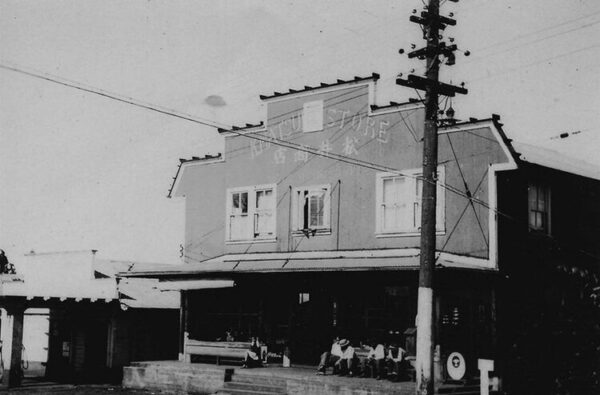
[From Makawao Museum]
was little changed when I visited in December 2024
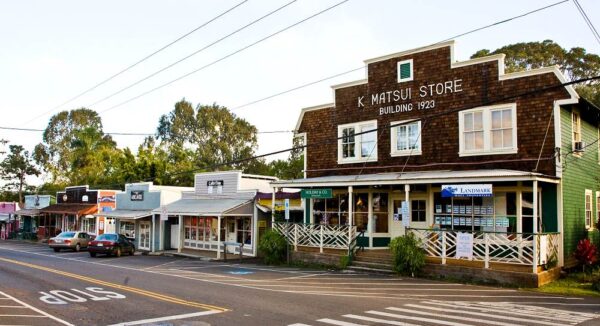
and if you look closely you can see a hitching post at the store’s left.
Unfortunately, while I had some interesting extended conversations with some of the artists, other than lunch, I found nothing to buy there. Equally unfortunate was that I found my lunch of both a tuna roll and a marlin roll from a hidden food truck called Satori rather bland.
I found Makawao somewhat analogous to Taos – not quite as high-end but still a bit on the expensive side. Perhaps I could have found something had I the inclination to spend more time there, but I had a blowhole and dragon’s teeth to see.
Seein’ things that I may never see again
As I set off to see the Nakalele Blowhole, I had no inkling what awaited along the rather torturous path I’d follow based on the directions from Google Maps.
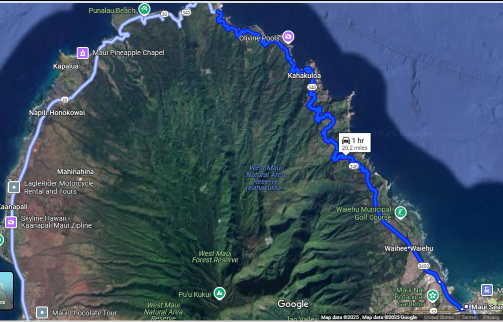
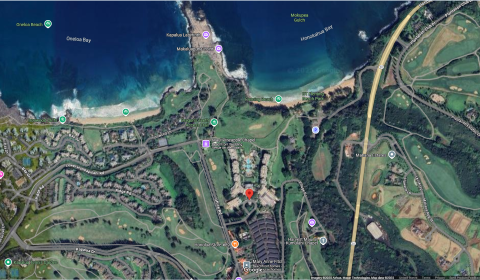
Perhaps I should have – at least a little. Although I didn’t have this visual (and it wouldn’t have helped or deterred me), where I should have paid better attention was the projected drive time of an hour to cover 20 miles. My contemporaneous notes call this drive, “frequently beautiful, often harrowing, and occasionally terrifying.” This applies to the stretch of road beginning just below the time indicator on the map to a bit past or close to the end point of this drive. The ride was replete with hairpin turns, blind switchbacks, and frequently little to no shoulder and no guardrails on the cliff side. I will not be on this road again.
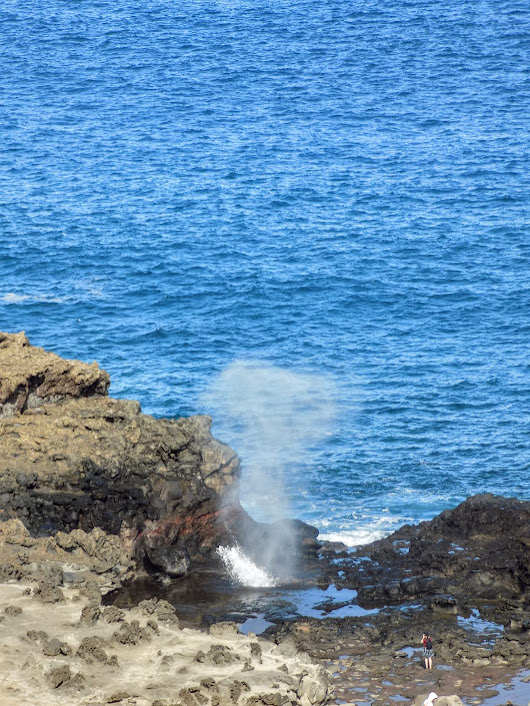
Nakalele Blowhole is among the better known examples of this geological phenomenon and is the best known on Maui. In some ways, it might help to think of a blowhole as a marine geyser in which water from below the surface is forced upward into an eruption.
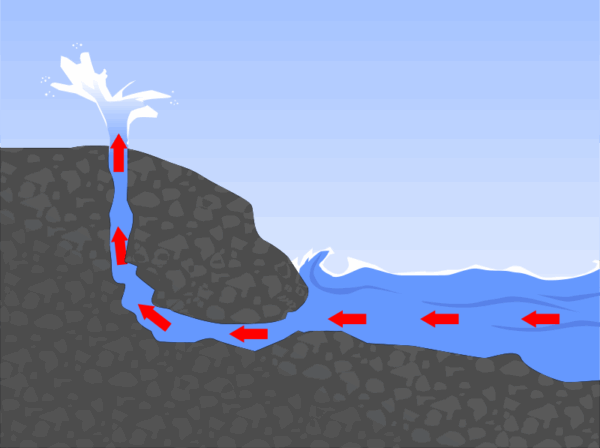
[From Wikipedia – AlphaZeta Public Domain]
However, where a geyser draws its power from water heated by magma or hot rocks and ejects water and steam, a blowhole’s energy emanates from ocean waves entering a sea cave forcing it to eject water and air.
Thar she blowholes!
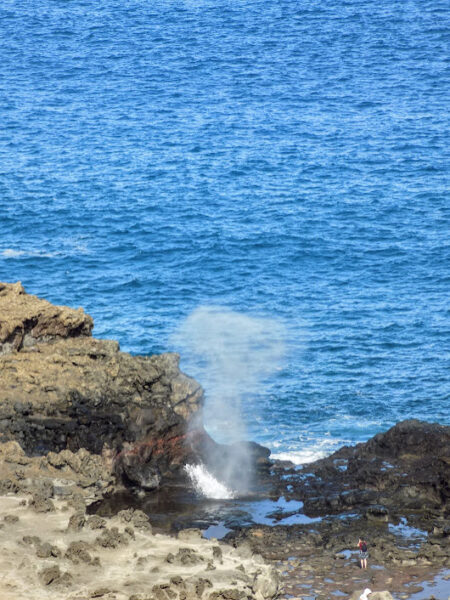
Here’s how it happens: The mechanical action and hydro-erosion of waves pounds fractures in coastal cliffs until they enlarge to form a sea cave. In cases where the cave grows not only inland but upward, it creates a vertical shaft. As the wave action and upward pressure continue, the latter forces open a hole at the top of the shaft. The opening is the blowhole. Now when waves enter the cave, they compress the air and water inside it forcing the ejection of water and air. I could never quite capture the blowing hole at its peak but here’s one look at it.
Go down the highway
But without a band of gypsies. My next stop was Makaluapuna Point and a spot colloquially called Dragon’s Teeth. Even coming off the twists and turns of Highway 340, getting to this spot was equally interesting. First, I needed to find a parking spot in the small lot near the Ritz-Carlton Kapalua. Then I started down the path walking beside and briefly even on the adjacent golf course to finally reach a formation that, from a distance, left me uncertain it was worth the drive.
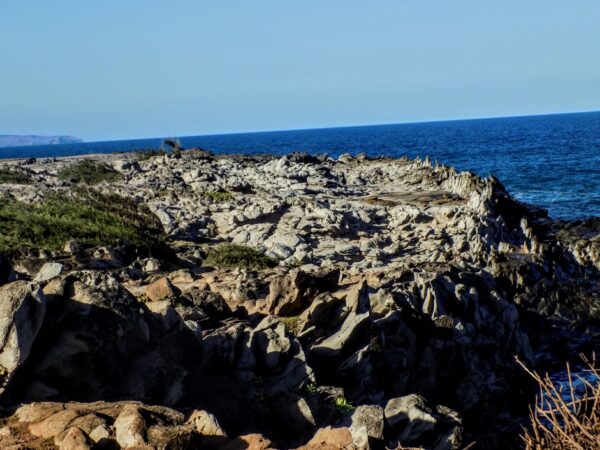
(The island in the distance is Molokai – the one time leper colony.) My opinion would change as I got closer as you’ll see below.
First, of course, I have to explain what exactly are these “Dragon’s Teeth.” Given what we now know about the formation of the Hawaiian Islands, it shouldn’t surprise you to learn that the Dragon’s Teeth are volcanic. It might surprise you to learn, however, that while they are the typical basaltic rocks spewed by most Hawaiian volcanoes, they are quite different from the Honolua lava flows typically found on Maui.
These lava flows are primarily composed of soda trachyte and oligoclase andesite and are much thicker than typical Hawaiian basaltic flows such as those from Kīlauea, Mauna Loa, and the Honolulu Volcanics which are predominantly tholeiitic basalt (a dark-colored, fine-grained, mafic igneous rock {rich in magnesium and iron} typically found in the oceanic crust). The rocks that comprise Dragon’s Teeth are even lighter, denser, and finer-grained when compared to these and even more so compared to other lava flows found on Maui.
Even if, on closer examination, they didn’t look like this,
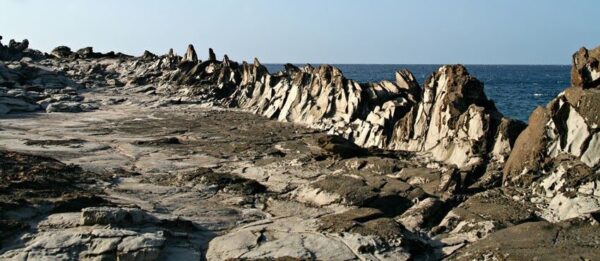
their unusual composition makes them well worth the visit.
The Dragon’s Teeth lava formations at Makaluapuna Point are composed of one of the last flows of the now extinct Mauna Kahālāwai or West Maui Volcano that occurred approximately 320,000 years ago. It hardened in vertical, fin-like formations when it encountered strong ocean waves and winds. This caused it to cool rapidly in the sharp, jagged spikes seen in the photo.
And now a brief temporal step back and a small confession. When I first arrived, I missed the small parking lot beside the Dragon’s Teeth Trail and found myself wandering a bit around on the Ritz-Carlton property.
I have to admit that I was mainly looking for an open public building to find a place to satisfy the increasingly annoying demands of my walnut-sized bladder when I found my way to the building housing Jean-Michel Cousteau’s Ambassadors of the Environment. I had a lengthy chat with Ashley who told me that she, too, had once driven the same road I’d taken to reach Kapalua and she planned to never do so again! We also talked about how the organization works as a hands-on outdoor education program to raise environmental awareness. The location on Maui focuses much of its programming on humpback whales. In the end she also pointed me in the right direction to find both a toilet and the Dragon’s Teeth.
Insisting that the world keeps turning
If you look back at the map near the top of this post, you’ll see the light blue line heading west and south from Kapalua. This alternate would be my return route to Kahului. This rout also took me past Lahaina (though not through the town center). Sixteen months after the devastating fires the landscape remained barren.
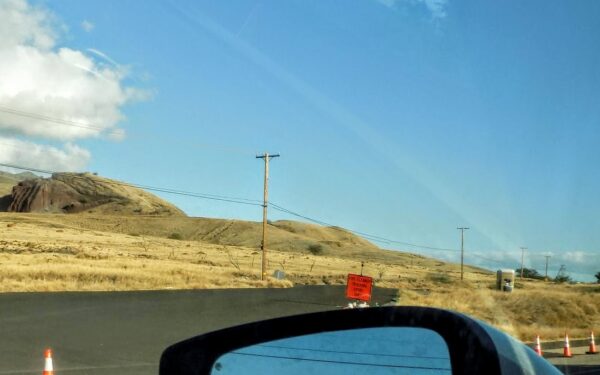
I’ve tried to enlarge the sign in the photo.
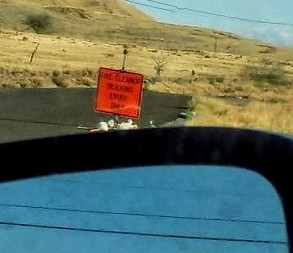
It reads, “Fire cleanup trucking entry only.” Clearly, much remains to be done to aid and complete this community’s recovery.
The life I love
I stayed at a hotel called Maui Seaside Resort that is not, by any means, a luxury hotel. (This is fine with me. I generally want a place that’s clean, quiet, and comfortable since my time and activities there are both limited. This fit that bill.) There’s a restaurant attached to the hotel called Tante’s that featured Hawaiian and Philippine cuisine and had moderately good reviews. It was closed for the staff holiday party.
I didn’t want to drive anywhere so I walked to an Italian restaurant called Casanova where my black seafood linguini in a garlic tomato sauce turned out to be my favorite meal in Hawaii to date but the truth is that even when the days (or drives) get frustrating or the meals aren’t great, travel gives me so much that being on the road is the life I love/
I thought it worth mentioning before I posted the link to the pictures.
-
It’s just a shot away – Prizren
March 6, 2026 -
Some things looking better, baby – Getting into Kosovo
March 4, 2026 -
Here, where the sky is falling – Kukës
March 2, 2026 -
That’s when we fall in line ’cause we got Berat
February 27, 2026 -
Walking on the big stuff – a climb to Tragjas
February 25, 2026