End of the spring And here she comes back
Here we are on Monday, the second official day of a Road Scholar tour and we’re about to have our first full on 90-minute lecture on the history of Aotearoa, New Zealand, and Aotearoa New Zealand. (One name Māori used for the land of the North Island before Europeans arrived was Aotearoa, the land became New Zealand from Abel Tasman’s arrival in 1642, and, I think it would be fair to say it’s been Aotearoa New Zealand since at least 2011 when John Key’s National Government put Aotearoa on the country’s passports. The Reserve Bank put Aotearoa on bank notes beginning in 2015.)
Fish and Canoe
For the Māori, Māui was a demigod who, among other things, brought fire to mankind. Hearing some of his brothers planning a fishing expedition that excluded him, Māui hid in their canoe until they were too far out to sea for them to force him out of the boat. Using a magic fishhook he’d carved from an ancestors’ jawbone, Māui cast it into the sea.
What he caught was so huge he needed the help of all his brothers to bring it to the surface. The gigantic manta ray they thought they’d caught was actually a huge piece of land and they named it ‘Te Ika a Māui’ (Māui’s fish). Without allowing time to thank the sea god Tangaroa, Māui’s brothers began carving out pieces of the huge fish creating the island’s valleys, mountains, and lakes.
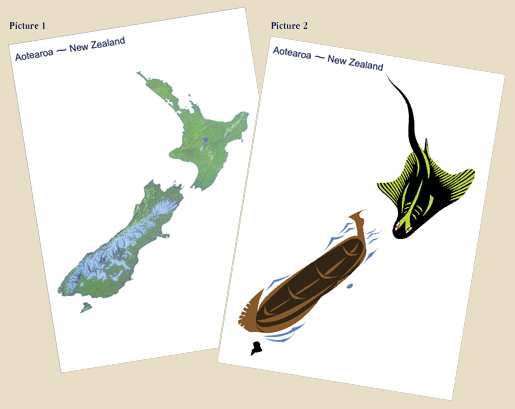
[From NEMP]
The South Island is the waka from which Māui and his brothers fished. The seat of the canoe was located at the Kaikōura Peninsula on the east coast of the South Island. This is where Māui stood when he first hooked the fish. Thus, the name given to the South Island is ‘Te Waka a Māui’ or Māui’s Canoe. Some parts of the legend add that Rakiura (Stewart Island) is the anchor stone of the waka and under this interpretation it’s called ‘Te Punga a Māui’ (Māui’s anchor stone).
As we learned in the previous post, Māori culture, like its parent Polynesian culture is based on the large tribal like grouping called iwi that itself consists of smaller units called hapū and whānau. Over the decades or perhaps centuries of the arrival of the seven waka each iwi settled in an area of one of the islands for which it bore responsibility or rohe.
Rohe is a broad term that represents the traditional lands and resources that an iwi is responsible for managing and protecting and that would have traditionally included:
- Care and protection of the living entity ancestral lands that’s connected to the people through whakapapa.
- Management of the forests, waterways and wildlife within their territory.
- Maintaining and defending territorial boundaries through either negotiation or conflict when needed.
- Preserving and practicing Māori customs, traditions, and spiritual connections to the land.
(Whakapapa is fundamental to Māori culture. The term encompasses genealogy, lineage, and the interconnectedness of all things. It’s maintained through oral tradition and still influences social relationships, land rights, and cultural practices and remains a source of identity and connection for Māori people.)
In the 21st century, an iwi map of Aotearoa looks like this.
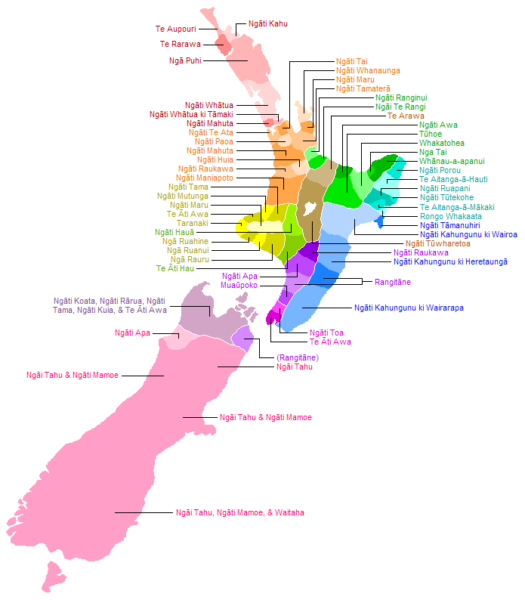
[From Wikimedia Commons]
While the South Island has only eleven iwi, the North Island has more that I care to count. Until recently, the Māori wouldn’t have viewed either island, let alone both islands as a single governable unit. So then, how does a unified Aotearoa fit in with this otherwise segmented structure?
The source of the name comes from the legend of Kupe. According to the tale, when Kupe’s wife Kuramārōtini sighted the North Island, she is said to have cried, “Ao! ao! ao tea! ao tea roa!” for the long (“roa”), white (“tea”) cloud (“ao”) she saw hanging above the land. Thus, the North Island is also Aotearoa – the Land of the Long White Cloud. As the country began recognizing its truly bicultural identity, media, government, and other sources began using Aotearoa as an identifying marker of the nation’s Māori heritage. And Māori, who, as we shall see throughout this blog, are quite adaptable, have accepted it.
Māori, kurī, and kiore
The section header above refers to the first three terrestrial mammals in Aotearoa. The kurī, a breed of Polynesian dog and the kiore, a Polynesian rat came as passengers in Māori waka. The latter was likely brought solely as a food source while the former likely had that purpose plus several others such as hunting, to provide material to make cloaks called kahu kurī, and also as companions. Before this, the only mammals in Aotearoa were three species of bats only two of which are endemic to Aotearoa and one of those, the greater short-tailed bat, is likely extinct. The surviving endemic short-tailed bat
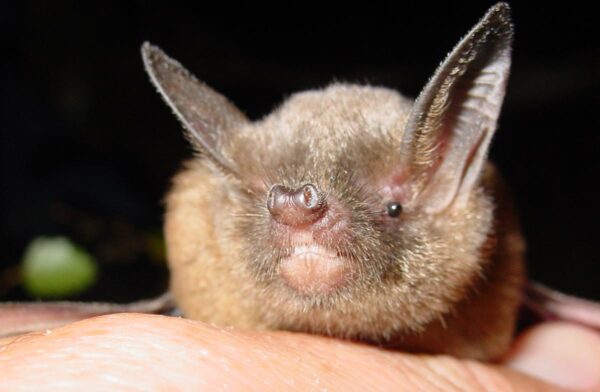
[Short-tailed bat by Colin O’Donnell NZ Department of Conservation]
is endangered.
Polynesian but not Polynesian
The first clear evidence of a seafaring culture in Oceania comes from the Lapita people who are generally considered to be the ancestors of all Polynesian people. There’s evidence of their settlements in the Bismarck Archipelago east of Papua New Guinea dating back at least 4,000 years BP. Their descendants would continue sailing eastward exploring, adapting, and settling. Over three millennia they would develop ingenious navigation and canoe building techniques that allowed them to complete the remarkable feat of settling the entire Polynesian Triangle by about the year 1,000 CE.
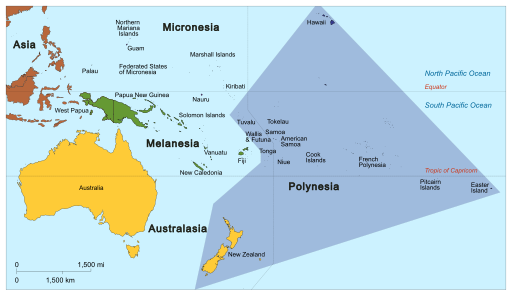
[From Wikimedia Commons User Tintazul under CC BY-SA 3.0]
Over this time they adopted the classic form we identify as the ocean-oriented Polynesian culture. However, while each settlement would retain enough common elements to allow varying degrees of connection, each also evolved to meet the demands of their new environments. This was certainly the case for Māori as they settled Aotearoa.
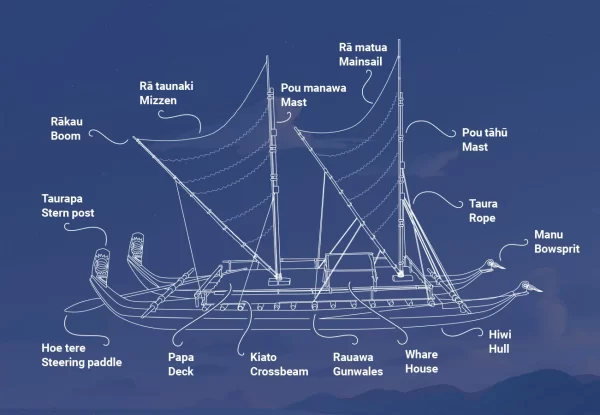
Chief among the shipbuilding techniques that allowed this cultural development and expansion was the double canoe that Māori call waka hourua or seafaring canoe. This was a double-hulled canoe connected by lashed crossbeams that provided stability and enough cargo capacity that they could bring not only the animals noted above but food supplies and planting material. While Māori weren’t interested in altering the flora of their new home to remind them of the old (as the British were in Australia), they certainly brought crops to plant that would have been familiar.
[From Matawara at Taumata School]
The cultural connections between Māori and their Polynesian cousins are evident and this keeps them broadly Polynesian but their relative isolation in Aotearoa also prompted new cultural elements that became uniquely and identifiably Māori. These included developing their own language, modifying old and creating new myths and legends unique to their culture, and adapting hunting, fishing, and cultivation techniques to meet their new environment.
Based on Polynesian social customs and tradition, they also established their system of social organization of the iwi, hapū, and whānau.
Iwi is the largest social unit of Maori culture. It’s typically territorially based and, with individuals who could trace ancestral ties through many generations to a single common progenitor, provided a symbolic sense of identity and unity in pre-European times. However, the hapū were probably more politically important.
[From Otago Museum]
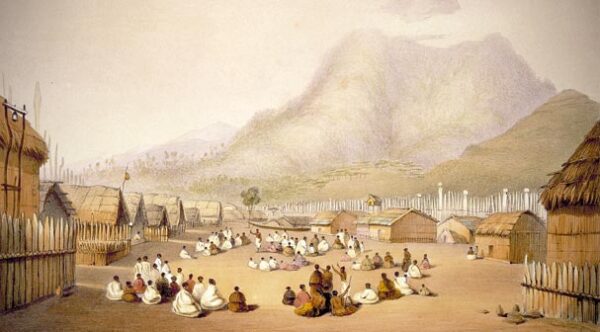
Hapū were more localized descent groups within an iwi that had strong territorial ties and more clearly defined territorial boundaries. They were responsible for managing land and resources, defending territory, and organizing collective activities such as fishing or farming.
The smallest social units functioning as day-to-day economic and social groups were the whānau and consisted of extended family members. They cultivated land, hunted, fished, and shared resources within their own borders and had key roles in cultural practices like marriages and funerals.
By not permitting private ownership, the structure of Māori society fostered collective responsibility and cooperation. Some of its emphasis on kinship ties and respect for ancestral lineage led to a somewhat socially stratified society.
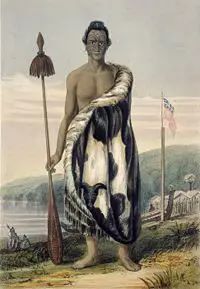
The rangatira or gentry provided leadership for both the iwi and the hapū. The ariki held the highest rank within an iwi. Their mana (power) combined hereditary, personal, and theocratic elements.
[From Newworldencyclopedia.org]
An individual who was also called rangatira generally held mana or decision-making power for the hapū and required significant practical wisdom. The position was often hereditary.
The remaining social strata were tauwareware and taurekareka. The former were commoners and the latter slaves. Taurekareka were usually captured in wars and were viewed as having lost their intrinsic tapu or sacredness. Although they were often used for manual labor and treated contemptuously, they were not slaves in the sense that chattel slavery manifested in American history. They could integrate into the iwi by marrying a free person or sometimes be returned to their home people where they might regain their tapu.
The history lesson concludes in the next post as we look at the arrival of the pākehā before setting out to explore a bit of Auckland.
-
It’s just a shot away – Prizren
March 6, 2026 -
Some things looking better, baby – Getting into Kosovo
March 4, 2026 -
Here, where the sky is falling – Kukës
March 2, 2026 -
That’s when we fall in line ’cause we got Berat
February 27, 2026 -
Walking on the big stuff – a climb to Tragjas
February 25, 2026