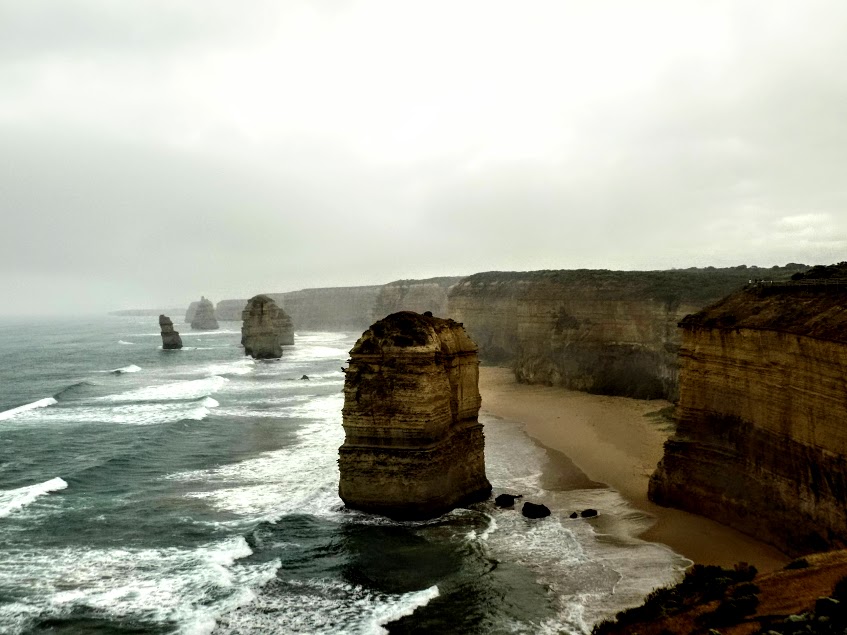
as I draw closer and closer to the end
(Can’t you hear, can’t you hear the thunder?)
Leaving from Melbourne, the way most people see the Great Ocean Road and the famous Twelve Apostles formations – whether driving themselves or taking a tour – is to proceed south on the M1 until they reach the C134 and continue to the southeast until they reach the Memorial Arch
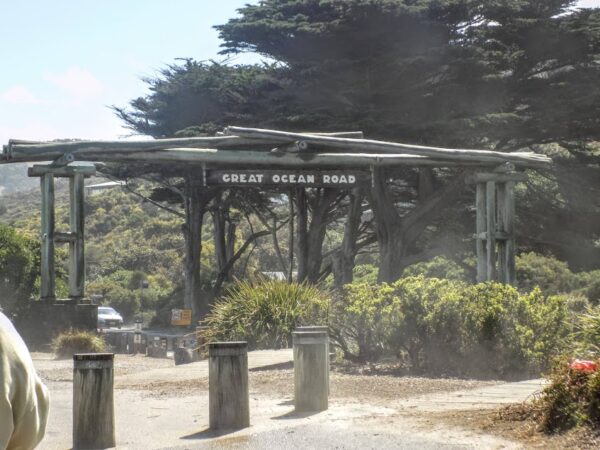
that marks the beginning of the world’s largest war memorial. From there, they’d continue south through Lorne and Great Otway and other interesting stops along the way before reaching Port Campbell – home to the famed formations.
Of course, I’m not most people so I chose a tour that did essentially the opposite – The Great Ocean Road Reverse Itinerary Tour. That is, our route took us inland and, after a stop for breakfast, ran directly down to Port Campbell and the Apostles. We would then turn around and drive north making all the stops that would have distracted us had we taken the standard route. The one downside to this tour is that it departs from the State Theatre at 06:50.
Fortunately for me, it was a two minute walk (okay, four minutes given the length of the hotel hallway) to the free tram and then another two minutes from the tram stop to the meeting point. Unfortunately for me and the other eight people on this excursion, the early morning Melbourne weather was brutal – a steady unrelenting downpour –
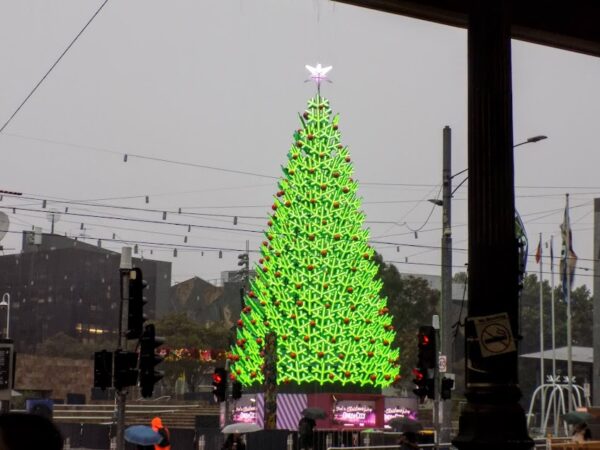
that our driver and guide said would likely clear by the time we reached the Apostles that were about 275km distant.
Nine of us going somewhere
With a maximum of 11 permitted on the tour, our van carried nine tourists – me, three single women (one Dutch, one German, and one Israeli who was cautious about mentioning her nationality), a Chinese woman with her daughter and son or son-in-law, and a couple whom I’d learn later in the day were from Brazil. We were all concerned about the weather but took some solace in our driver’s reassurances.
We headed off down the M1 and drove for a bit over an hour before stopping for breakfast in Winchelsea. I think the name of the place we stopped was Kenty’s but my notes aren’t as legible as I’d like. I recall that it was a sort of bakery café where I had some sort of egg laden breakfast sandwich and (surprise!) a cup of tea.
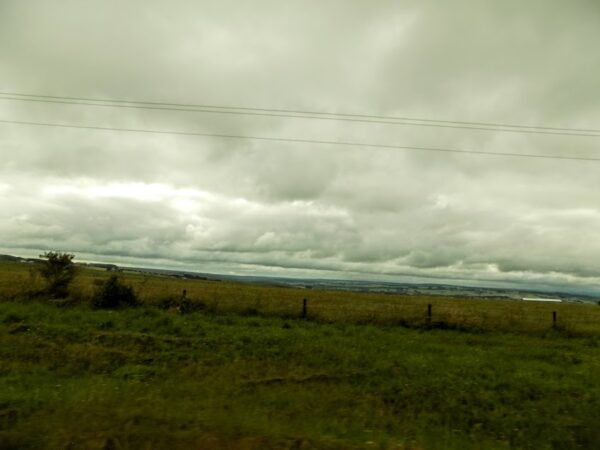
The rain continued but not as fiercely as it had when we started so I think the group was cautiously optimistic as we started on the next hour-and-a-half of our journey down to Port Campbell National Park – the site of the 12 Apostles. Our route took us off the coast road past Mount Gellibrand, the town of Colac, and scenery that looked much like this.
A brief geological dive
Since the ride to the Apostles from this point is barely longer than an hour, I’ll keep my explanation of their geology short. You see, the Apostles are unique among formations like this that are somewhat common.
The Apostles are sea stacks. Sea stacks are isolated outcrops of rock standing in the ocean and are remnants of eroded rocky headlands. The one in the photo below is called Haystack Rock and can be found at Cannon Beach Oregon.
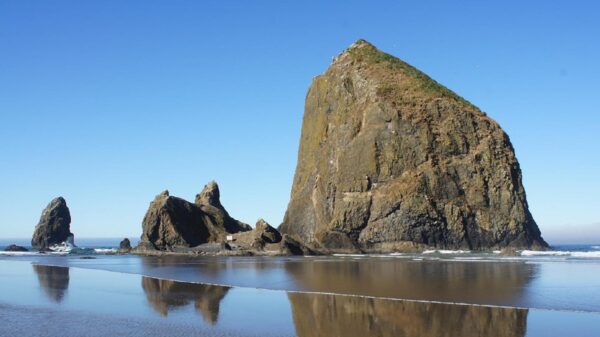
[From NPS by Tjflex2 is licensed under CC BY-NC-ND 2.0]
You can go to this website for photos and a list of the 20 best sea stacks off the Oregon Coast or to this site for ten you can find elsewhere in the world.
Let’s look at some of the qualities that make the Apostles geologically unique. Most sea stacks are composed of relatively hard rocks such as sandstone, basalt, or granite so the stacks themselves can withstand the erosive forces that isolated them. The Apostles are composed of limestone and marine fossils. In geological terms, the evolution of these stacks occured relatively quickly. The process taking them from headland to arch to stack and eventual collapse can be completed in as little as 800 to 1,800 years.
The limestone in the stacks varies widely in its age. The base is generally about 13,000,000 years old and the top layers are about 3,000,000 years younger. This sort of geological timeline is unusual in this type of formation.
It had, indeed stopped raining before we reached Fort Campbell but, as you can see,
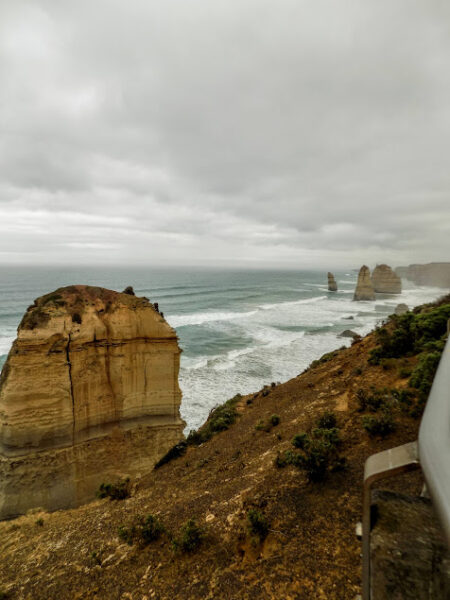
the threat remained.
I was amused by the information on this sign
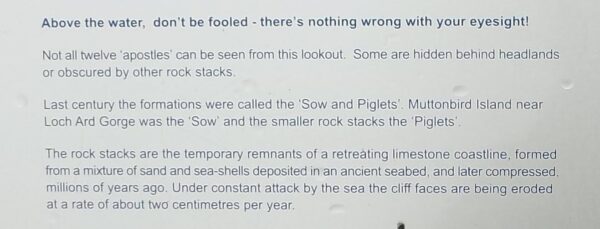
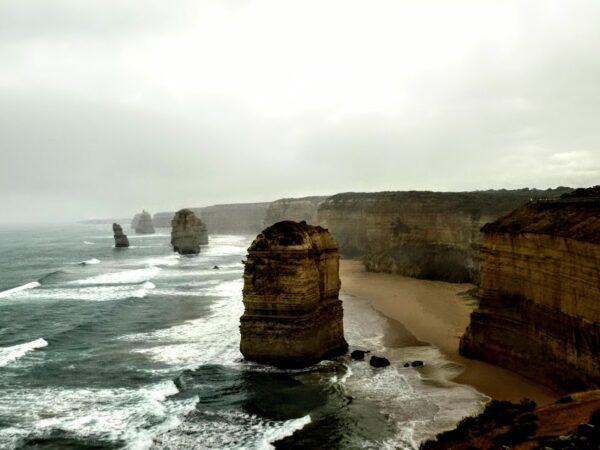
and not merely because the formations were once called the “Sow and Piglets” but by its admission that “Not all twelve ‘apostles’ can be seen from this lookout.” when, in fact, the most any non-Aboriginal person could have seen is nine! In 2024, erosion has reduced that number to seven. I think this picture captures six of them.
As we turned back toward Melbourne, we’d make stops at the formation called the Razorback,
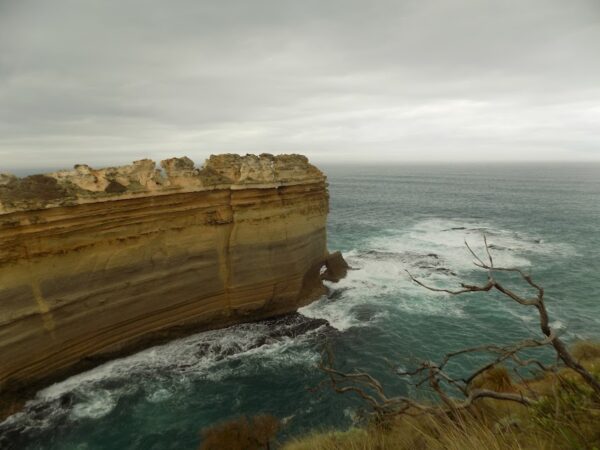
at Loch Ard Gorge where the ship Loch Ard sank in June 1878,
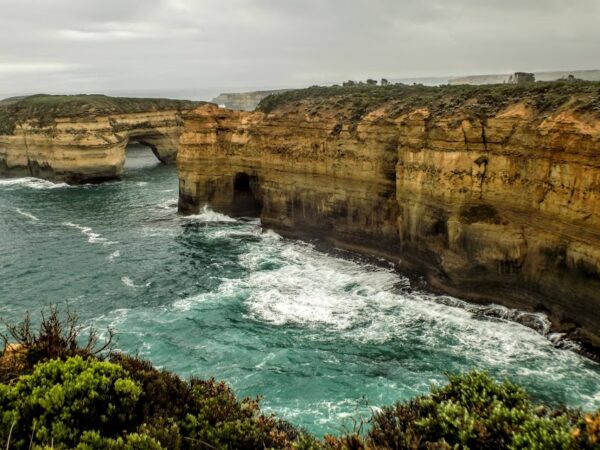
take a walk down Gibson’s Steps to the beach,
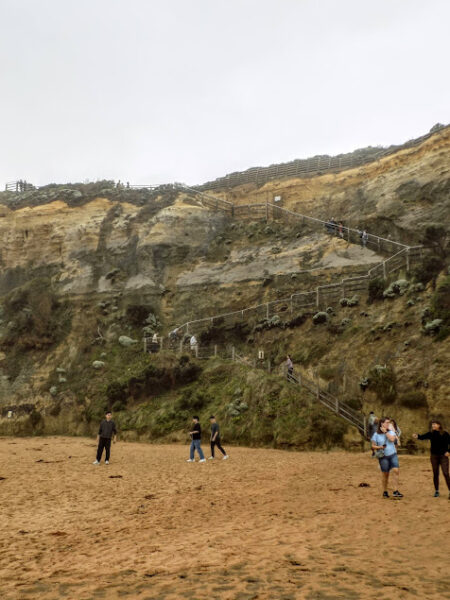
and into the rainforest with a walk to the rather anemic cataract called Anne’s Cascade
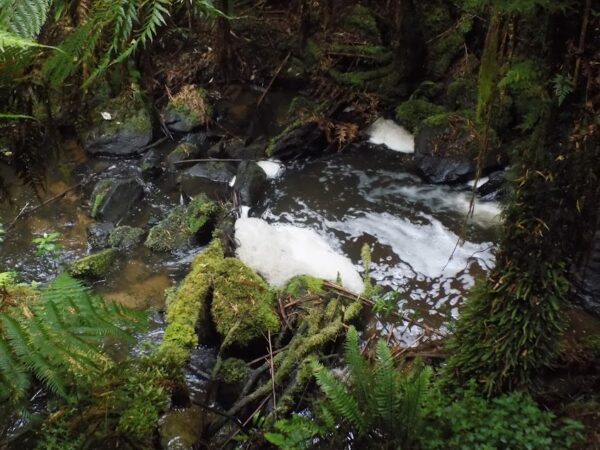
all before stopping for lunch in Apollo Bay. During this time I’d taken a seat opposite A & M the couple from Brazil. I think our conversation hit its stride when I told them I’d been to Brazil and A asked me if I’d been to Rio de Janeiro and what I thought of it. I took out my phone, opened this post about Rio and read him the section headed “First thoughts about Rio.” He thought I’d captured the city well. There’s more to come about A & M.
Lunch at Apollo Bay proved to be something of an adventure. The skies once again opened and dropped rain in torrents. In fact, at one point we’d be riding through a hail storm! I don’t recall where I had lunch but I do recall that I forgot a lesson I should have taken to heart. I ordered the seafood sampler and everything on the plate was deep fried. Given the frequency that Fish and Chips had at least been an option on a menu, I should have anticipated this.
However, because I lack self-discipline when ice cream is involved, despite calorically gorging myself at lunch, I still managed to consume a cup of pistachio gelato from Dooley’s (Multi Award Winning Premium) Ice Cream. This, again demonstrates my adherence to the belief that no matter how full I think my stomach is, there’s still space for ice cream.
Coming full circle
All that remained for the day was our return to Melbourne, a stop at the Memorial Arch at the east end of the Great Ocean Road that marks the beginning of the world’s largest war memorial, a side trip to Split Point, and a small surprise. Built by approximately 3,000 returned soldiers from World War I between 1919 and 1932 as a tribute to their fallen comrades, the 241km road is dedicated to the memory of those who served and died during World War I.
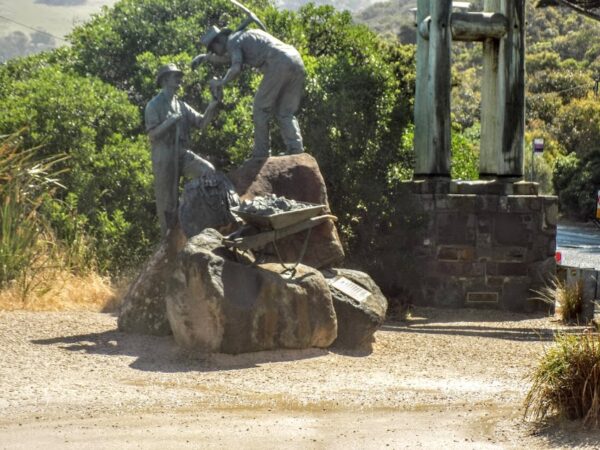
As the ride continued, A, M and I chatted in a mix of English and Portuguese. He was kind enough to speak slowly so that I usually understood his general point. I learned that we had twice been neighbors living just a few miles apart in Montgomery County. A had been there once as a single man in his youth and returned with M because he so enjoyed the area and so she could study English at Montgomery College.
Our final stop provided the opportunity to see something else one can see only in Australia. I don’t know if he took us to the front nine or the back nine of the Anglesea Golf Club but we stopped by a fence where I took this photo.
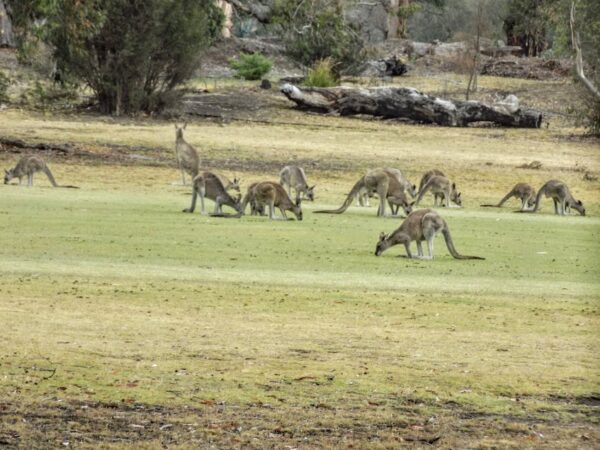
Not a hazard. Just play through.
And finally
As I had with L in Hobart, A & I connected on WhatsApp. When he parked at the drop off point in Melbourne, our driver told us that if we went right and up the stairs we’d be at the pickup location. I set off to do that while A & M went in the opposite direction.
As I neared Flinders Street Station, the immediately identifiable sound of the opening bass notes of My Girl echoed across the concourse. A favorite song from my youth, I quickened my pace and found the source – a table of four guys who were having a great time after work. I couldn’t help myself so I joined in singing and dancing (badly) until the song ended, we shook hands and I thought, that will be a fun story to tell when I get back to the States.
A few seconds after boarding the tram to return to the hotel, I got a WhatsApp message from A. It had three pictures. This was one of them.
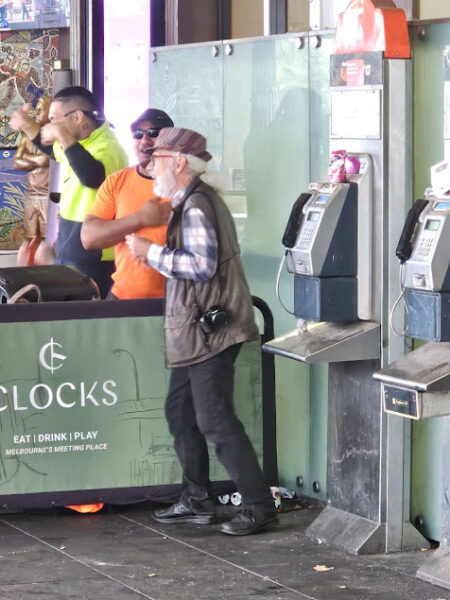
Tomorrow will be my last day in Melbourne and while you’re waiting for that story, here are all of the rest of today’s pictures.
-
It’s just a shot away – Prizren
March 6, 2026 -
Some things looking better, baby – Getting into Kosovo
March 4, 2026 -
Here, where the sky is falling – Kukës
March 2, 2026 -
That’s when we fall in line ’cause we got Berat
February 27, 2026 -
Walking on the big stuff – a climb to Tragjas
February 25, 2026
2 responses to “as I draw closer and closer to the end”
I opened your blog this morning at this post and thought I had the wrong Gruncle . . . Because surely it was the Great Australian Train Trek that my Gruncle was on not the Walking Australia program!!
All good things – even train treks – must come to an end. But if you missed some, you can scroll backward or go to the Categories page