Antwerp and Me – To the river so deep
At the end of yesterday’s post, I was setting out to find a Belgian Waffle. I’d written the name of two places suggested by an internet search and decided to march in their general direction and, without further use of any map app, settle into whichever I spotted first. (This isn’t entirely true. I deliberately routed myself away from House of Waffles hoping I’d find Wafelhuis Van Hecke without too much difficulty.)
I can hardly be described as a waffle connoisseur but my knowledge of the treat certainly extended beyond Eggos. However, in seeking a Belgian Waffle in Belgium, I learned that there are two distinct types – the Brussels style and the Liege style. Coming from the US, I was familiar with the lighter, crispier Brussels style but knew nothing about the thicker and chewier Liege style.
Although I walked past it twice, I eventually found the small shop and stepped inside.
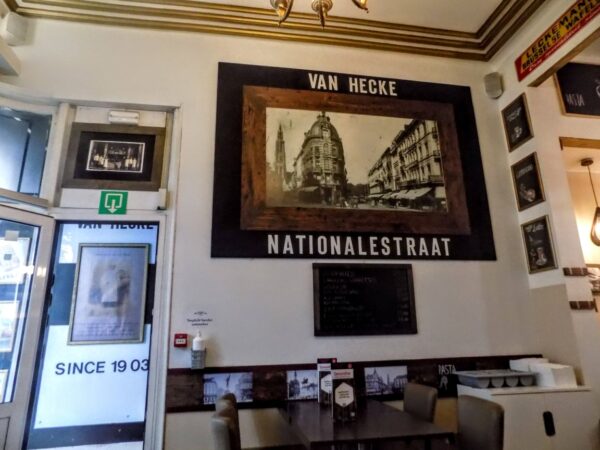
Rather surprisingly, it was staffed by a Serbian couple and, when I overheard them speaking Serbian, I shocked them when I wished them good afternoon in a Slavic language. (It was probably Croatian. Although there are minor differences between the languages of the countries formerly yoked together as Yugoslavia, they’re mutually comprehensible. My Balkan trip didn’t include Serbia so I never learned the specifics of that language but I knew the greeting from the rule I explained in the first post about this trip.) From that point our interaction became boisterous, joking, and quite fun.
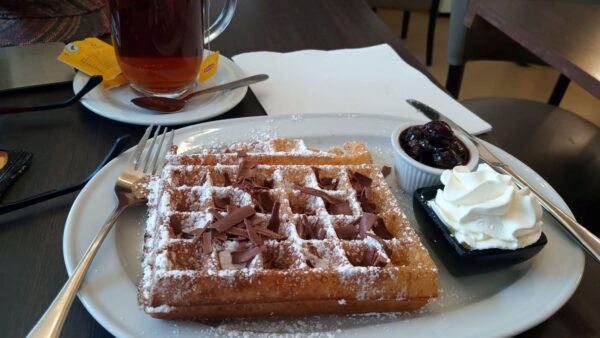
The menu saved me from facing the dilemma of which style of waffle to choose because I only saw Belgian style. I opted for one called Mon Cherry. Before I slathered it with the whipped cream and cherries, it looked like this.
But I can’t seem to find my way over
Two places remained on my must see list of sites in Antwerp. The first was Saint Anna’s Tunnel (Sint-Annatunnel) and the other was Het Steen – the medieval castle that once was considered the city center. The first was about a kilometer from where I’d had my waffle and the day had warmed enough that I was happy I’d left the hoodie in Brussels.
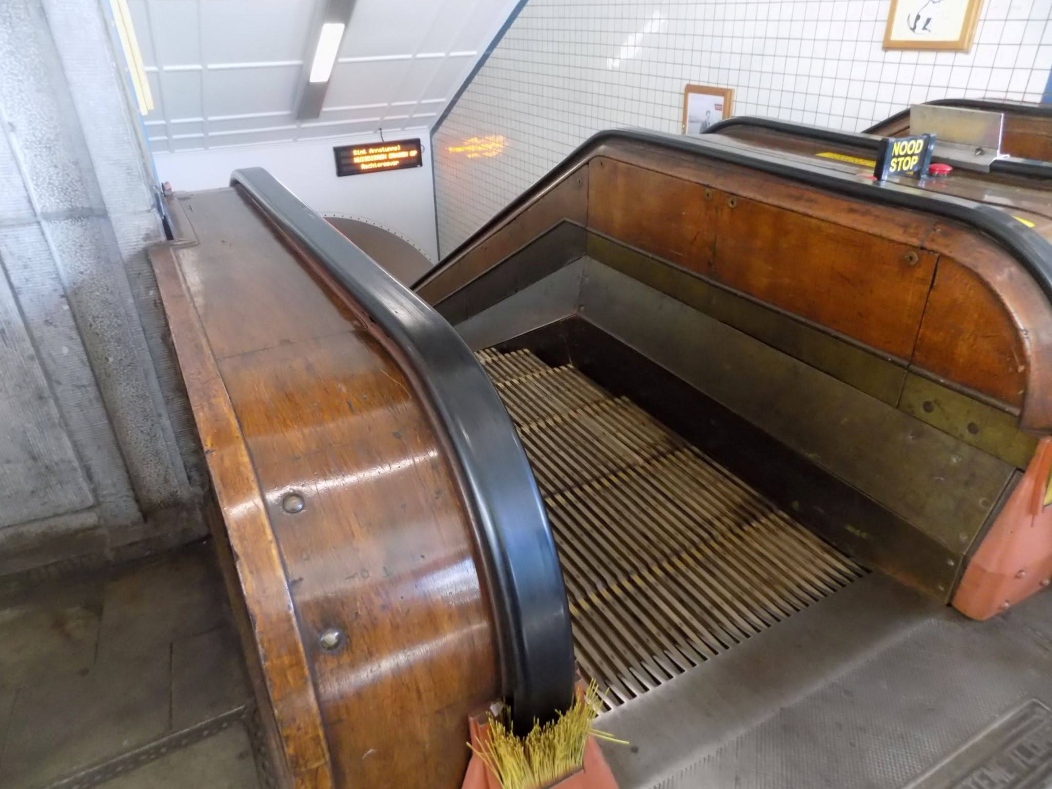
I decided to let Google Maps guide me to the tunnel and had it turn me into something of a fool because it wanted to guide me, I think, down the escalators and into the tunnel itself. It never announced that I’d reached the destination and I circled the entrance more times than I care to count or admit before realizing it was the building in front of me. In my frustration, I neglected to take a picture of the entrance. Fortunately, we have Wikimedia Commons. (In my defense, I ask you to note that the building is unmarked.)
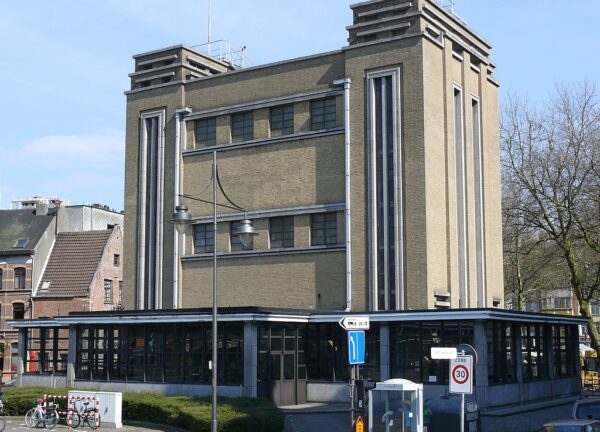
[Ad Meskens, CC BY-SA 3.0 https://creativecommons.org/licenses/by-sa/3.0]
Built in 1933, the tunnel connects the older right bank of the Scheldt River with the city’s newer left bank suburbs and is exclusively for pedestrians and cyclists. Among the most noteworthy features are the wooden escalators that descend more than 30 meters to the river bottom. Wooden escalators were rather novel at the time and that is even more so the case today.
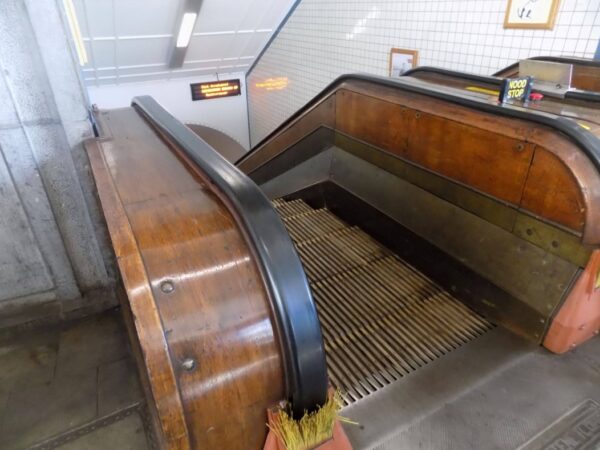
Once inside, the stark tube can look a little intimidating
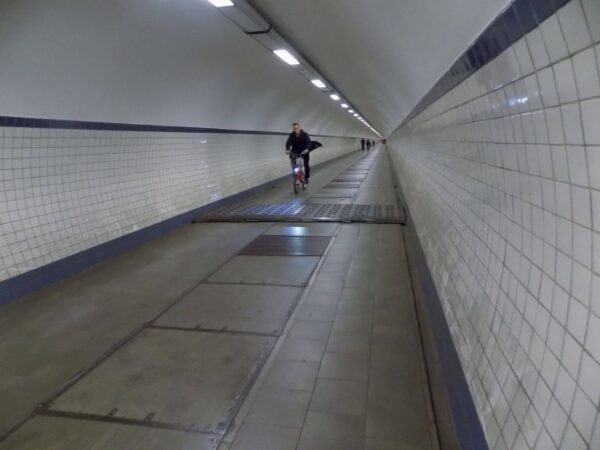
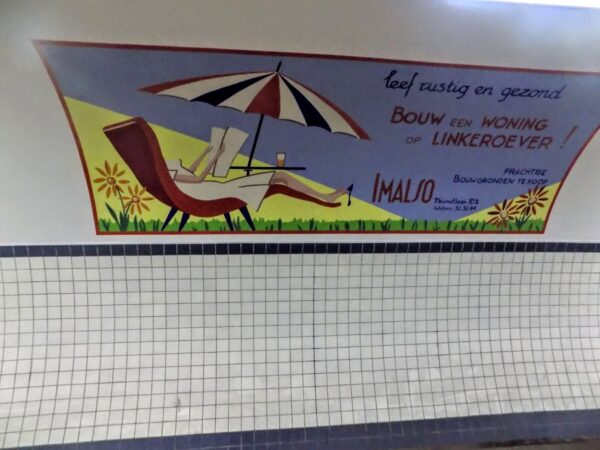
(Please note the speed humps for the cyclists. I didn’t think they helped much in slowing them down.) Happily, the tiled monotony is occasionally spotted with vintage – or vintage looking – ads like this one.
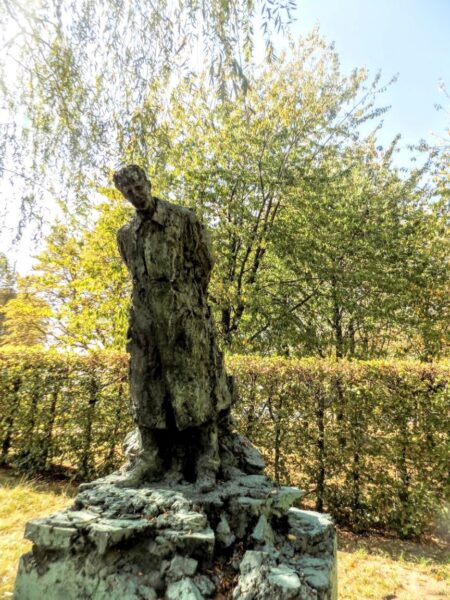
And the park on the left bank affords some nice views of the city center and has a statue of King Baudouin.
Well the streets are all crowded
As I’ve traveled more and more, I’ve discovered more and more ways humanity connects culturally across time and geography. The trickster is an example of this. Sometimes they appear as gods. The Greeks had Hermes, the Norse Loki. Sometimes insects such as the Ashanti people’s Anansi the spider. And animal forms are quite common. For the people of America’s Pacific Northwest it was a raven. Travel to Japan and you can learn about Kitsune the fox. In Antwerp, the trickster is a giant called Lange Wapper. Like many tricksters Lange Wapper is a shapeshifter. He gained this power as a reward from a woman he saved from drowning.
As a result his personality changed from a kind man into someone who enjoyed teasing and terrifying the townsfolk. He might transmogrify into a small child to drink the milk of nursing mothers, or appear as a shadow lengthening and looming over drunkards staggering home at night, or he might impersonate nuns or priests to play cruel jokes. He was also known to cheat children in games. He is said to have had a fear or at least a strong dislike for the Virgin Mary. People began placing effigies of her outside their homes to keep him at bay and this is often cited as a reason so many Antwerpian homes have such an effigy.
Perhaps because his legend blends local identity and folklore and the tales about him can, as is frequently the case with trickster tales, be used as moral lessons, over time, Lange Wapper managed to transcend his origins and morph into a beloved symbol of Antwerp.
In 1963, sculptor Albert Poehls created this bronze statue
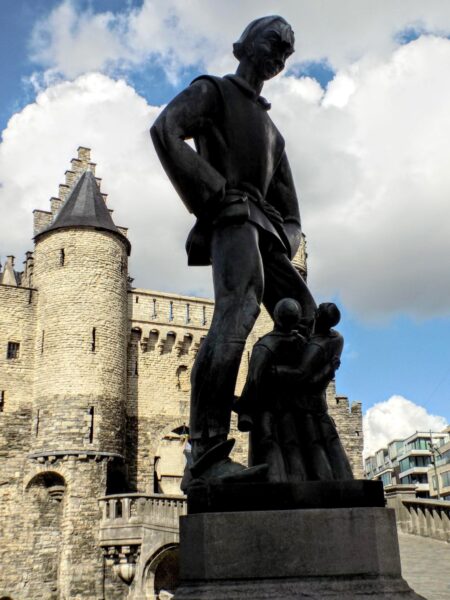
of Lange Wapper. Antwerp installed it in front of Het Steen castle.
The first structure on the site appeared in the ninth or tenth century. It was fortified and the stone edifice was constructed in the first quarter of the 13th century and it’s this construction that provided its name. Het Steen translates to English as The Stone. Considered Antwerp’s oldest building, it was rebuilt in 1520 by Holy Roman Emperor Charles V. What visitors see today
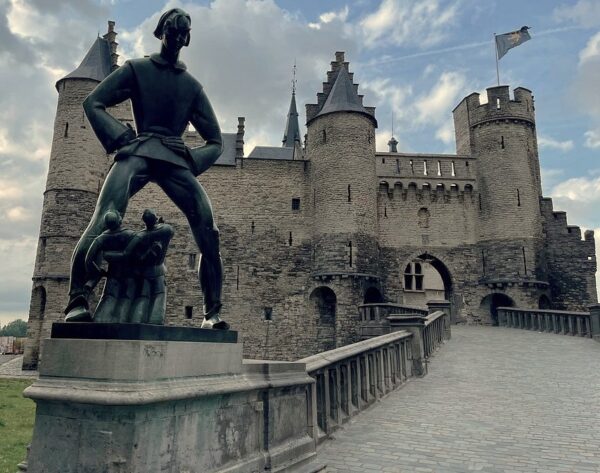
is only a remnant of the entire complex – much of which was destroyed in the nineteenth century.
All’s not well that ends not well
Once again the benefits of solo travel became manifest when I had a less than satisfying end to an otherwise enjoyable day. Perhaps I was a bit bumfuzzled when I reached the train station (which is an impressive structure)
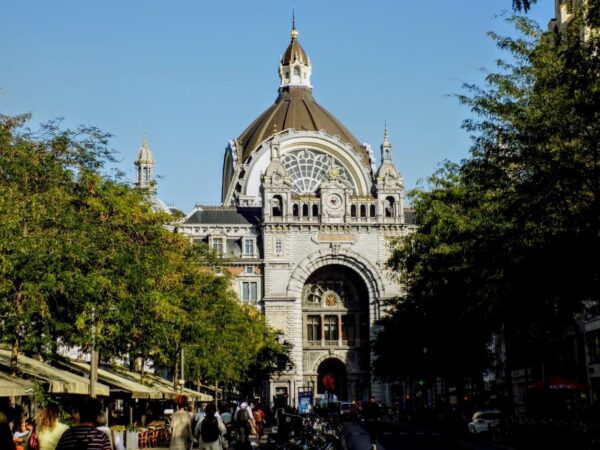
but I managed to board the local train rather than the express. It drumbled along progressing so slowly that what had required barely more than half an hour in the morning needed nearly thrice as long to return. When I arrived in Brussels, the metro wasn’t running so I had to walk from the train station to the hotel. This helped neither my energy nor my dining appetence.
Still finding my thoughts a bit cattywampus from the time change, I decided to return to the same restaurant where I’d supped Monday night because it was quite close to the hotel and the moules-frites with a Leffe Ruby had been quite good.
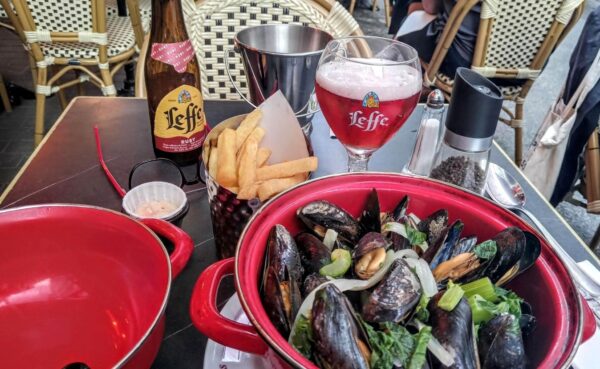
(By the way, some inquisitive folks reading this my find sources that assert frites {or French fries as we call them in the US} aren’t necessarily French and that it’s plausible that these strips of fried potatoes have a Belgian origin. They will claim that American soldiers fighting in World War I ate fried potato strips in the French speaking part of Belgium and brought the term with them when they returned to the US. There’s considerable evidence that this isn’t true.
On his website, the Belgian food historian Pierre Leclercq traces the first mention of pomme de terre frite to 1775. John Reader’s book Propitious Esculent: The Potato in World History notes that Thomas Jefferson, on his return from serving as Commissioner to France brought with him some sort of fried potato recipe belonging to Antoine-Augustin Parmentier – whom I profiled here – that he served at a White House dinner in 1802.
The term appears in an 1856 English book titled Cookery for Maids of All Work. The Yale Book of Quotations cites this American use in 1886, “Springfield (MA) Republican 12 Oct. 1 (GenealogyBank) REMEMBER that the place to buy Saratoga Potatoes is at No 4 Dwight-street (near State), also French fries Wednesdays and Saturdays.” All of this seems to undermine the World War I story but some myths remain doggedly persistent.)
As for me, my series of unfortunate events continued when the server brought me not the salmon I’d ordered but the sole meuniere. My acedia was too deep to correct him and, thus, I was helpless to correct the additional €10 cost as well.
Moving at a chelonian pace, I needed nearly twice as long as I normally would to traverse the 100m or so to the hotel. Because it hosted the Olympics, we’ll remain in and around Antwerp to complete its entry in the Olympic Host Cities and Me series (which will provide a bit of a vocabulary break for you) before I post the entry about my second day in Brussels. Before all that, I can offer you some additional photos to view.
-
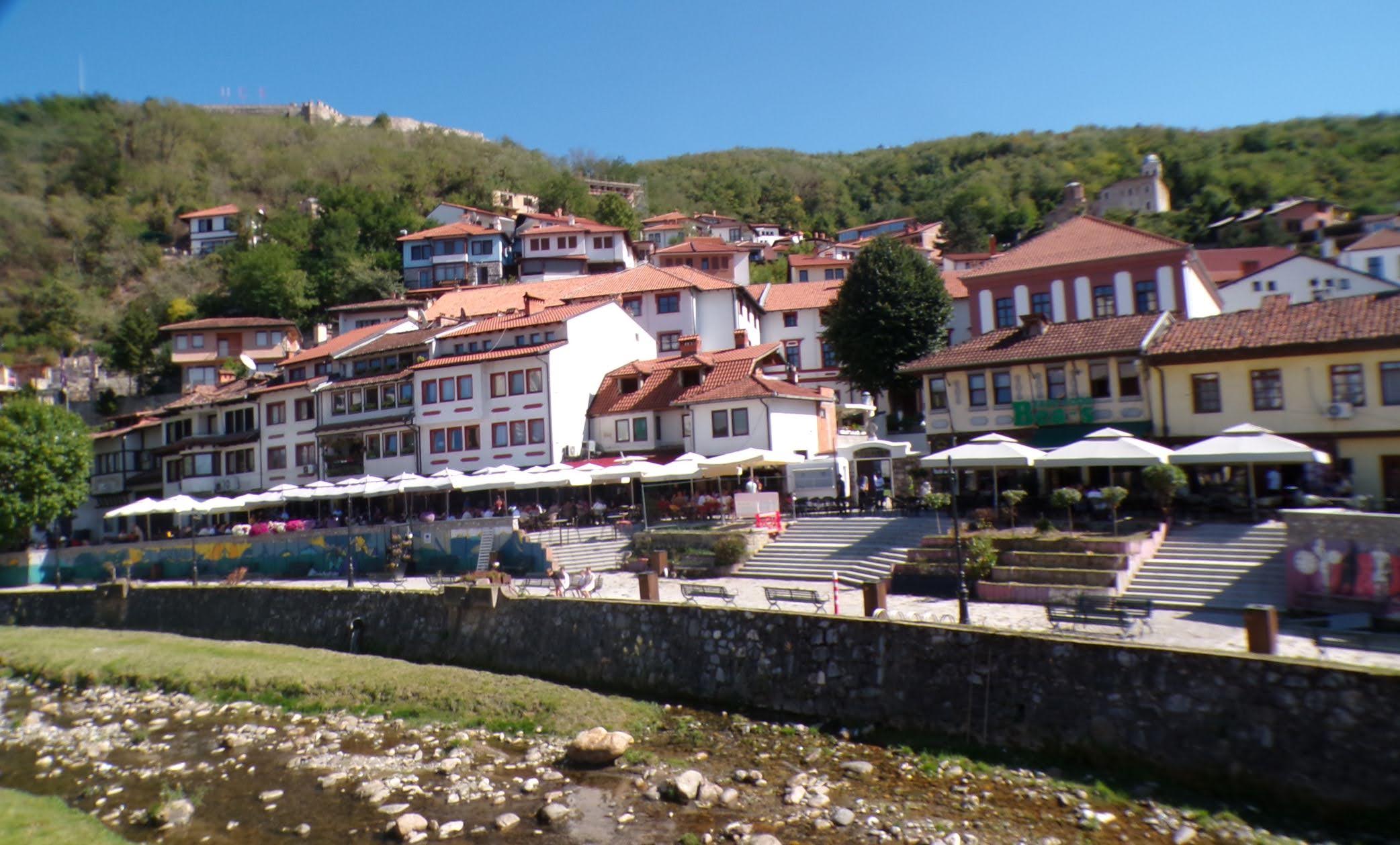
It’s just a shot away – Prizren
March 6, 2026 -
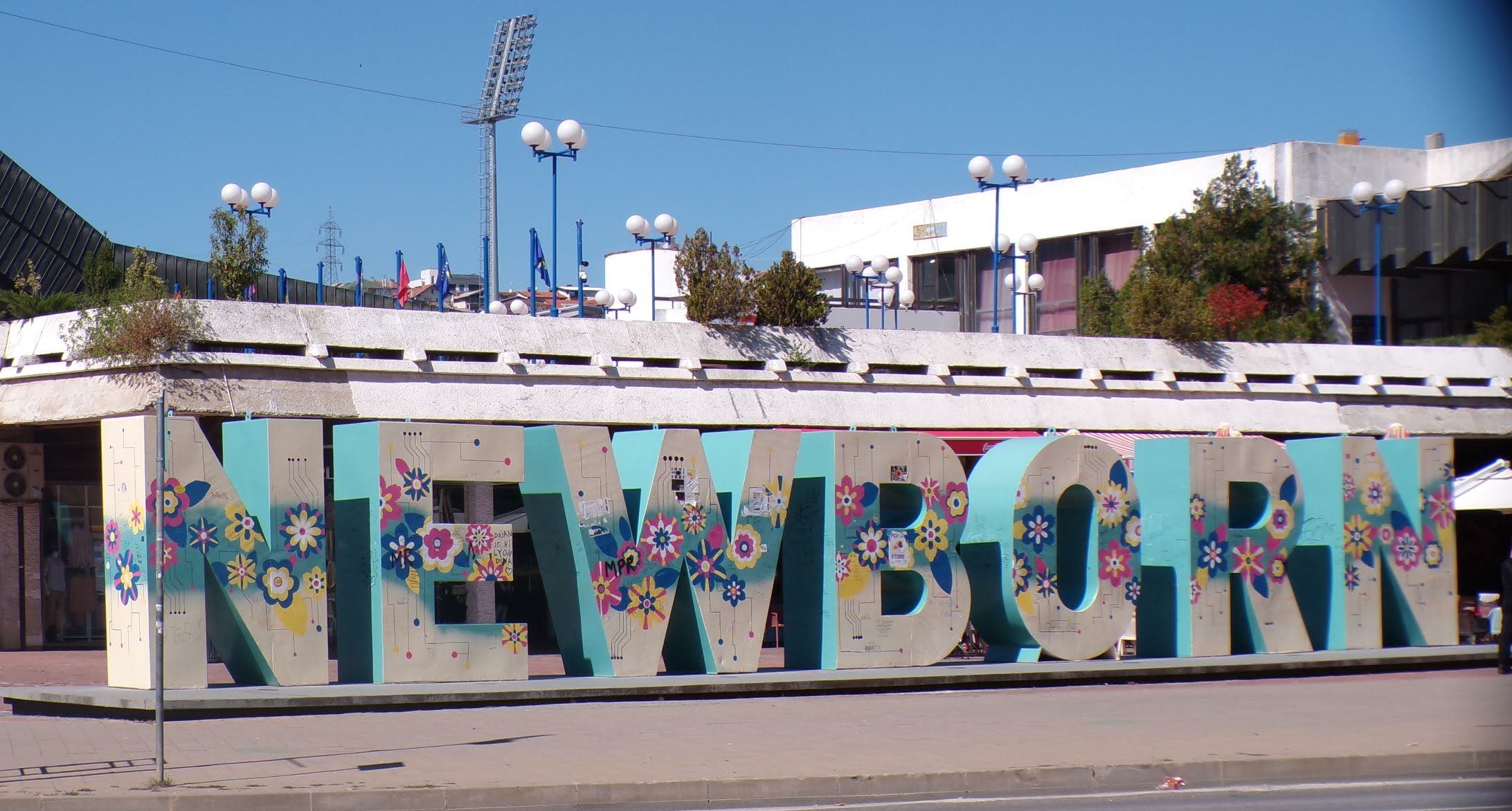
Some things looking better, baby – Getting into Kosovo
March 4, 2026 -
Here, where the sky is falling – Kukës
March 2, 2026 -
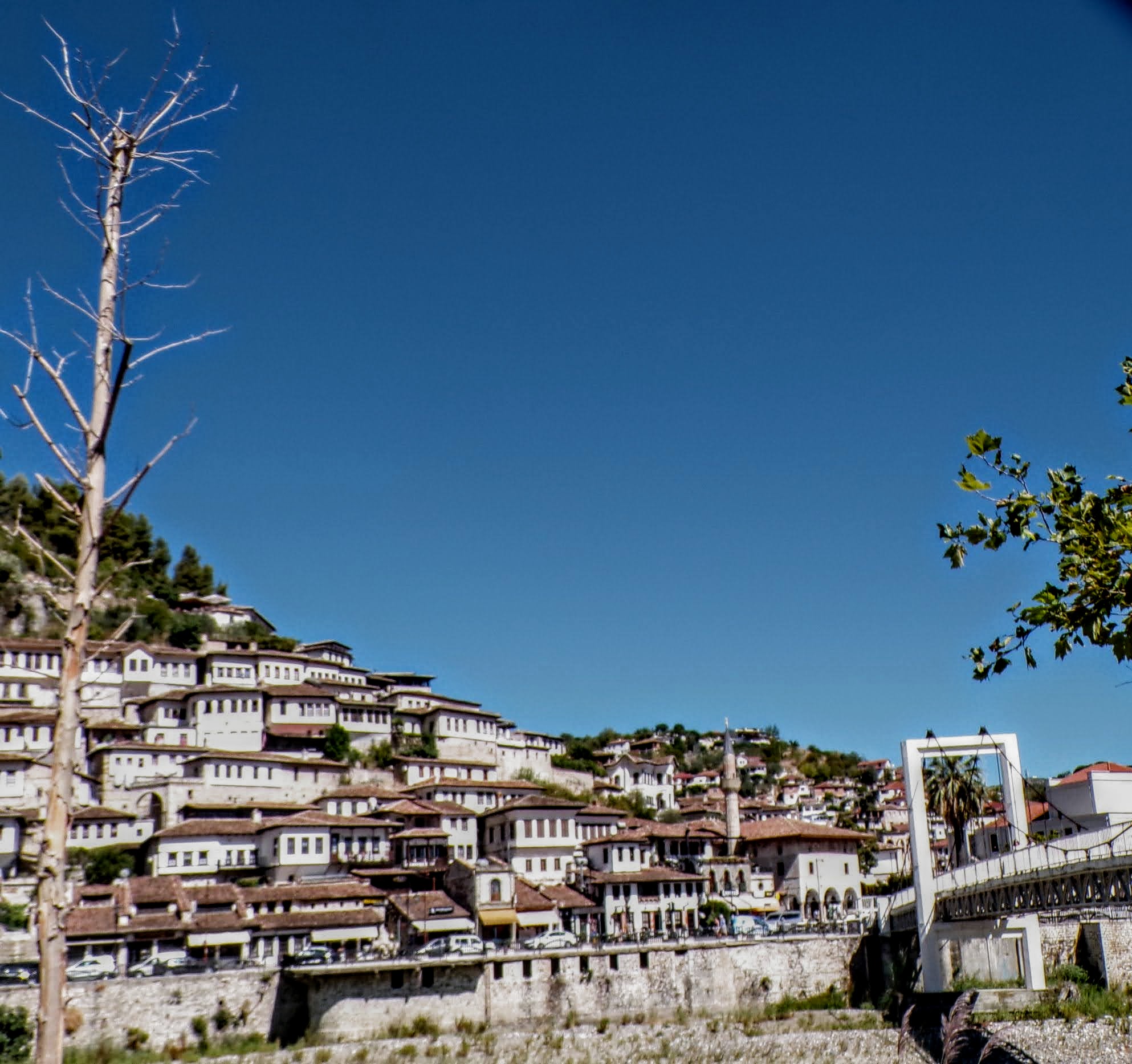
That’s when we fall in line ’cause we got Berat
February 27, 2026 -
Walking on the big stuff – a climb to Tragjas
February 25, 2026
4 responses to “Antwerp and Me – To the river so deep”
Ah, the chelonian pace. Very Terp-like, but not your usual gait….
True. Not my usual pace but somehow appropriate, wouldn’t you say?
And it’s interesting in the video that it seemed everyone coming up the escalator had a bike or scooter. Were you the only person on foot?
No, there were others on foot. I was trying to limit the pedestrians in the video to give an impression of how the speed bumps aren’t particularly effective in slowing the cyclists,