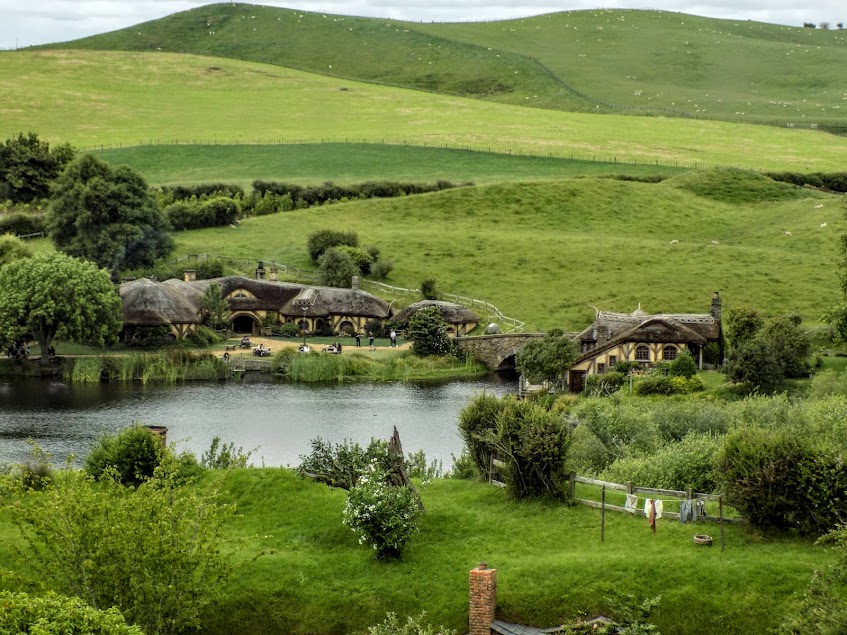
A Hobbit I simply can’t break
One might consider the reason I came to Aotearoa two days ahead of the scheduled RS tour an enigma. You see, I’d be spending this first full day not in Auckland but in Hobbitton. Well, not exactly the entire day because it’s about a two hour drive to reach the site of the movie set meaning it’s a two hour drive back to Auckland. But, between the drives, I’d be at the Alexander Family Farm – aka Hobbitton.
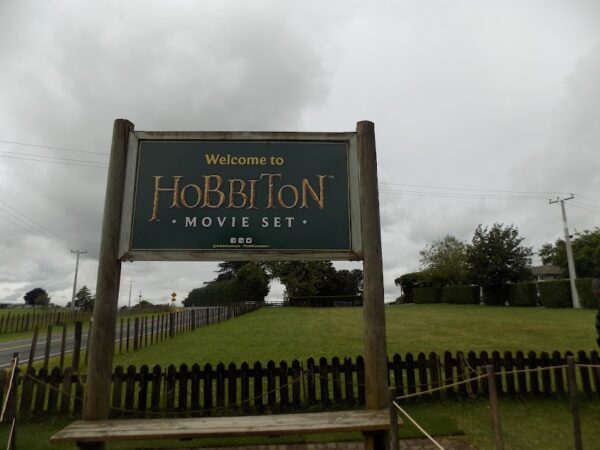
My decision to visit the Hobbiton movie set is the bit that’s at least a little enigmatic. While I was enamored of Tolkien’s books in high school and college I was not a fan of Peter Jackson’s adaptation of the Lord of the Rings and I’d never seen The Hobbit. So why go? First, if you’ve followed some of my other travels, you know I habitually visit movie and other pop culture locations. Second, one doesn’t often have the opportunity to visit as complete a movie set as this. And third, I’m in the only place in the world where I can spend time at this particular movie location and the likelihood of my returning here is almost nil. As I saw it, I had no choice. (And, of course, its presence on Atlas Obscura added another few ounces in its favor on the decision making scale.)
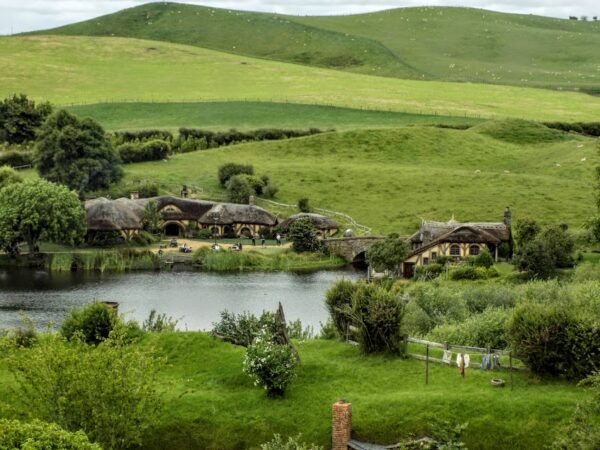
How they found the Shire
A combination of a little serendipity and a lot of determination led to the Alexander Farm becoming Hobbiton. The serendipity happened during aerial reconnaissance by director Peter Jackson’s location scouts when they overflew the more than 500 hectare sheep and beef farm near Matamata in Aotearoa’s Waikato region. They were immediately struck by three aspects of the property:
- The landscape was eerily similar to Tolkien’s description of the Shire.
- The lack of power lines, buildings or roads made it easy to replicate a time and place when these didn’t exist.
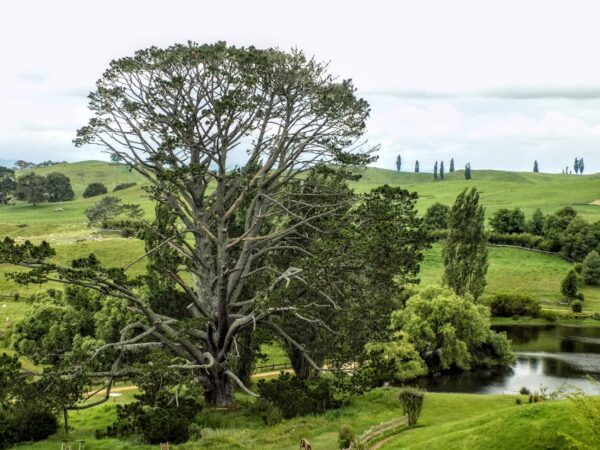
- The presence of a pine tree towering over a lake adjacent to a rising hill that became the iconic Party Tree and Bag End.
The persistence came from both Jackson and location scout David Comer. The first time Comer visited he was famously turned away because the family was watching a rugby match and didn’t want to be disturbed. When he returned, he had to convince a skeptical patriarch to allow him to have a detailed look at the farm and he was granted permission to do so as long as he “closed all the gates so he didn’t mix up the stock.” Over tea, he got permission to return with a larger crew and, once they convinced the family that filming wouldn’t create major disruptions to the operation of their farm, and that they would restore the property to its original state, the site for Hobbiton was set.
Then how did the site come to be permanent?
Construction of the original Hobbiton began in March 1999. With the New Zealand Army assisting in road construction, Jackson built 39 temporary hobbit holes (doors and windows only) using untreated timber, plywood, and polystyrene to use in filming the Lord of the Rings Trilogy. Similarly, the Mill and the double arch bridge used easily disassembled material.
The Lord of the Rings begins and ends in Hobbiton. (In fact, we’d learn on our tour of the site that the very last scene of the third movie (The Return of the King) was the first one shot and that the little girl who runs out of his hobbit hole
to greet the returning Samwise Gamgee was, in fact, the actor’s (Sean Astin) daughter and the youngest is the real-life daughter of Sarah McLeod who plays Rosie. (The trilogy’s budget is said to have been $281,000,000 or about $53o,ooo,ooo in 2024 dollars with all three movies being filmed over a 14 month period beginning in October 1999. If Jackson had had his way, he would have filmed The Hobbit first – thereby following the actual sequence of Tolkien’s narrative. However, New Line Cinema opted to begin with filming the LOTR trilogy. It’s likely that the worldwide gross of $2,900,000,000 of the trilogy eased Jackson’s path to filming The Hobbit.)
After filming ended in December 2000 the same crews that had built the sets began dismantling them. An extended period of rain interrupted their progress and before they could return, locals, recognizing the area began visiting what remained of Hobbiton and Ian Alexander’s son Russell began leading guided tours of the site.
After negotiating a deal with the studios, Hobbiton’s doors officially opened to the public in December 2002 with the Alexanders expecting 300 visitors per year. The first year’s number was forty times their expectation.
It would be nearly eight years after filming on the LOTR trilogy wrapped before beginning the pre-production phase of The Hobbit but when the negotiations began to rebuild Hobbiton in the same location, the Alexanders this time insisted that the set be built from permanent materials.
Tricks of the trade
Probably the most prevalent non-CGI filmmaking trick used in the LOTR trilogy is a camera technique called forced perspective. It’s nothing new. One of the earliest recorded instances of the technique can be seen in the 1908 short film Princess Nicotine, where a fairy appeared to be cavorting on a man’s tabletop. In the 1920s, Harold Lloyd and Charlie Chaplin made use of it in Safety Last! and Modern Times respectively.
The technique fools the eye and makes objects appear larger, smaller, farther away, or closer than they actually are by altering the viewer’s sense of size, position, scale, and proportion. This is critical in the LOTR world where even I would be a giant among the hobbits of the Shire. Here’s one way they accomplished the illusion.
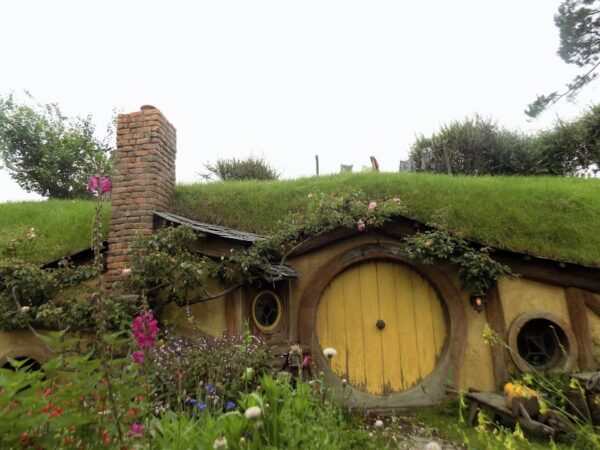
Despite the permanence of the construction for The Hobbit, the set on the Alexander’s farm was used only for exterior shots. All of the interior scenes were filmed at Stone Street Studios in Wellington. Thus, walking through Hobbiton today one can spot doors to hobbit holes such as this one
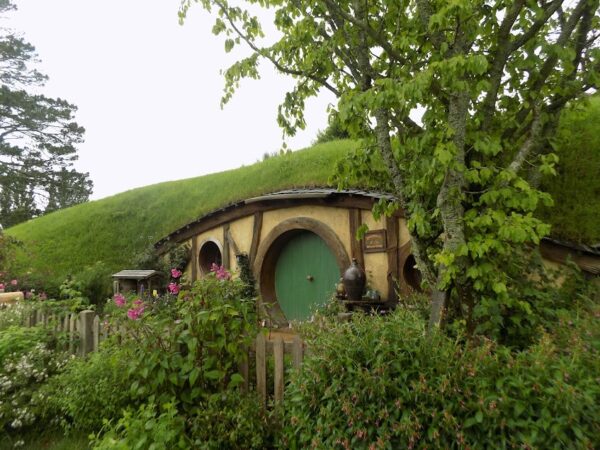
that are built at 60% human size mainly to make Gandalf look large and others like this one
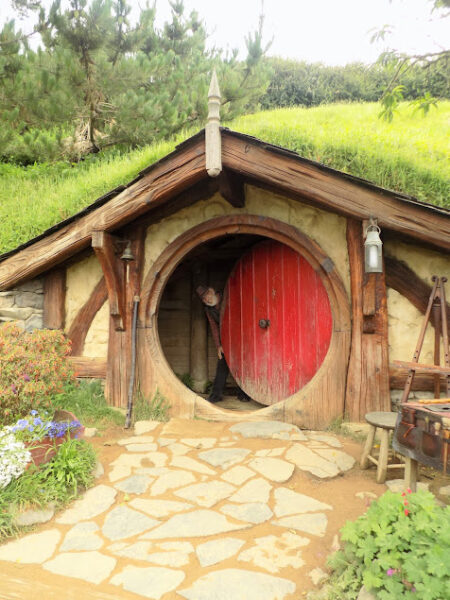
built at 90% human size to be more appropriate for the hobbits. (Fortunately, my shod feet are too small and not hairy enough to mistake me for a hobbit.)
In the LOTR films, there’s an oak tree on the hill over Bilbo’s home at Bag End. For the trilogy, the filmmakers cut down a tree from the nearby town of Matamata, disassembled, and then reassembled it on the set. It was bolted together and adorned with artificial leaves to give it a lifelike appearance. (I couldn’t confirm that Matamata was the postwar home for the famous WWI spy Matamata HariHari neither does it have a satellite campus of Wassamottamotta U.)
Even had the tree not been one of the disassembled elements after filming the trilogy, it would have had to be recreated when Jackson returned to film The Hobbit nine years later. At the beginning of that story, the tree would have been 61 years younger than it was at the outset of LOTR. The tree that stands there now,
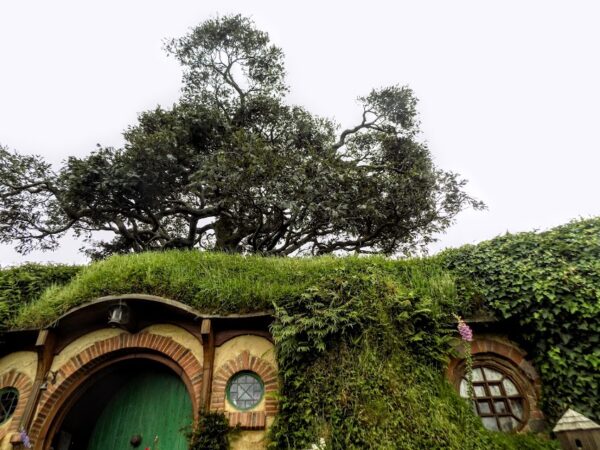
is entirely artificial. It’s constructed of steel, expanding foam, fiberglass, and silicone. It originally had 376,000 silk leaves shipped from Taiwan and individually attached by hand. Because the sun had faded them, they were all repainted 10 days before filming The Hobbit began.
In the years since opening the site to the public, several interiors have been added to the set to enhance the visitor’s experience. There are now two fully furnished hobbit holes
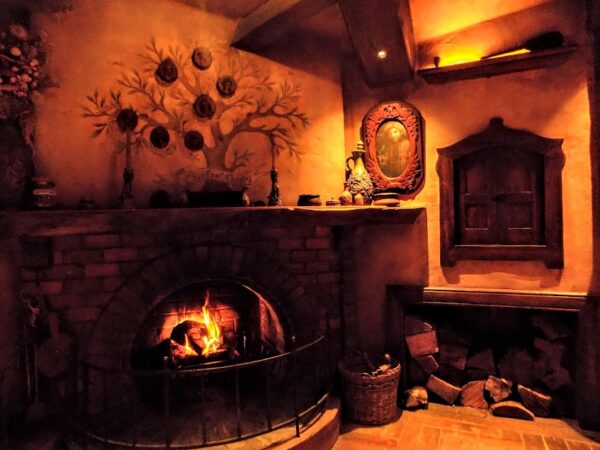
with every aspect of life accounted for,
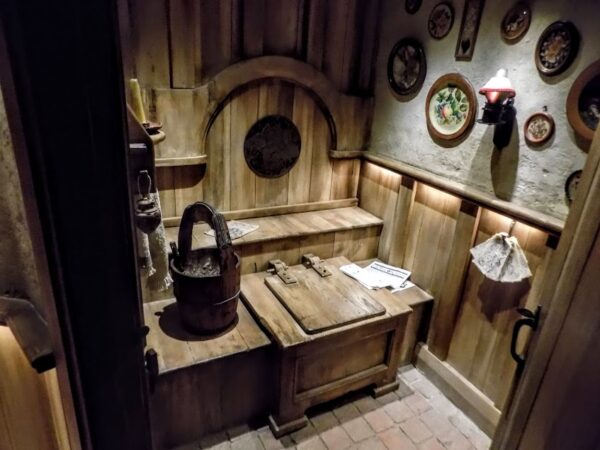
and a functioning Green Dragon Inn (a curious but probably coincidental name choice by Tolkien given the role the Green Dragon Tavern played as a meeting place for Paul Revere and the Sons of Liberty) where visitors are served their choice of Southfarthing Range beverages – two traditional ales, an apple cider, or non-alcoholic ginger beer. (I had the ginger beer. Feel free to ridicule me in a comment.)
Back in Auckland
It can sometimes be difficult to be a traveling tea drinker. It seems that every hotel room has a coffeemaker (that’s rarely cleaned) and dozens of different coffee choices. Then if you rifle through the coffee supplies you might find a lone tea bag. Such was the case in my room in Auckland. I went to the front desk where I asked for some additional tea for my room telling the staff person, “I drink tea like Aussies drink Beer.” Fifteen minutes later he knocked on my door with 13 tea bags for my four night stay. I think that was just about right.
I walked around the corner and had dinner at a restaurant that could have been named with me in mind, Reign and Pour. I had a gently seasoned spinach ricotta ravioli in a creamy mushroom and truffle oil sauce. Twas fine.
Tomorrow, I embark on another Road Scholar tour – this one of Aotearoa. Here are my other Hobbiton photos.
-
It’s just a shot away – Prizren
March 6, 2026 -
Some things looking better, baby – Getting into Kosovo
March 4, 2026 -
Here, where the sky is falling – Kukës
March 2, 2026 -
That’s when we fall in line ’cause we got Berat
February 27, 2026 -
Walking on the big stuff – a climb to Tragjas
February 25, 2026