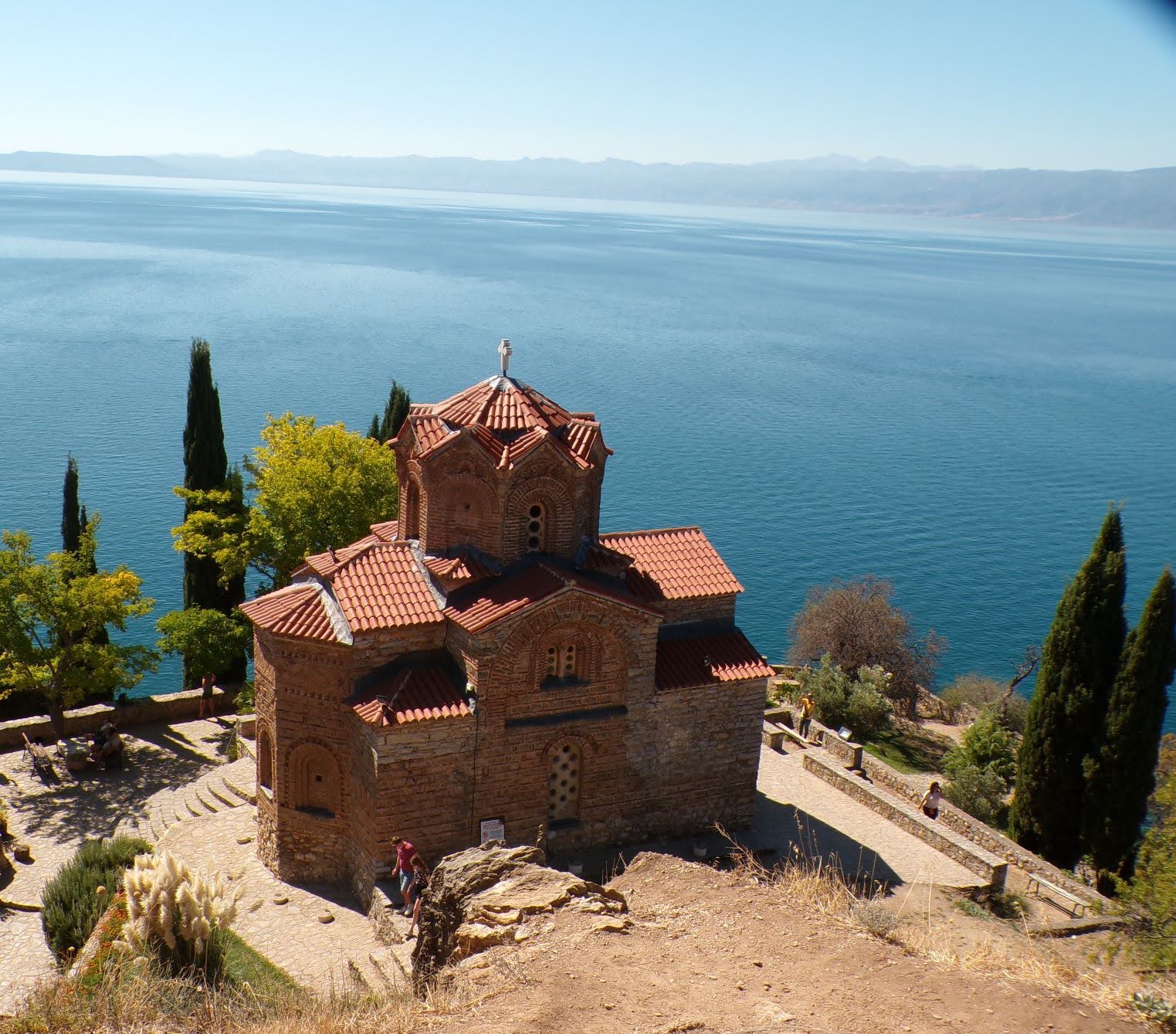
If you’re looking to find a place in the summer sun – Ohrid
If you haven’t discerned it by now, I’ll admit to being a collector and a quantifier. I could have chosen to spend Sunday and Monday in Albania perhaps making a deeper exploration of Tirana or seeking some other places of historical interest rather than making a quick day trip to the neighboring countries of Kosovo (yesterday) and North Macedonia (today). But the Balkan countries are small
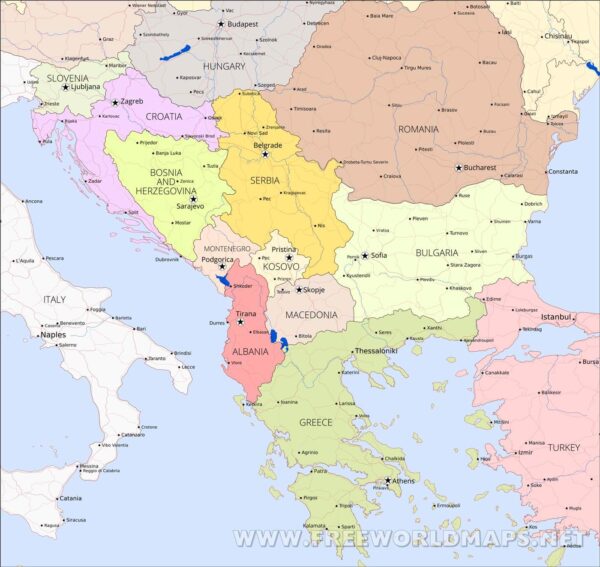
[From Free World Maps]
and it seemed a shame to lose the opportunity to add two more names to the list of countries I’ve visited. (My friend D, who practices international immersion, would probably give me a bit of the side eye for considering a one day jaunt as being more than a mere casual visit to a place. {Actually, she’s too generous a spirit to give me that look. She might think it, though. 😉} I’m not certain even my two weeks in Albania would meet her standard – and, though there’s certainly great value in her preferred travel style, I think there’s value in my didactic, if usually brief, approach as well. Thus, these forays meet my standard – which is spending money and having a meal in a place as long as it’s accompanied by some measure of research so I exit, if not a bit wiser, at least a little more knowledgeable.) So it is that today, I’m off to Ohrid, Macedonia the town by the homonymous lake that’s shared by the two countries.
Including the time to cross the border, we’d need only about three hours to reach Ohrid from Tirana so my review of the country’s history and the lake’s geography will be mercifully brief.
If you’re a fan of the Maryland Terrapins, the man in the photo below from Vratnica is probably the Macedonian with whom you’re most familiar.

He’s Sasho Cirovski and he’s been the head coach of the men’s soccer team in College Park since 1993. If you’re a more general history buff, it’s more likely to be this man,
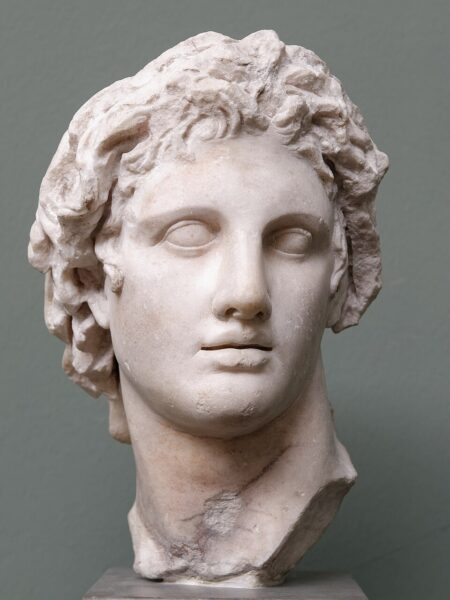
[From Wikipedia – Public Domain]
born in the ancient city of Pella (no window jokes, please) in an area of the Macedonian Kingdom that’s in modern day Greece. His name is, of course, Alexander and he ruled a Great Empire.
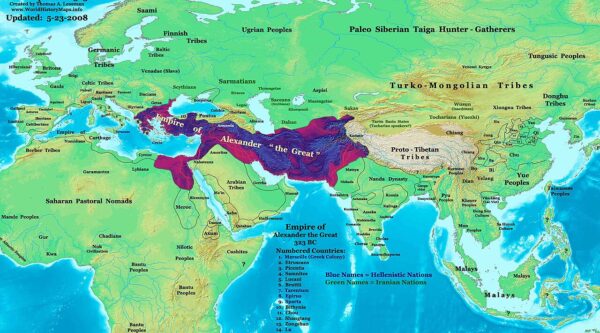
[From Wikipedia – By Thomas Lessman – Own work CC BY-SA 3.0]
Rome conquered the region in the 2nd century BCE, creating the province of Macedonia and integrating the area into wider Roman economic and military networks. After the Roman Empire split in 395, the territory was integrated into the Eastern or Byzantine Empire.
By the late sixth century, Slavic tribes led by the Pannonian Avars began settling in the area of North Macedonia. Then, in the early 7th century, it was colonized by a Slavic tribe known as the Berziti. Bulgaria conquered the city around 840.
The name Ohrid first appeared in 879 and Clement of Ohrid established the Ohrid Literary School in 886 that elevated the city’s position into becoming one of the two major cultural centers of the First Bulgarian Empire. Between 990 and 1015, Ohrid was the empire’s capital and stronghold.
For the ensuing 700 years or Bulgarian, Byzantine, and Serbian states controlled the area but Ohrid remained a political and religious hub. The Ottomans conquered the territory in the mid-14th century and, like its neighbor Albania, it remained under Ottoman rule for more than 500 years before their hegemony ended with the Balkan Wars of 1912-1913. Most of the territory of today’s North Macedonia was then annexed by the Kingdom of Serbia.
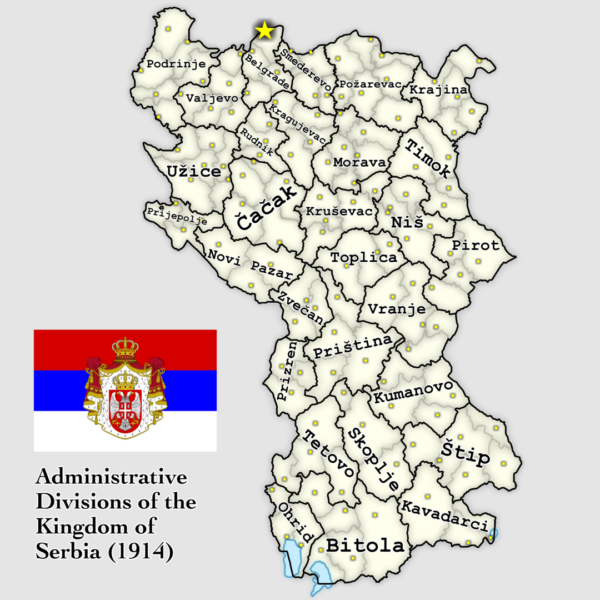
[From Wikipedia – By Kason741 – Own work, CC BY-SA 4.0]
Following World War I, the area became part of the Kingdom of Serbs, Croats, and Slovenes – renamed the Kingdom of Yugoslavia in 1929. In 1945 it became the Socialist Republic of Macedonia within socialist Yugoslavia.
As Yugoslavia disintegrated, North Macedonia declared independence peacefully in 1991. It joined the United Nations in 1993 under the provisional reference FYROM (Former Yugoslav Republic of Macedonia). A naming dispute with Greece prevented it from claiming its preferred name – Macedonia. That dispute was resolved with the Prespa Agreement, and in 2019 the country officially adopted the name Republic of North Macedonia. (As I’d learn on my visit, Macedonians ignore the qualifier “North” – at least they do in Ohrid.)
It’s very, very old
The town of Ohrid is a cultural UNESCO World Heritage Site. The adjacent lake is a natural one and many of its characteristics alone would make it worth visiting. First, Lake Ohrid is a tectonic lake and less than one-quarter of the world’s lakes have formed through this mechanism. It lies in a graben in the Dinaric – Hellenic mountain belt on the border of North Macedonia (248km²) and Albania (110km²) and is larger than the island of Malta. The basin is shaped by active normal faults, making the surrounding area a seismogenic landscape with visible fault scarps, stepped slopes, and localized hydrothermal activity.
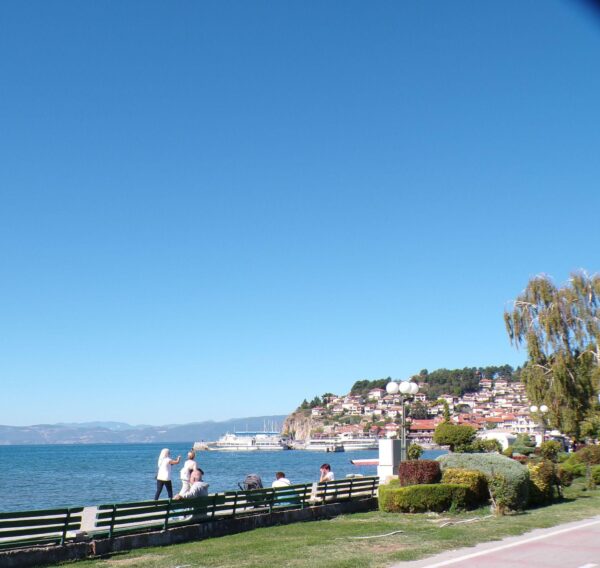
Most lakes on Earth have formed through glacial processes making them geologically young. Tectonic lakes are not and Lake Ohrid is considered to be Europe’s oldest. The lake basin began forming at least 1.9-2 million years ago.
Like most large northern hemisphere lakes Ohrid’s circulation is widdershins along the lake’s shores. These movements are the result of the wind forcing and Coriolis effects. During an average winter, only the top 150-200 meters of water are blended.
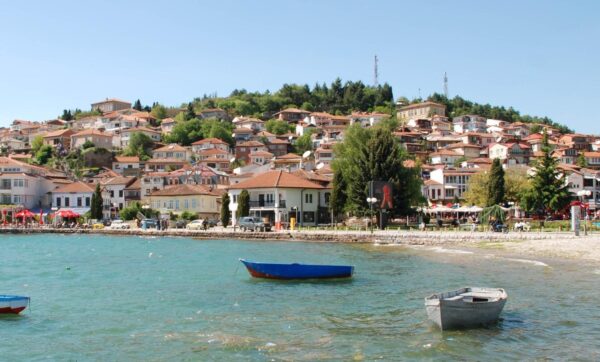
Another of Lake Ohrid’s impressive features is its endemism and is often referred to as the museum of living species. You can find 20 unique species of phytoplankton and sessile algae alone. Of the 21 native fish existing in Lake Ohrid, one-third of them are endemic as are 80% of the 72 mollusk species. And, as you can see from the photos above and below, it’s quite beautiful.
Let me spell it out for you
I noted above that “Clement of Ohrid established the Ohrid Literary School in 886.” This was a crucial development not only for the city but also for literacy. For a period of seven years (between 886 and 893) Clement taught some 3,500 disciples in the Slavonic language using the Glagolitic alphabet. Created by Saint Cyril, it’s the oldest known Slavonic alphabet. In 893, at the behest of the Bulgarian ruler Knyaz Boris, Naum of Preslav (also called Naum of Ohrid) joined Clement in Ohrid. Naum established a monastery near the town and together Naum and Clement developed the Cyrillic alphabet we see predominantly used in Slavic speaking countries.
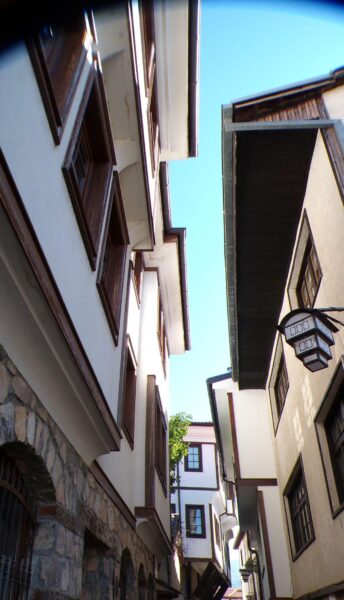
We had a nice walking tour of the town of Ohrid with a local guide. She pointed to the distinctive architecture.
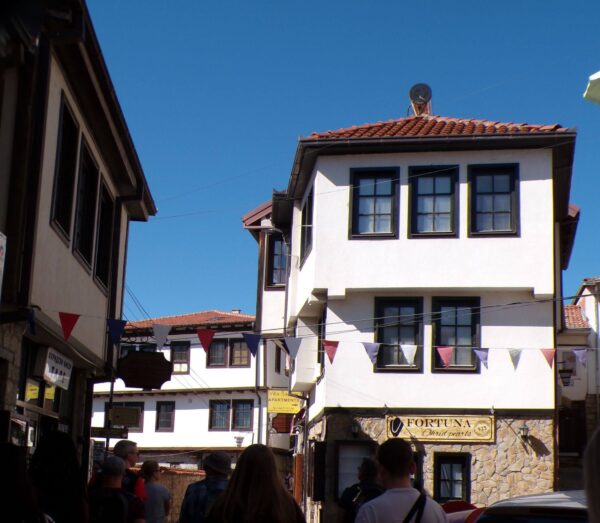
where even the streetlights mimic the inverted structure with the upper floors extending beyond those below.
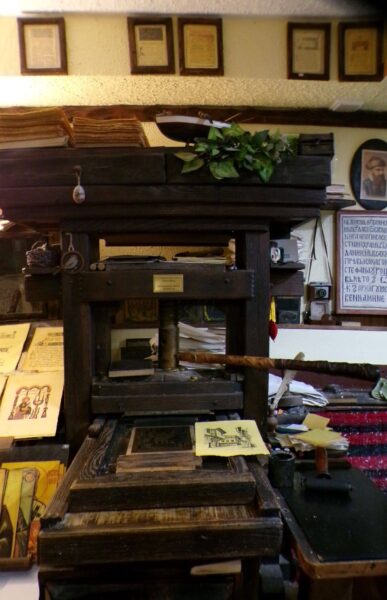
Ohrid also features one of the world’s seven workshops for hand made paper. Not only that, but you can also see a functioning 15th century Gutenberg printing press.
She took us to the Ancient Theater of Ohrid. Dating to the late 3rd or early 2nd century BCE and constructed during the Hellenistic period, it’s the only such theater in Albania. Originally built into a hillside to present Greek dramas, the Romans modified it to host gladiatorial games in the second century. While only the lower seating remains today,
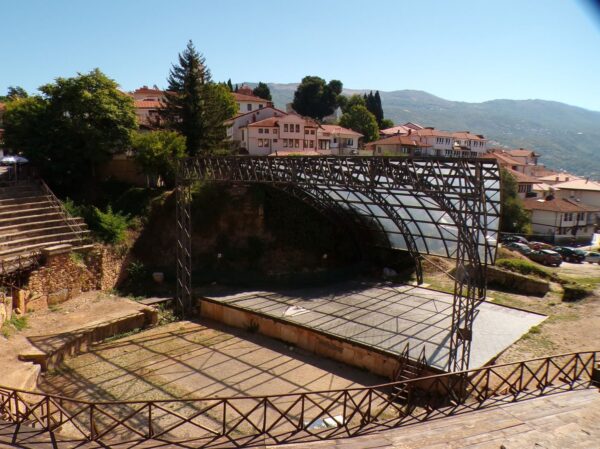
its core design remains distinctly Hellenistic and, as you can see, it does host modern events.
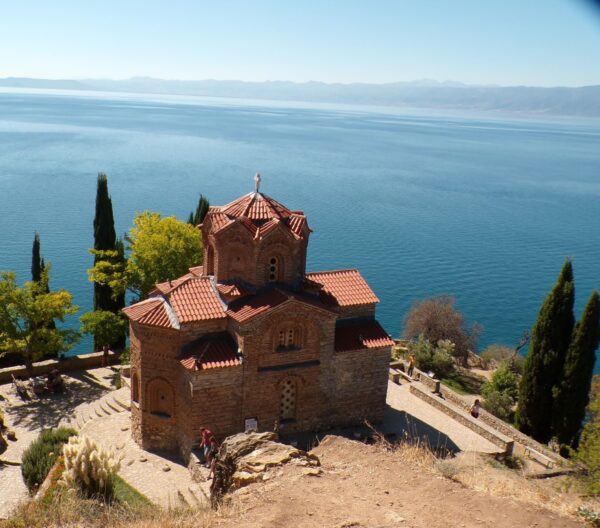
Ohrid is also known for its churches and it’s said there were once 365 in the small city. We visited two of them – the grounds of the famous St Sophia Church and we also climbed the hill to try our best to duplicate a famous picture of the Church of St John at Kaneo. (It’s here. Scroll down the page at the link to see it.)
During her tour, our guide made a point of telling us how, as a Slavic language, Macedonian has no words in common with Albanian. Now, I’d learned that Albanian is a unique and isolated branch of the broad group of Indo-European languages but I found it hard to believe her claim. Of course, being the pedant I am, by the end of our hour-and-a-half tour, I found two words that are essentially the same in the two languages. The first is beach. I’d noticed in Orikum or Durres that beach in Albanian is plazhi (PLAH-zhi) and noted its similarity to Portuguese (praia) and Spanish (playa). In Ohrid, I saw this on a sign for a beach плажа (PLAH-ZHA). And, of course, there’s also my favorite beverage – tea in English. Chá in Portuguese. Çaj (chai). And чај (chai) in Macedonian.
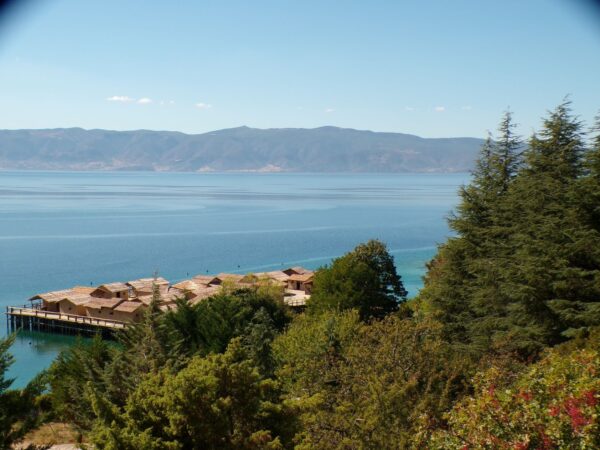
Three of us on the tour shared a pleasant, if less than gastronomically memorable, lunch at a restaurant with an open air patio overlooking the lake. We left after lunch and made two lakeside stops on our return. One at the Gulf of Bones – a reconstructed prehistoric palafitte settlement from the Late Bronze & Early Iron Ages –
and the other at the shockingly commercial monastery built by Saint Naum.
And thus ends my day in North Macedonia. Tomorrow I’ll share the tale of a rather miraculous bus ride to Sarandë. A few unpublished photos remain. And they’re here.
-
Photos and their stories – Lisbon – Summer 2026 part two – plus an egg-straordinary bonus
August 21, 2026 -
Photos and their stories – Lisbon – Summer 2026 – part one
August 21, 2026 -
The indigenous people of Da?ow?aga? (Olympic Valley and me supplement three)
August 19, 2026 -
The indigenous people of Da?ow?aga? (Olympic Valley and me Supplement two)
August 17, 2026 -
Olympic Valley in the time before humans (Olympic Valley and Me Supplement one)
August 14, 2026