Humans arrive near Antwerp (Antwerp and me supplement two)
Those of you who have read any of my previous discussions of human evolution know that I generally adhere to the dominant paradigm which is the Out of Africa hypothesis. This posits that ancient human ancestors arose in Africa and, over millions of years, migrated first to Eurasia, then likely to Australia (based on what I learned of newly discovered archaeological evidence during and after my November 2024 trip there), and, over time, finally reached the Americas. A recent article on the site Phys.org tested the Out of Africa hypothesis against the Multiregional Model that proposes “that modern humans evolved from archaic populations in multiple regions simultaneously.” As this dispersal pattern shows,
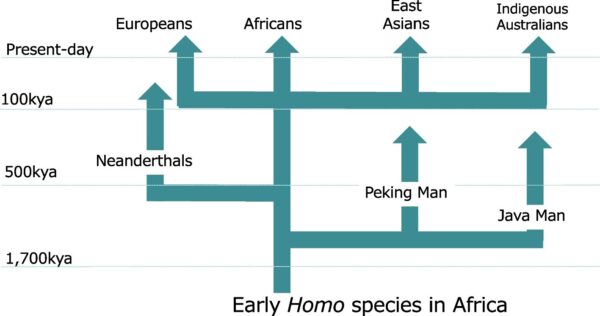
[Diagram from the Journal of Physiological Anthropology (2025). DOI: 10.1186/s40101-024-00382-3.]
the best interpretation still leads to an African origin.
The map below shows what most believe is the likely migration pattern.
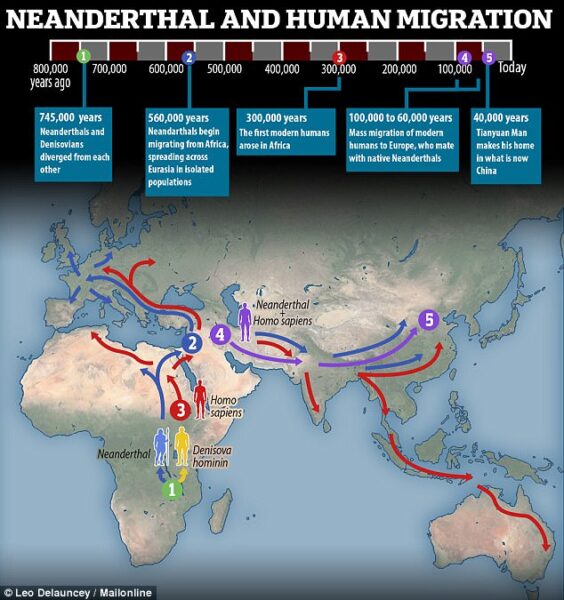
[From Daily Mail]
They conclude that, “Evidence confirms that modern East Asians descended primarily from southern route migrants, while Native Americans and Northeast Asians exhibit a mix of northern and southern ancestry, all with arrows that point to a shared African starting point.”
Those of you who haven’t read these previous entries now have a baseline for the information that follows. However, you also need to keep in mind that anthropology, like all good science, is itself evolving and hypotheses will mutate based on new evidence. In the case of anthropology, much of this evidence stems from advances in genetic sequencing technologies.
For example, until a 2019 study by the Max Planck Institute for Evolutionary Anthropology the commonly accepted timeline for the point when modern humans diverged from Neandertals was between 300,000 and 500,000 years ago. This study, using 430,000-year-old bones from the Sima de los Huesos
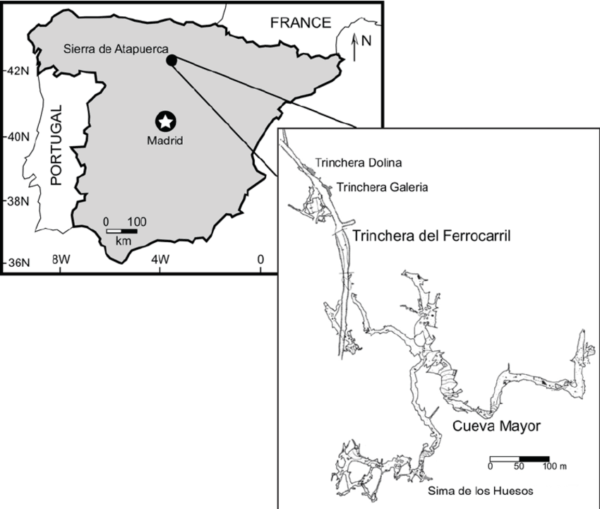
[From Research Gate uploaded by Robert S. Feranec]
site in northern Spain, presents considerable evidence that moves this divergence much further into the past – closer, in fact, to 800,000 years. (This would move the split on the chart above chronologically closer to the time of the Peking and Java Man divergence.) Thus, time and continued scientific exploration could alter the scenarios I present below.
As Neandertals populated Eurasia, they were particularly peripatetic when the climate for mobility was advantageous. While some Neandertals traveled west, as evidenced by the cave in Spain, others continued to the north and east. Current best evidence suggests that the first H neanderthalensis populations to reach western and central Europe likely traveled west from the Caucasus. They would have followed the river valleys of major river systems such as the Danube, Rhine, and Meuse – the last of which is the largest river flowing through Belgium – that would have provided resources, relatively easy terrain, and the most direct access to the Ardennes.
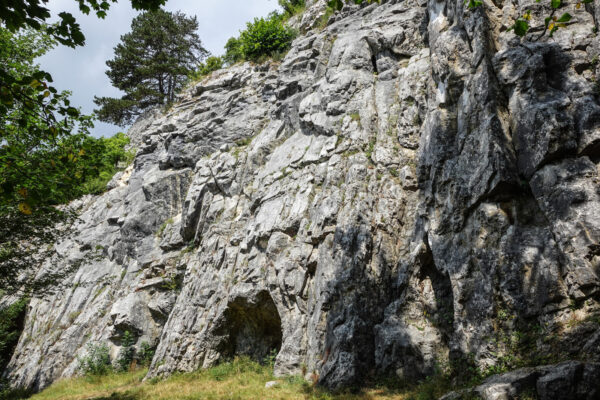
The earliest evidence for human population in the area sprouts in the Goyet Cave system some 75 kilometers south of Brussels and dates to approximately 120,000 years ago.
[From Visitwallonia.com]
Other Neandertal artifacts found at Engis about 20 kilometers east of Goyet and dating to 100,000 years BP show that they likely maintained a sustained presence in the region. These arrival dates are supported by their correspondence with Marine Isotope Stage 5e that occurred between 130,000 and 115,000 years ago.
(Marine Isotope Stages (MIS) are alternating warm and cool periods in the Earth’s paleoclimate that are deduced from oxygen isotope data derived from deep sea core samples. In 1947, Harold Urey wrote a paper hypothesizing that the ratio between oxygen-18 and oxygen-16 isotopes in calcite, the main chemical component of the shells and other hard parts of many marine organisms should vary depending on the prevailing water temperature in which the calcite was formed.
In 1967, Nicholas Shackleton, building on the pioneering palaeoceanographic work of Cesare Emiliani, suggested that the fluctuations over time in the marine isotope ratios were caused mainly by changes in the volume of icesheets which, when they expanded, took up the lighter oxygen-16 isotope in preference to the heavier oxygen-18. Further study showed that the isotope cycles corresponded to terrestrial evidence of glacial and interglacial periods.
Working backwards from the present, which is MIS 1 in the scale, even numbered stages with their levels of oxygen-18 represent cold glacial periods, while the odd-numbered stages represent warm interglacial intervals. Emiliani developed the timescale in the 1950s and it’s now widely used to delineate dates in the Quaternary period.)
The most recent and abundant evidence of a Neandertal presence at Goyet has been tagged with an age of 40,000 – 45,000 years. It has provided some potentially surprising insights into Neandertal cultural practices of the time. You can watch a short video about Goyet here.
These same caves provide the earliest evidence for anatomically modern humans (Homo sapiens) in Belgium indicating their presence beginning between 35,000 and 40,000 years ago. It’s associated with the Aurignacian culture. The oldest Aurignacian occurrence found in Belgium to date is a bone point from Spy Cave less than 30 kilometers west of Goyet. It has been directly dated to between 38,100 and 36,500 years BP.
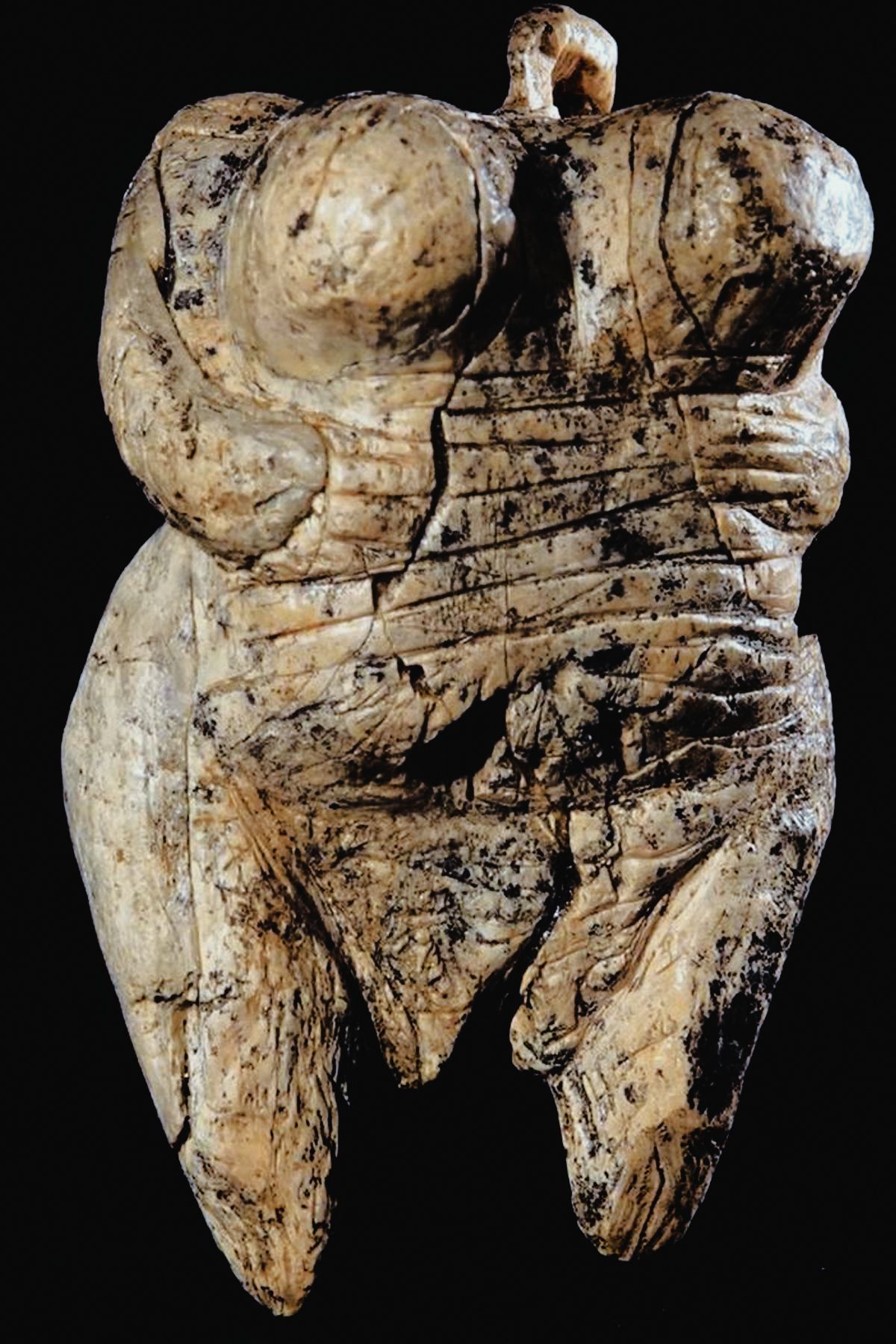
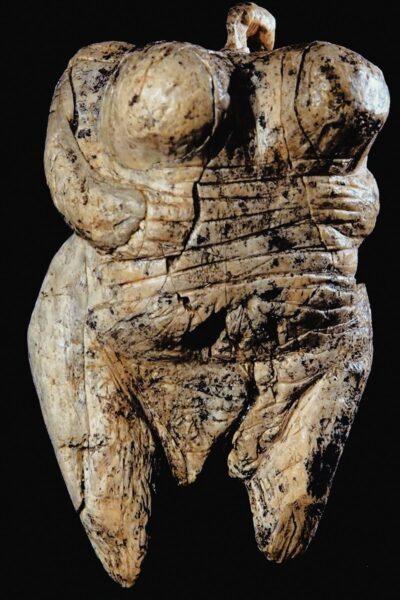
(The full Aurignacian culture is believed to have arisen in the Bükk Mountains in far eastern Hungary between 43,000 and 39,000 years ago. In fact, travel a mere 500 kilometers or so south from Goyet to Hohle Fels at Schelklingen and you’ll reach the location where someone in the Aurignacian culture carved the earliest undisputed human sculpture – the Venus of Schelklingen.)
[From Bradshaw Foundation]
These findings place Belgium among the earliest sites in northwestern Europe with confirmed modern human habitation and demonstrates that both H neandertalensis and H sapiens coexisted in the area. However, the current archaeological record doesn’t show clear evidence of direct interaction or long-term coexistence at these specific sites even though other sites have shown that the species shared tool technologies and DNA sequencing has proved that the two populations clearly interbred.
In fact, studies published in late 2024 concluded that this interbreeding lasted for nearly 7,000 years. Although some speculation estimated that interbreeding between Neandertals and early modern humans began as long as 54,000 years ago, estimates arising from rigorous studies calculated an average start of 47,000 years ago. Since the Neandertal population began disappearing about 43,000 years ago, this would have meant the interbreeding period lasted for only three or four thousand years. Some fascinating new studies, summarized here, indicate that H sapiens and Neandertals began interbreeding more than 50,000 years ago thereby extending the period to 7,000 years.
Finally, I’ll note that had this evidence been available 45 or 50 years ago, it would likely have caused a substantial change to Jean Auel’s massively popular Earth’s Children series. This evidence of prolonged interbreeding between H sapiens and Neandertals makes it unlikely that either Ayla’s son Durc or Rydag (who appears in the book titled The Mammoth Hunters) would have been viewed as abominations. Works of fiction can sometimes be more enlightening than reality. Oftimes, though, science wins the day.
-

Photos and their stories – Lisbon – Summer 2026 part two – plus an egg-straordinary bonus
August 21, 2026 -

Photos and their stories – Lisbon – Summer 2026 – part one
August 21, 2026 -
The indigenous people of Da?ow?aga? (Olympic Valley and me supplement three)
August 19, 2026 -
The indigenous people of Da?ow?aga? (Olympic Valley and me Supplement two)
August 17, 2026 -
Olympic Valley in the time before humans (Olympic Valley and Me Supplement one)
August 14, 2026