walking up and down, walking up and down
At the end of the previous post, i was barely halfway through my first full (second overall) day in Melbourne and, before the day was over, my feet were going to cover more ground than I’d imagined. Happily, as the day approached lunchtime, the dreary fog of the morning had lifted portending sunshine and warmth all-around. The first order of business was to grab a bite of lunch and when I walked past this storefront
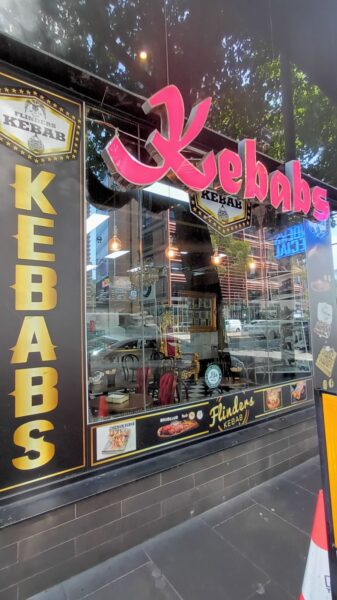
I felt compelled to stop here as a bit of a shout out to E because we’d eaten many kebabs on our train adventure. From there, I was off to
Fitzroy Gardens.
My old friend Atlas Obscura had pointed me to many curiosities in Melbourne and one of them was Fitzroy Gardens. Named for the tenth governor of New South Wales, development of the site, which had been set aside as a reserve in 1848, into a more formal garden began in earnest after another of Australia’s gold rushes that began in the 1850s and would spur significant growth for Victoria’s capital city.
I snapped a few photos upon entering the park but my first point of interest was Captain Cook’s Cottage. The British explorer Captain James Cook should be familiar enough to most readers that I will eschew a detailed biography but will remind readers that Cook’s expedition on the Endeavour was the first recorded European encounter with Australia’s east coast on 19 April 1770 and that ten days later he sailed into what he eventually named Botany Bay.
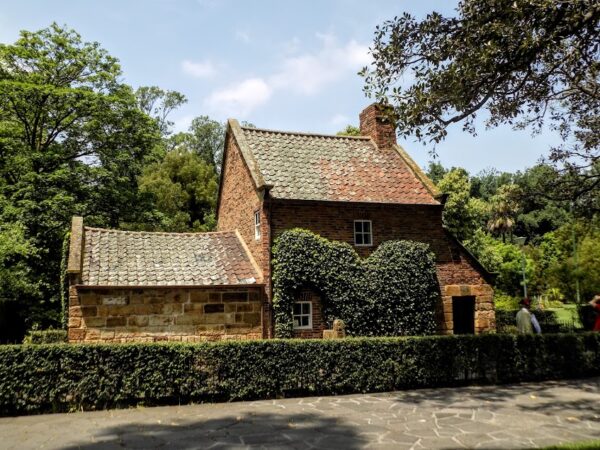
I’m not so interested in Cook that I was willing to spend the time or the money to venture inside but happily snapped a photo of what might or might not have been his childhood home that had been disassembled and shipped to Australia as a gift to the people of Victoria from Sir Russell Grimwade in 1934.
Trees scarred and decorated and a miniature village
(No one seems to think that I fit in)
My next stop was at the Scarred Tree – one of six Aboriginal “scarred” or culturally modified trees identified within the City of Melbourne. Culturally modified trees where bark has been shaved off to make canoes, containers, shields, and temporary shelters are common in Australia but less common in its large cities and since this one was nearby,
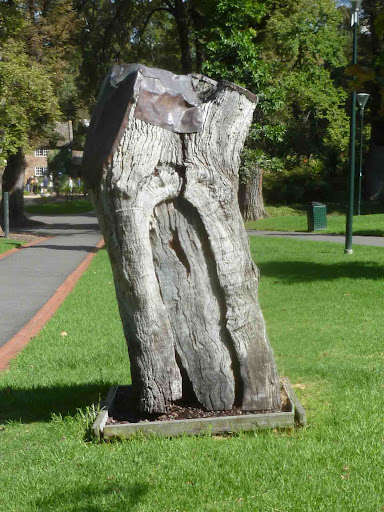
worth a short detour.
I walked from there to look at another gift from an English man to Melbourne, the model Tudor Village where I not only took some photos but had a lovely chat with a magpie.
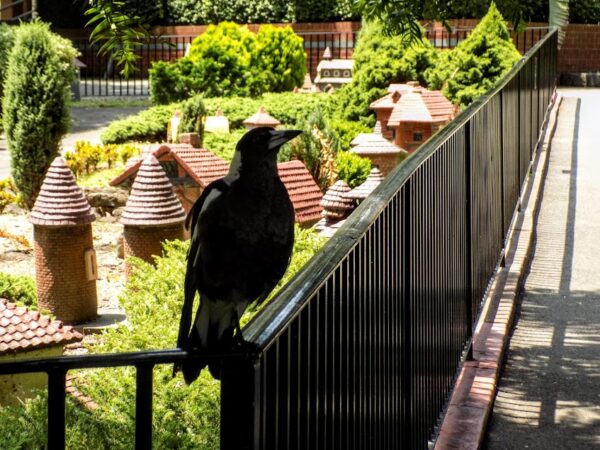
According to AO,
The citizens of Lambeth, a district in South London, England, decided to raise funds for this gift. In 1948, the village was sent from London and placed in one of Melbourne’s many parks. It was designed by Edgar Wilson, a 77-year-old retired pensioner, who modeled the houses after a traditional English village from the Tudor era.
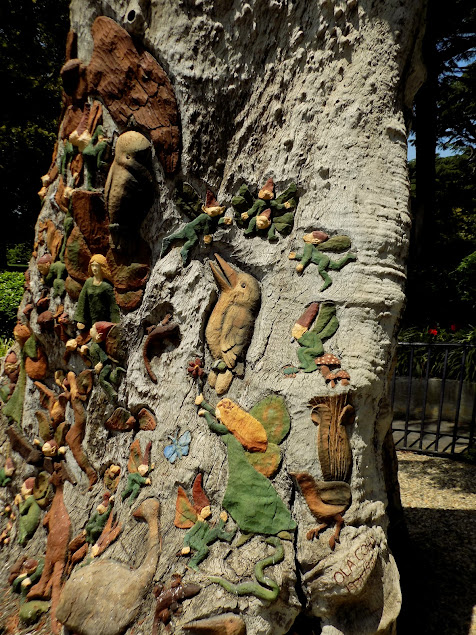
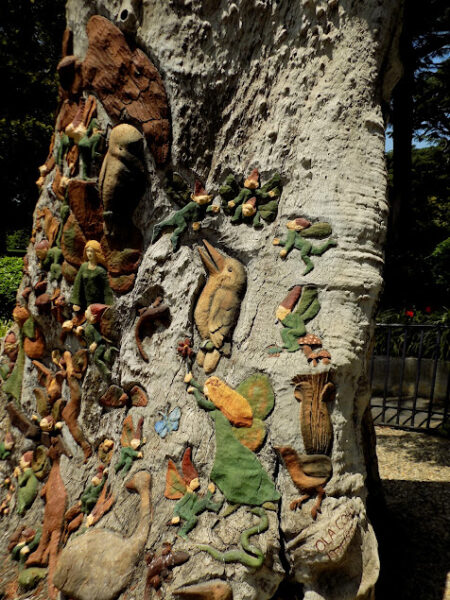
Close by this village was The Fairies’ Tree that is the work of children’s book author Ola Cohn. A plaque by the tree taken from the foreword of her book by that name reads, “I have carved a tree in the Fitzroy Gardens for you and the fairies, and those who believe in them. For they will understand how necessary it is to have a fairy sanctuary – a place that is sacred and safe as a home should be to all living creatures.”
From Fitzroy I was off to another urban green space – nearby Carlton Gardens. This wasn’t one of AO’s prompts but it is listed as a UNESCO World Heritage Site and, since I’d been to so many others, I thought this would be an easy addition to that list (not that I’m keeping one).
As I noted above, Melbourne had a significant adolescent growth spurt spurred by the gold rush that began in 1852. It’s estimated that the population grew from 25,000 to 40,000 in a matter of months. The city’s wealth also substantially increased and by the late 1870s, the local powers wanted to showoff their newfound wealth and urbanity. Thus, Melbourne held an International Exhibition in 1880 and the centerpiece was the Royal Exhibition Building in Carlton Gardens.
UNESCO explains why it is designated a World Heritage Site,
Inscribed on the World Heritage List in 2004, the Royal Exhibition Building and Carlton Gardens reflects the global influence of the great International Exhibitions of the nineteenth century that intensified industrialisation and international trade.
and since none of my photos capture the enormity of this building, here’s one from What’s On Melbourne
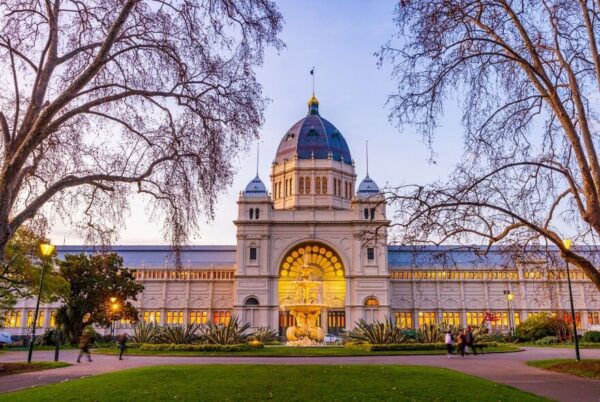
that does a better, if still imperfect, job.
My decision to walk out to Collingwood to see Keith Haring’s famous mural that was mentioned in the previous post turned out to be one of mild regret. It’s not that the wall was uninteresting,
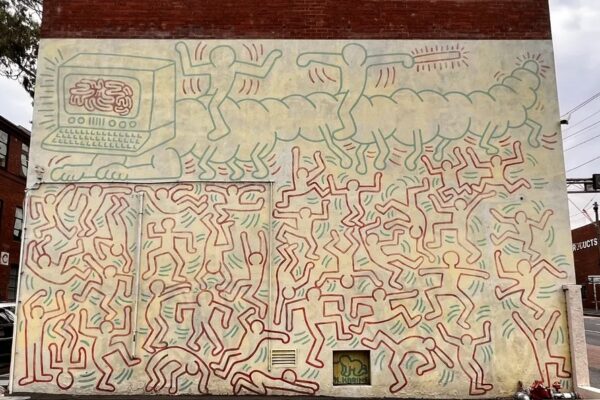
it was the additional three kilometers or so it added to my walk.
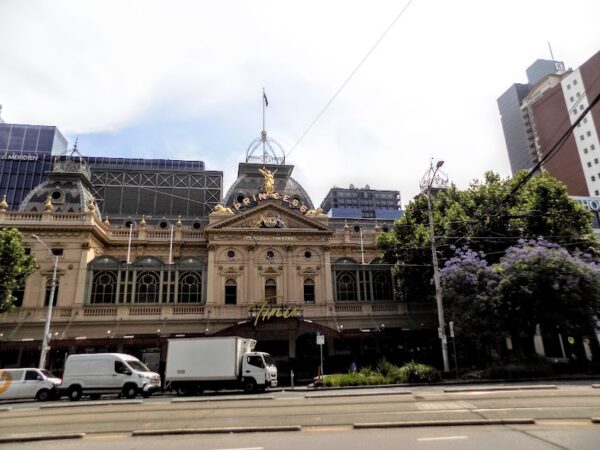
Fortunately, a feature of Melbourne’s tram system would twice rescue me. On my way back toward the CBD and my hotel, I stopped to take a picture of the Princess Theatre and the Parliament of Victoria – the former because I found the building intriguing and the latter because as long as I was walking past it, I thought I should.
It’s something of a happy accident that the theatre was one of the AO attractions that hadn’t made my list. Once again, here’s a portion of their description,
The grand Princess Theatre in Melbourne, aside from being one of the oldest landmarks in the city, is no stranger to superstitious ghost stories. A seat in the dress circle is still kept open every opening night for the spirit of noted Gilbert & Sullivan opera singer Frederick Baker, who died in the theater.
On March 3, 1888, “Federici” (as he was known) was performing the role of Mephistopheles in Faust when he had a heart attack while descending down the trap door into “Hell.” It was certainly a creepy coincidence, but when (sic) rest of the cast came off stage they were shocked to hear that Federici had died: They’d all just been alongside him while they were taking their bows on stage.
No petrol but a delicious supper
Unlike my time on the RS tour, I had to be prepared to find all my own dining options for my time in Hobart and Melbourne. I’d had DB’s help Monday night and decided Tuesday to try a restaurant the featured Aboriginal cuisine albeit with some modern twists. Thus I came to Big Esso at Mabu Mabu founded by Nornie Bero of the Komet Clan of the Meriam People in the Torres Strait. The restaurant is located on Federation Square across from Flinders Street Station.
I’d dragged myself back to my hotel to freshen up and have a brief rest because I’d walked close to 20km on a warm day and I was a bit worn out. It was here that Melbourne’s tram system provided wonderful assistance. You see, it’s free within the CBD and the stops leaving the hotel and arriving near the restaurant were both no more than 100 or 150 meters from the respective locations.
I had Cassava and native thyme with roasted saltbush for my entree and Naarm mussels in eucalyptus smoked butter with preserved kumquat and sea blite as my main.
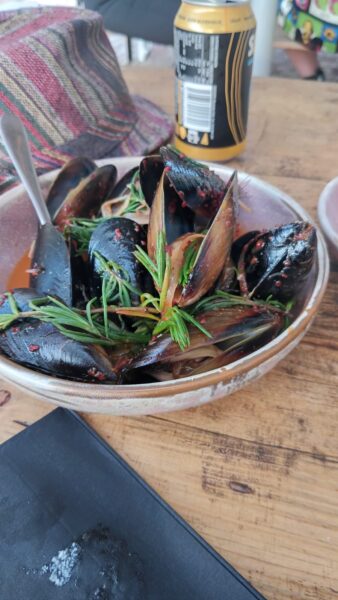
The canned drink in the background is Sobah – a non-alcoholic lemon aspen Czech style pilsner. It was an excellent (not inexpensive but excellent) dinner.
I was still feeling tired from the extended walking of the day so I rode the tram back. On this particular ride, the trolley driver, who sported a big handlebar moustache, greeted all the riders singing, “Welcome to the tramily.” He followed that by singing any number of familiar Christmas songs and complimented my hat when I left the tram.
As it turns out, there was yet one more AO object that came into my vision daily because it was on the corner just outside the Grand Hotel. It’s an installation called “Raising the Rattler Pole—The Last of the Connie’s” by David Bell. AO calls it “an ode to Melbourne’s last W-class “rattler” tram.”
You can see it, an all the other pictures I took this afternoon by using this link.
-
Photos and their stories – Lisbon – Summer 2026 part two – plus an egg-straordinary bonus
August 21, 2026 -
Photos and their stories – Lisbon – Summer 2026 – part one
August 21, 2026 -
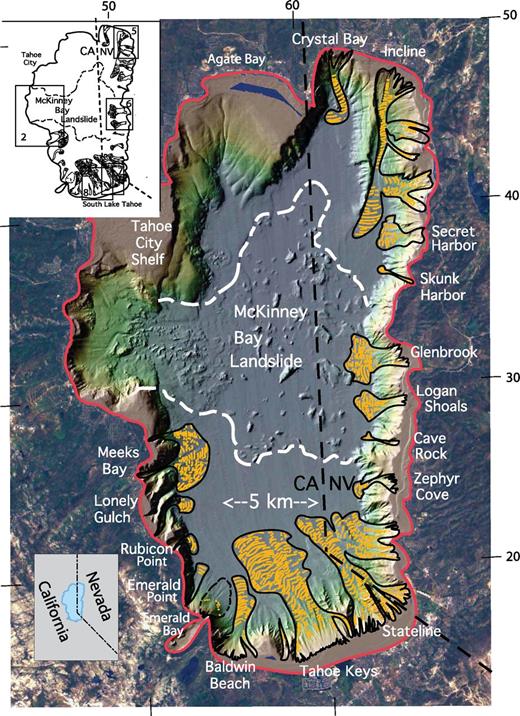
The indigenous people of Da?ow?aga? (Olympic Valley and me supplement three)
August 19, 2026 -
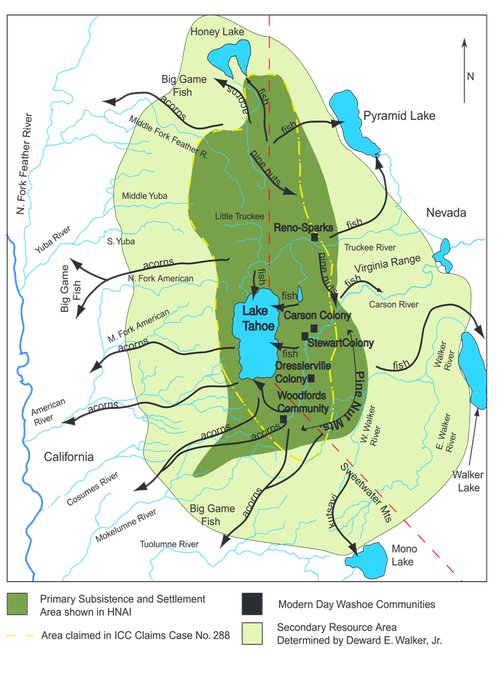
The indigenous people of Da?ow?aga? (Olympic Valley and me Supplement two)
August 17, 2026 -
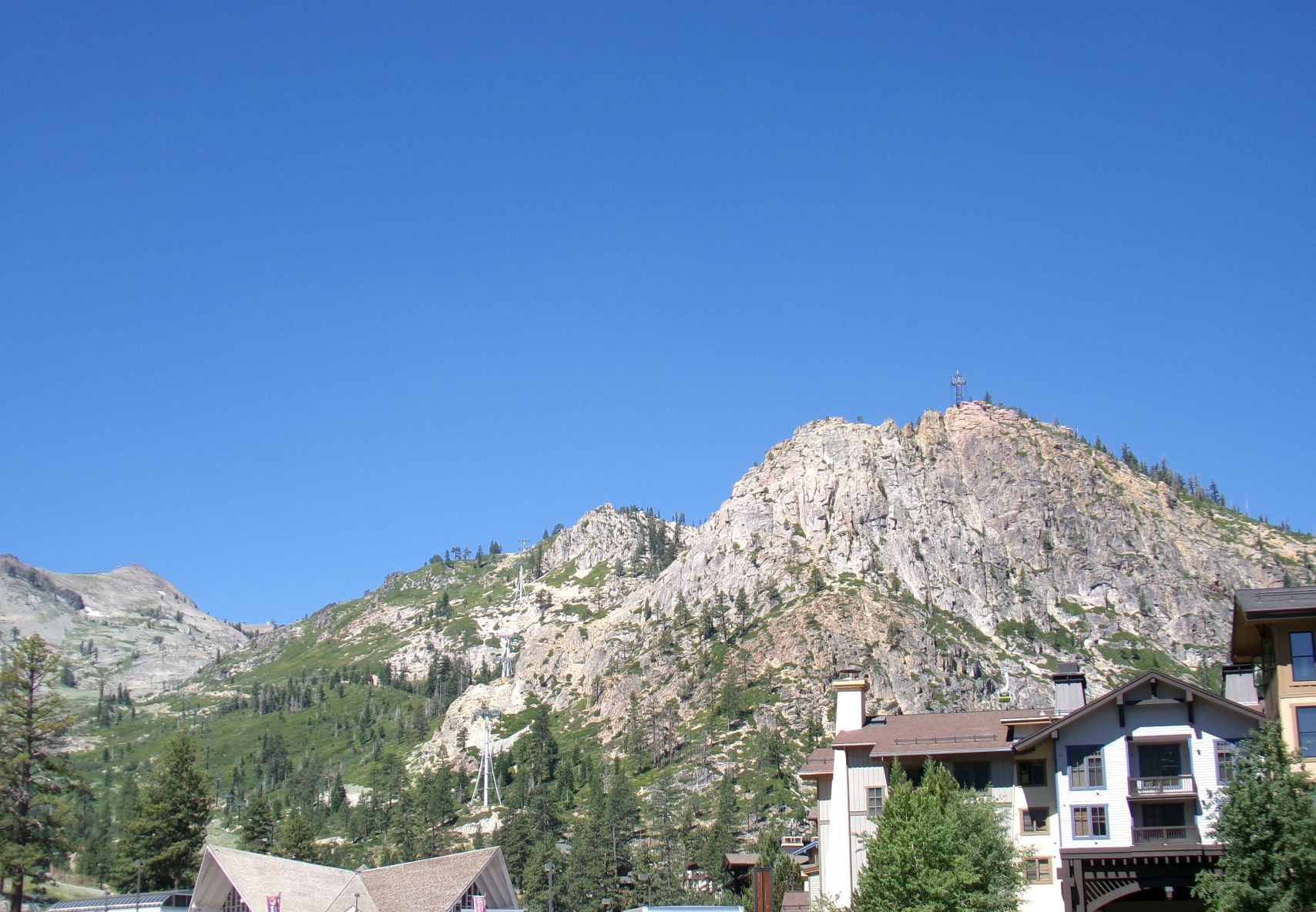
Olympic Valley in the time before humans (Olympic Valley and Me Supplement one)
August 14, 2026
2 responses to “walking up and down, walking up and down”
This was an interesting read Todd, during my lunch today.
I knew about one or two places here that you mentioned.
A old English sailor I follow on U-Tube visited two places you did.
Cool history and way to much walking too. Thanks.
It was a lot of walking. But, that’s what I do. And I hope you’re enjoying that cold one after a hard morning’s work.