Through the ripples how they shine – a day in Frankfurt
I awoke Saturday morning and stepped out of the hotel carrying the list I’d assembled of places to see in Frankfurt into a surprisingly underpopulated urban canvas. I inhaled deeply as a feeling of leucocholy descended through the smur that seemed to be keeping this city of three-quarters of a million people under a soporific duvet. Then I realized that this paucity of people provided a superior photographic setting and jauntily started my burghal walk.
It may seem a bit frivolous to have simply planned to walk around the city seeking specific photo-ops. This meant I’d forgo many of the cultural attractions the city has to offer but I hold a firm belief that walking through a city is the optimal path to absorbing a sense of the place. And I only had one day in Frankfurt to accomplish this.
Previously on this trip I’d determined that Brussels was the city of -pis statues – having sprouted more of them than one might expect – and that Antwerp was a city apparently obsessed with hands. I was about to discover that Frankfurt is a city of fountains. I don’t often take issue with the descriptions I read on Atlas Obscura and, in truth, perhaps I should have paid closer attention when I read this,
Frankfurt, a city so rich with bustling businesses also holds a strong card in the arts with its beautiful, carved fountains poignantly placed in parks and in front of special monuments. A favorite pastime of Frankfurters is touring each of these fountains, especially those designated as “Wishing Wells.” These four wishing wells include the Marshall Brunnen (Fountain), Gutenberg Monument, Operaplatz (Opera Plaza) Brunnen, and Liebfrauenberg Brunnen.
When I plotted a walking route on my Organic Maps App, I saw that I’d take them in a slightly different order. The Marshall Brunnen

was closest to the hotel and the Lucae Fountain at Operaplatz was just a few hundred meters beyond that.

The next stop on my wishless wishing well list was the Gutenberg-Denkmal in in Roßmarkt

and I’d finish with the Liebfrauenberg Brunnen outside the Kleinmartkhalle that would undergo a shocking transformation by the time I’d return for lunch.

From there it was a short walk to the famous Römerberg where, along with the restored medieval style buildings one can spy the Gerechtigkeitsbrunnen (Fountain of Justice)

This particular fountain donned a very different robe during imperial elections and coronations. (Recall from the previous post that the “Golden Bull of 1356 designated Frankfurt as the permanent city for electing German kings (Holy Roman Emperors‑elect)”). In those instances Römerberg became the place to be in part because the people would be served Ochs am Spieß or ox on a spit and wine replaced the water in the Gerechtigkeitsbrunnen.
A quick internet search led me to a few other walkable brunnens and thus I could continue my “fountainous” tour of Frankfurt but first I had a short detour to the Old Jewish Cemetery. This is the second oldest Jewish cemetery in Germany. It’s believed to date to the 12th century but the oldest extant tombstone is from 1272. (The oldest Jewish cemetery in Germany and in Europe is in Worms where the oldest visible headstone is from 1076.)
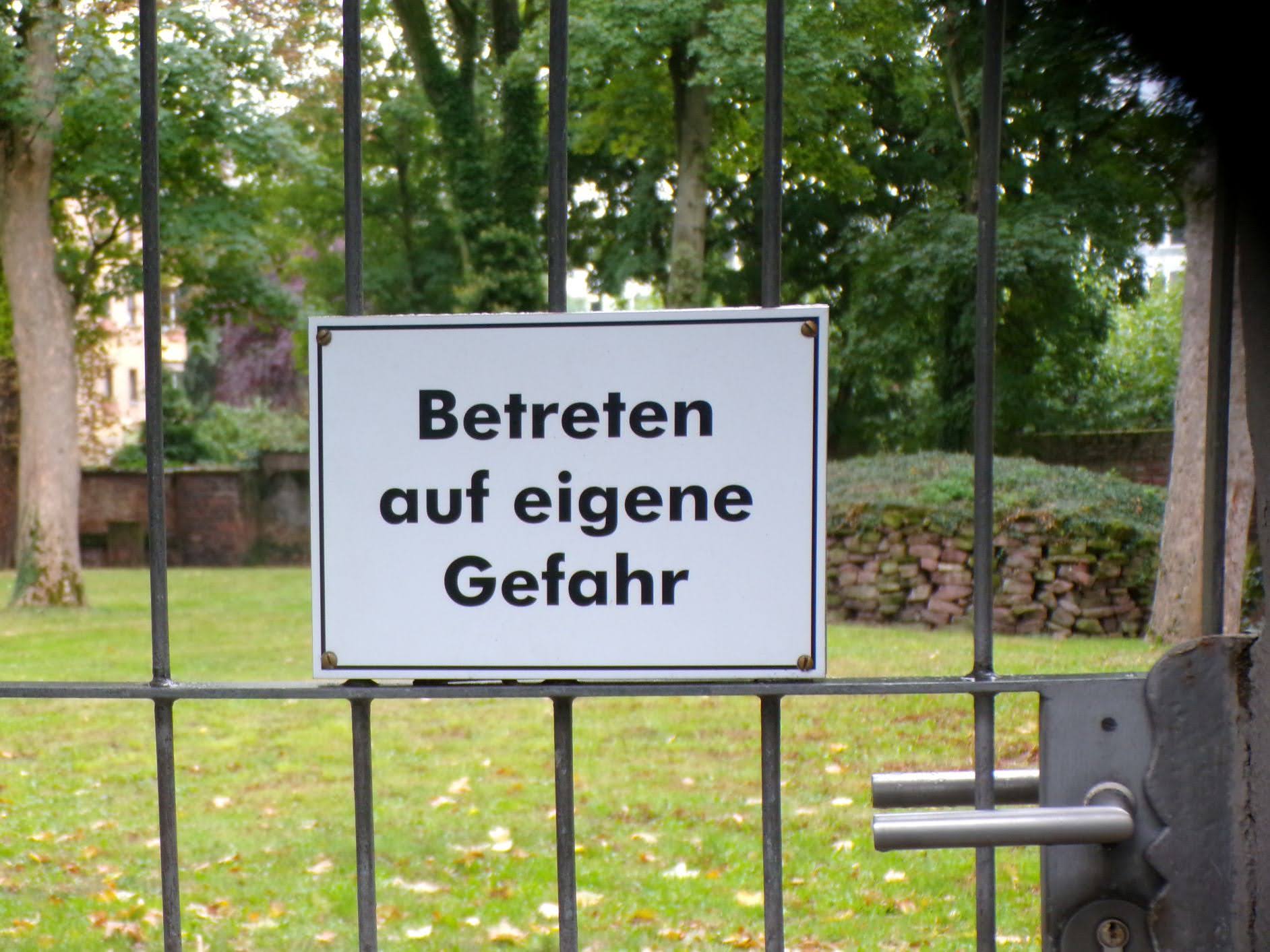
I didn’t want to risk entering the cemetery

(You can obtain a key to the gate from the adjacent Museum Judengasse) but I did circumnavigate its enclosing wall that’s marked with name blocks commemorating nearly 12,000 Frankfurt victims of the Nazi mass murder of European Jews.

Three more fountains. Still no coins
I had four more fountains I though I could walk to and I managed three of them before lunch. They were, in sequence, the Brockhaus-Brunnen, the Struwwelpeter-Brunen (Shock-headed Peter), and the Freßgass-Brunnen. Of the three, only one enchanted me – Shock-headed Peter.
Der Struwwelpeter is the title of a German children’s book first published in 1845. The author was a well-known physician – Dr Heinrich Hoffman. The original book had six rhymed and illustrated stories with children protagonists. Wanting to impart a moral lesson, Hoffman’s stories, like most German fairy-tales of the time, didn’t have happily ever after endings. Hoffman’s punished his misbehaving children. (The original stories collected by the Brothers Grimm, were, indeed, quite grim.)
Atlas Obscura which curiously doesn’t feature the fountain but does have an article about the book describes one tale.
One of the most famous stories is “The Story of Little Suck-a-Thumb,” a boy named Konrad who was warned not to suck his thumb, lest Scissorman come and cut it off. But he can’t resist. He puts his thumb into his mouth and, lo and behold, the terrifying Scissorman appears and snips off the offending digit. This morbid creature quickly entered the canon, and appeared later in diverse texts such as W.H. Auden’s poetry and Tim Burton’s Edward Scissorhands.

The hare isn’t an artistic flourish. It was a featured character in one story.
Lunch and the afternoon
I’d walked plenty in the morning and, since I’d skipped breakfast, decided I’d earned a decent lunch. I’d read about the Kleinmarkthalle and had passed it earlier when I walked by the Liebfrauenberg Fountain. Sometimes these markets, such as the Time Out section of the Mercado da Ribeira in Lisbon, are geared to the tourist trade and sometimes they’re authentically local. This had looked like (and proved to be) the latter.
As I got closer to the market, I noticed the clouds thinning but the crowds thickening and could hear loud music that had been absent earlier in the day. By the time I reached the square neither the crowd nor the music were much to my liking. I was initially puzzled but soon realized that it was the last Saturday in September. I’d stumbled into Oktoberfest.
I try to maintain a youthful outlook but I’ve long passed the time when I find it pleasant to be in the midst of a crowd where many people are fuzzled or on their way to that state, where they shuffle along oblivious to anyone not in their immediate circle acting as though their compotation is all-important.
I found my way into the market and, hindered by the crowd, shuffled with them along the two lengthy main aisles before turning back at a stall that served Indian food. It was perfectly acceptable but I simply wanted to eat and leave. Which I did.
I had one more fountain to see on the north side of the Main. The Märchenbrunnen or Fairy-tale Fountain. Somehow I thought I was going to see a fountain adorned by characters made famous by the Brothers Grimm. I didn’t. (That Märchenbrunnen is in Berlin.) This one features a central water nymph who sits atop the fountain, surrounded by dolphins and reptiles spouting water.

From there I turned around because I wanted to cross the river using the famous Eiserner Steg – the wrought iron footbridge that connects the center of Frankfurt with the Sachsenhausen 
district. I crossed the bridge thinking perhaps I’d go to the nearby Museum of Applied Art or the World Culture Museum just on the other side of Metzler Park. I passed the first museum and seemed to hear the park beckoning me. Oddly, there’s nothing particularly enticing about it. It’s a pleasant enough green space with some trees that sits between the two museums.
It was only after I stepped into the park that I felt inundated by a wave of travel fatigue. This wasn’t reminiscent of the physical fatigue that overtook me when I was walking to the Gulbenkian Museum at the end of my first extended stay in Lisbon. This was more a current of evagation preventing me from focusing on anything. I found a quiet bench and sat down. I might have even dozed off.
I roused myself and shoved off in the direction of the hotel. After having dinner at Pizzeria 7, I returned to the hotel to pack and prepare for my flight home. Little did I know what chaos awaited. While you’re waiting that final tale, here’s where you can see the rest of my Frankfurt photos.
-
Through the ripples how they shine – a day in Frankfurt
March 20, 2026 -
And then I’ll fly, so high across the sky – Tirana to Frankfurt
March 18, 2026 -
Reflections of the way life used to be – travel days
March 16, 2026 -
It’s getting to the point – Blue Eye and Gjirokaster
March 13, 2026 -

There’s bound to be a better ride Than what you’ve got planned – busing to Sarandë
March 11, 2026