Reflections of the way life used to be – travel days
Reflections on Albania
Only four days remain on this 2025 adventure and three of those will be consumed mainly by moving from one place to another. Thursday – the five-hour return bus ride from Sarandë to Tirana. Friday a flight to Frankfurt and Sunday my homecoming flight to the US. And, while I’ll write about each, the main purpose of this post is to provide my general impressions of this leg of my trip partly as a response to the question, “Why Albania?” – one people frequently asked both before and after this journey.
I had a practical motive for choosing Albania. Because I spend blocks of time in Lisbon, I wanted to travel to a country in Europe not in the Schengen Area
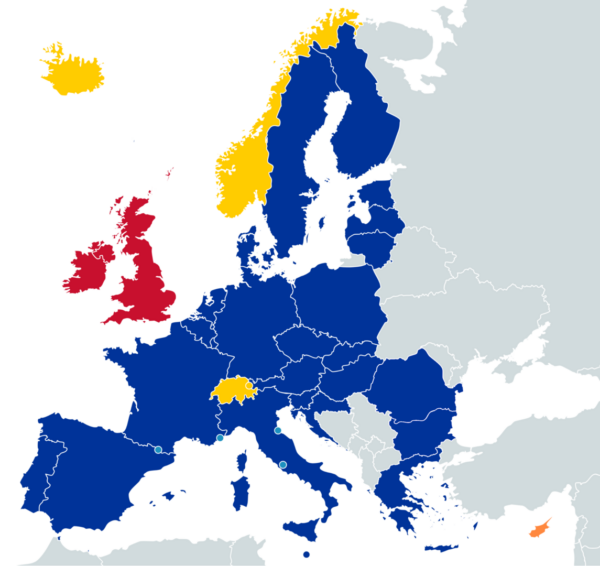
[From Wikipedia – By ZElsb – Schengen_Area_(Lablled_Map).png, CC BY 4.0]
where I could spend a few weeks without starting the 9o/180 day tourist visa clock.
(The Schengen Area is the system of open borders encompassing 29 European countries that have officially abolished border controls at their common borders. It functions as a single jurisdiction under a common visa policy for international travel purposes.
Cyprus and Ireland are the only EU states that aren’t part of the Schengen Area. Until 2026, Americans could travel to any Schengen Area country without a prior visa application. However, the tourist visa is limited to 90-days in any 180-day period and calculating those days isn’t simple. The EU plans to implement a system called ETIAS in the last quarter of 2026 that will require an online application and a €7 fee. The stay restrictions won’t change.)
On the map above, the gray countries surrounded by the dark blue Schengen Area are: Albania, Bosnia & Herzegovina, Kosovo, Montenegro, North Macedonia, and Serbia. I’d been to Bosnia and Montenegro and of the remaining four, Albania popped up repeatedly in my research. That’s the practical reason.
Coincidentally, I find the Balkan region historically fascinating. The sequential presence of the great empires of antiquity and the continuing religious and tribal clashes make it compelling and engrossing. At least to me. Ergo, Albania.
What I found there
When planning my travels, I try limiting my expectations. Anticipation is among the fun elements of travel but elevate your expectations too high, and you’re bound to meet disappointment. Rather, be receptive to what you find, welcome the experiences you have (even the bad ones), accept the cultures you encounter and engage the people you meet, and you’ve unlocked the great pleasure of travel. I knew there would be mountains. I knew that, while the sobriquet Albanian Riviera has recently appeared in the travel press, its seaside resorts were less developed even compared to other recent hot spots such as Split, Croatia. I knew the people had a reputation for being particularly welcoming. I tried limiting my presumptions to those.
I arrived in Tirana to a mildly chaotic scene at the airport with unmarked buses parked just 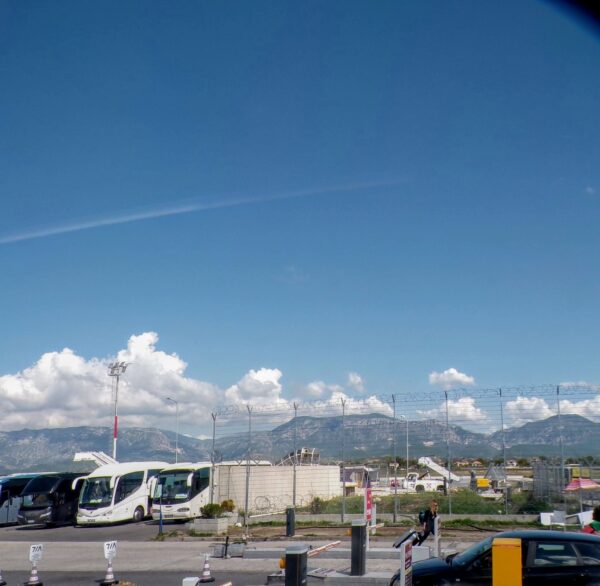
outside. I found the one I needed to take me into the city but the ride provided an early hint of what I’d encounter on upcoming bus trips when a man walked through the aisle collecting the fare from people who hadn’t prepaid. Such on-board purchases don’t happen in the US.
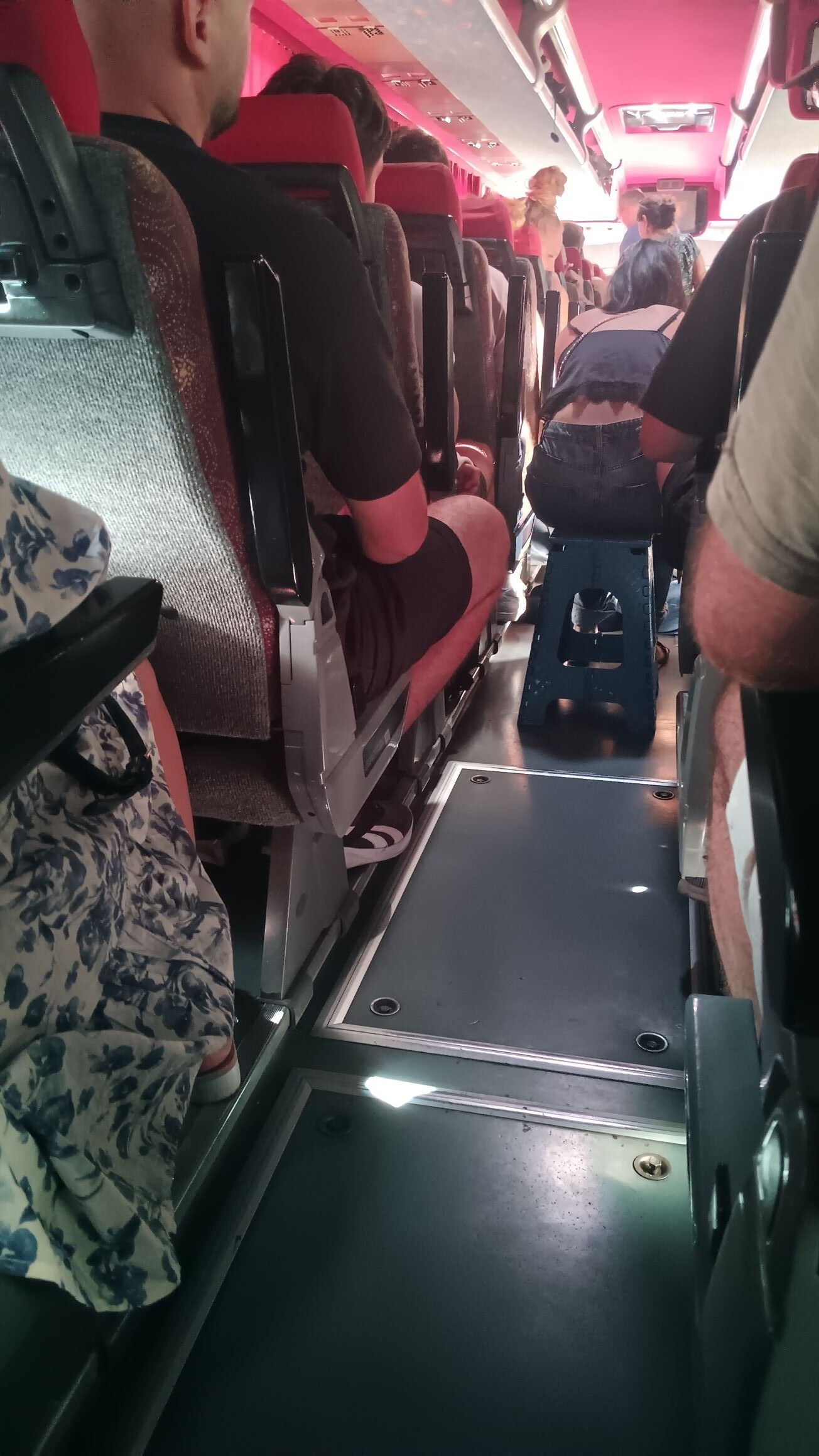
Here’s something else that doesn’t happen on western buses: Overselling. Recall that J and I had our ride from Orikum to Vlorë on what I’ll call a bootleg bus that crammed 18 people onto a 15 passenger van. Okay. That was an unofficial bus with the driver hustling to make some money. The bus I rode back to Tirana from Sarandë was managed by a licensed company. Still, we had this
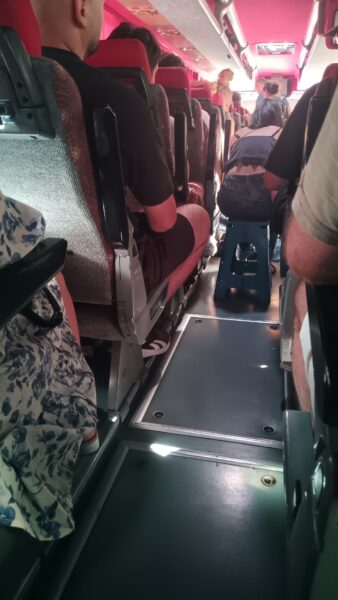
“in the aisle” seating.
(Without C as a traveling companion, the return bus trip felt as though it was, indeed, five hours long. The Ramel Hotel was a little farther from the square than the Livia but still convenient and on a very quiet side street.
It was close enough to suppertime that I set out to find a decent meal. After wandering past one restaurant after another, I settled on ERA-Blloku

where I supped on zucchini croquettes and chicken fillet with truffle sauce. I also had my last Korça – the local beer I drank far too frequently in the preceding weeks.)
The Albanian capital was an interesting mix of historic preservation and modern construction.
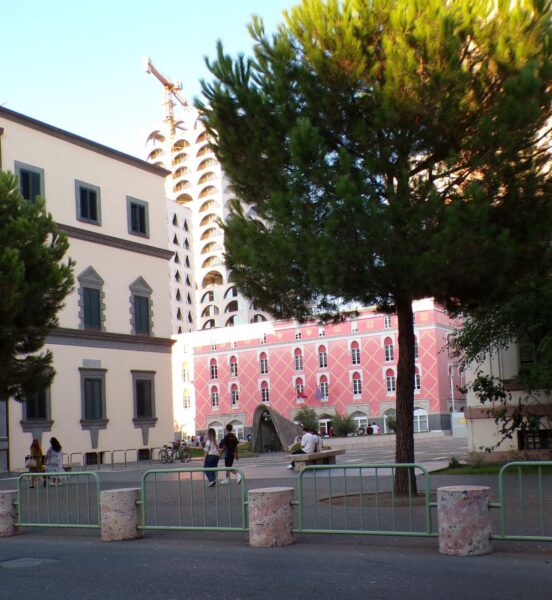
History and modernity contrasted similarly among restaurants, vendors, and even the hotels. It’s clear that the nation is working assiduously to emerge from its long period of isolation under the dictatorship of Enver Hoxha when it was often referred to as the “North Korea of Europe.” After Hoxha died in 1985, the process of restoring individual property rights took place gradually over the ensuing five years and accelerated after the fall of the Eastern bloc governments in 1991.
Then, in the late nineties, Albania suffered an unprecedented economic collapse when several pyramid schemes declared bankruptcy and siphoned nearly half the country’s GDP. And, as if that wasn’t enough, there was also the Kosovo refugee crisis at the end of that decade. Yes, more than a quarter century has passed but Albania is still recovering. But these echoes, remnants and traces provide a bit of exposure to Albania’s history since independence.
From the mountains
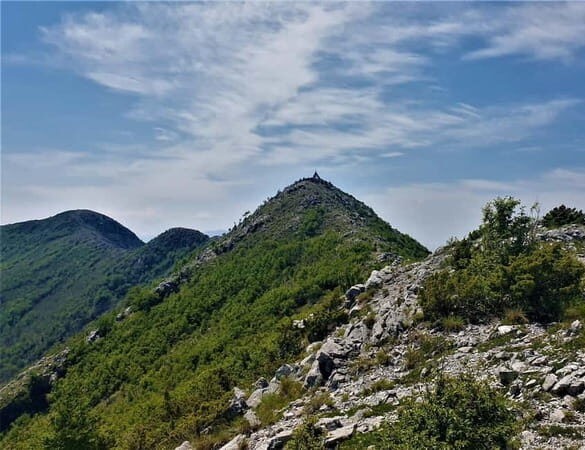
The mountains are interesting and varied with both dense foliage

and exposed rock – generally limestone and dolomite in the north and, in the Mirdita Zone, ophiolite formations. (These are fragments of oceanic crust and upper mantle obducted onto the continental margin.)
To the sea
Both Durres and Vlorë are coastal cities and I’d consider Orikum where we stayed near Vlorë principally a seaside resort. However, I think my most accurate impression of Albania’s coast came from my stay in Sarandë – a place I found to be very much in transition. I stayed in the Hotel Magllara that seemed to be one of the nicer small family run hotels in Sarandë (At present, small, family run hotels seem to be the norm in Albania.) and the room (one of six in the hotel) was more than adequate.
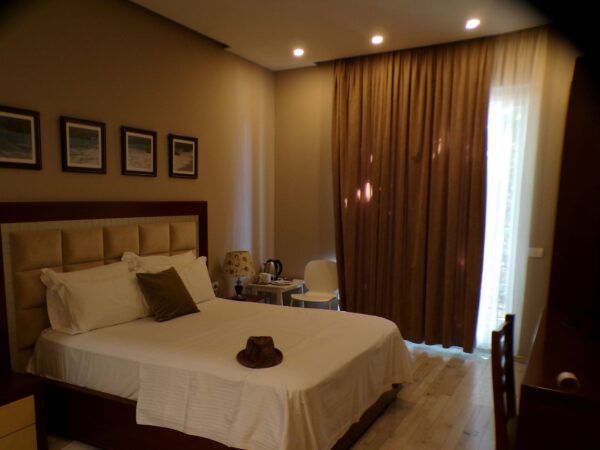
(It even had a kettle!) The rate for my late September stay was less than $80 per night. Walk 600m west along the Promenade, and you reach the Vale Hotel. It’s about four times as large as the Magllara and looks like it was built within the last 5-10 years. Its nightly rate was about $200.
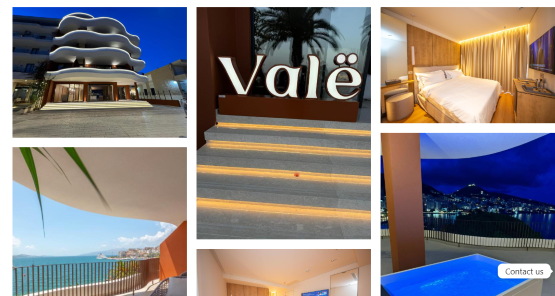
[Screenshot from the hotel website]
Although the Vale Hotel isn’t part of an international chain, both Marriott and Radisson recently opened hotels in Tirana and, over the country as a whole, the penetration of chain hotels has more than doubled since 2018.
Tourism is becoming a big business in Albania and the country’s National Tourism Strategy for 2024-2030 aims to increase the number of available rooms from an estimated 270,000 to 477,000 over this period. According to this article from The Albanian Times, “The government projects that by 2030, Albania will generate €6.7 billion in revenue from tourism, up from €4.16 billion in 2023. This increase will be driven by higher tourist arrivals, longer stays, and enhanced tourist services across the country.”
To the people
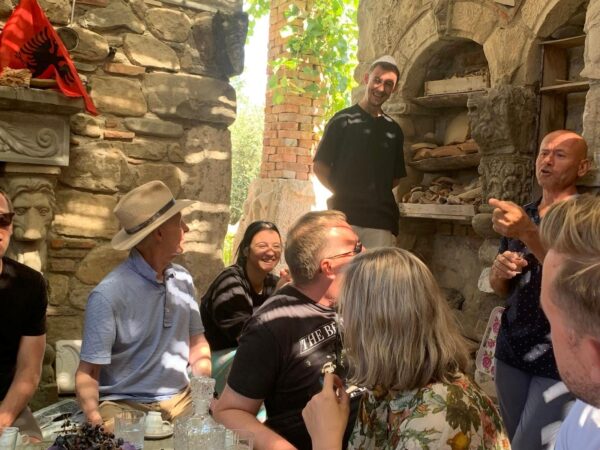
I noted a third pre-visit expectation – the particularly welcoming reputation of the Albanian people. While I discovered that they are, indeed, welcoming and generous, perhaps stemming – at least in part – from their traditions of Kanun and besa, I’ve visited other places where I’ve found the residents equally welcoming.
My first visit to a non-English speaking country was to Japan in the 1980s and there I encountered the Japanese tradition of omotenashi in which all visitors, especially foreigners, are treated with exceptional politeness and care. Even someone who might make a large enough cultural error to be considered a “meiwaku gaikokujin” (troublesome foreigner) is likely to receive a “gaijin card” that tolerates their missteps.
On the other hand, I’ve traveled to places where I’ve been made to feel quite alien and certainly less than welcome. In this regard, the Albanians are generally in the upper tier of hosts. Like anywhere you travel you can encounter the occasional snollygoster and you’re likely to meet someone who is rather bibulous. Still, you’ll almost assuredly enjoy your interactions with these kind people.
A statement I repeated often both during and after this trip is, “I’m glad I went now because I got at least a taste of traditional Albania and I think it will be a very different place in five years.” Reading the strategic plan reinforced that impression because aggressively courting tourism changes places.
(The tradition of couvert in Portuguese restaurants is a small example. On my first trip here in 2022, finding a small presentation of bread, cheese, olives, and the like was fairly common. These were not complimentary. If you didn’t immediately reject them, there’d be a charge added to the bill. It may not be true elsewhere but in Lisbon in 2025, the couvert is increasingly listed on the menu and must be ordered.)
I think much of the Albania I visited in 2025 will still exist in five years but I also think it will be harder to find.
-
Reflections of the way life used to be – travel days
March 16, 2026 -
It’s getting to the point – Blue Eye and Gjirokaster
March 13, 2026 -

There’s bound to be a better ride Than what you’ve got planned – busing to Sarandë
March 11, 2026 -
If you’re looking to find a place in the summer sun – Ohrid
March 9, 2026 -
It’s just a shot away – Prizren
March 6, 2026