These songs of freedom – Independence in Vlora
At the end of the previous post, I promised an adventure and I hope I didn’t oversell the event. It began when J and I met in the lobby of the hotel to try to determine how and where to get a bus into Vlora. Despite the assurances from the desk clerk that we need only stand outside on Rruga Rradhime – the road in front of the hotel, we still left the lobby with some small uncertainty.
We saw a small group of people assembled near the hotel to our south and walked toward them. A few minutes later, they began moving en masse toward an approaching van. We followed. The van had no sign indicating that it was associated with any sort of public or private bus company and nothing that identified its destination as Vlora. However, since the route was relatively short (about 15km) and direct as this screenshot from Bing Maps shows,
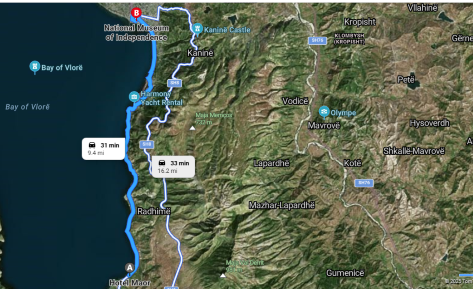
we joined the crowd on board. And when I call it a crowd on board, I mean this literally. It was a 15 passenger van carrying 18 people. J and I were two of the three standees.
As I’m wont to do, I’d made some mental notes about landmarks we’d passed on the way from Vlora to Orikum and any misgivings I might have had dissipated each time we passed something familiar and vanished completely when the van reached Sheshi Paravësia or Independence Square, turned right, stopped, and began to disgorge its passengers. This is the point where we paid our fare of 250 lekë.
From there it was a short walk across the campus of the University of Vlora Ismail Qemali to our first (and main) stop of the day – the wildly unassuming National Museum of Independence.
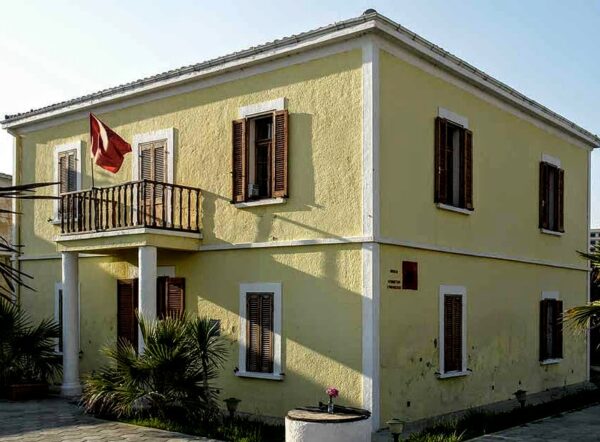
You may rightly be wondering, if Durres was such an important city and Tirana is the nation’s capital, why is the Museum of Independence in Vlora? The simple answer is that Vlora is where the Albanian Declaration of Independence was signed and the city served as the fledgling nation’s first capital. You might also be wondering why I might consider an uneventful bus ride an adventure.
Let me explain. No, that is too much. Let me sum up.
J and I got on an unmarked and unregulated bus that, for all we knew, could have been going to Durres or Tirana. Other passengers on the bus might have spoken English but it didn’t seem that the entrepreneurial driver did and, with no fare posted, he could have charged us anything from 250 lekë to 2500 lekë. For me, any situation with that level of unknowns qualifies as a bit of an adventure.
You say you want a revolution
Untangling the threads that weave history into some sort of coherent narrative that’s presentable as a series of images on an embroidery is usually complex and, in few places, is that complexity more apparent than in the Balkans. Through our journey thus far, we’ve mentioned the distinct major empires that controlled Albanian territory for much of its history – Roman, Byzantine, and for five centuries prior to Albanian independence, the Ottomans.
While Albanian efforts to preserve their language and culture stretch back to the time of Skanderbeg in the 15th century I’m going to open this brief summary of the steps that led to the November 28, 1912 Declaration of Vlora with the 1878 formation of the First League of Prizren
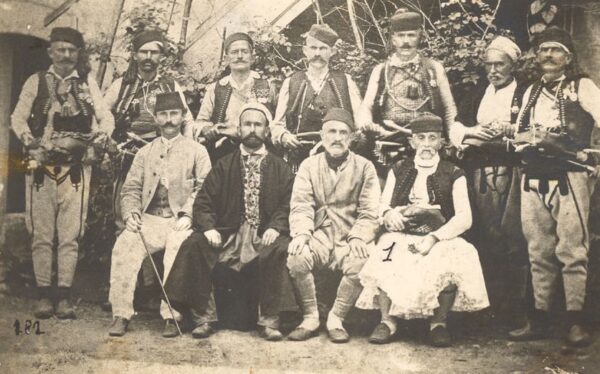
[From Wikipedia – Public Domain]
and its issuance of the Karaname. This document emphasized the intention of a group of 47 beys to establish autonomy within the Ottoman Empire within which they would, “struggle in arms to defend the wholeness of the territories of Albania.”
The First League proposed a consolidation of four Ottoman vilayets (the vilayet was an updated version of Ottoman administrative areas called eyalets) with mainly Albanian populations (seen below with modern borders in gray).
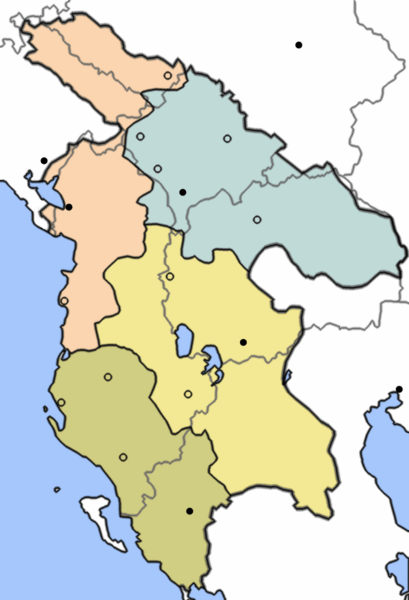
[From Wikipedia By Pasztilla – Own work, CC BY-SA 4.0]
Ulttimately, the First League failed to prevent the partition of Albanian territory by the Great Powers (Austria-Hungary, France, Germany, Great Britain, Italy, and Russia) at the 1878 Congress of Berlin. This agreement modified the Treaty of San Stefano, ceded parts of Albanian territory to Serbia and Montenegro while leaving claims by Greece and Bulgaria unresolved. Later, the League engaged in armed resistance to those territorial cessions. Ottoman forces crushed that resistance in 1881.
The Balkans remained politically tumultuous throughout the early twentieth century and, in 1911, the Albanian National Committee formed to organize resistance and political action. Their early attempt to proclaim independence in Orosh was, like that of the First League’s, short-lived once again due to Ottoman military intervention.
In the spring of 1912, a series of bilateral treaties between Greece, Bulgaria, Serbia, and Montenegro mainly brokered by the Russian Empire created the Balkan League principally to expel the Ottoman Empire from southeastern Europe and redistribute its European territories among the allied countries. Led by Montenegro’s declaration of war against the Ottomans on 8 October 1912, the others quickly followed suit and began a series of coordinated military actions that came to be called the First Balkan War.
Sensing the opportunity, Ismail Qemali and Isa Boletini convened a gathering in Vlore of local leaders
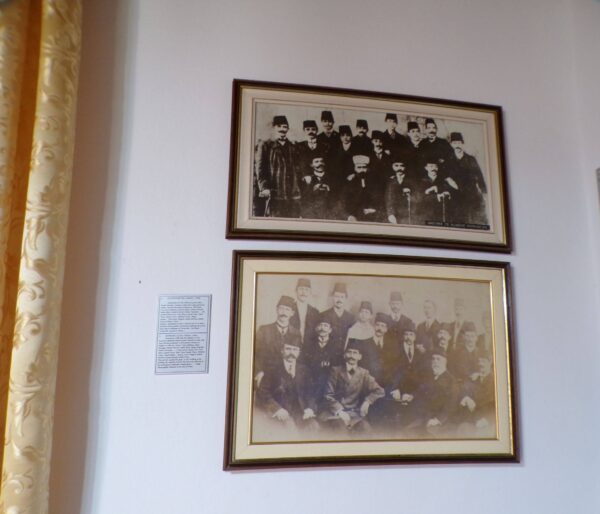
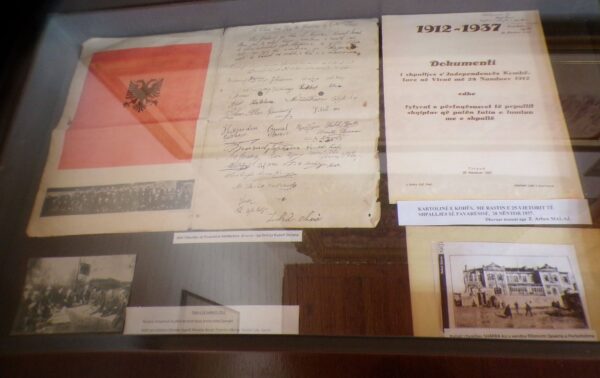
from around Albania that led to the signing of the Declaration of Independence on 28 November 1912.
Trouble ahead, trouble behind
Ismail Qemali, who had been deeply involved in the Patriotic Club Laberia and who would become Albania’s first Prime Minister called the assembly of regional leaders. He chose Vlora as the site because it remained unoccupied by any other Balkan nations and it was a safe and symbolic location to declare independence. Under his leadership, the Assembly of Vlora established the first national government there on 4 December 1912.
It was in the small building that now houses the National Museum of Independence that they began to create national institutions and central administration hoping to unify all Albanian regions under one government –
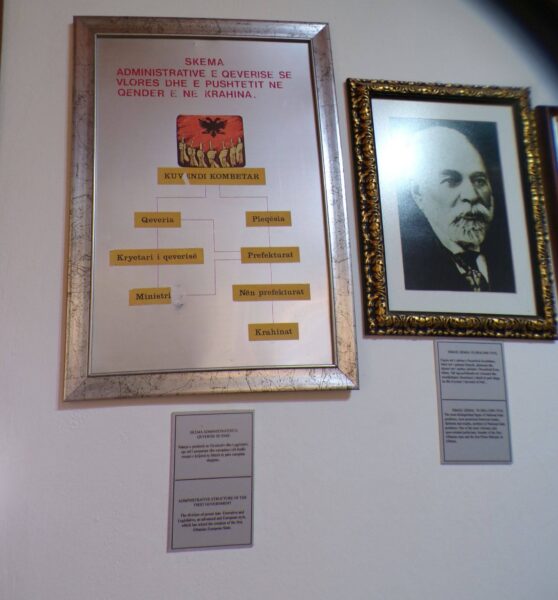
a task easier said than done.
Qemali wanted to create a western style European constitutional government but some of the regional leaders who had signed the Declaration of Independence perceived this approach as promoting his personal creation rather than reflecting a broad national consensus. He also had to overcome competing political visions. Some groups preferred continuing guerilla style warfare against the Ottomans while Qemali and his allies preferred diplomatic solutions with backing from the Great Powers. Still further, he had to resolve existing internal disputes over territorial claims while also attempting to establish new administrative and religious structures for a religiously and regionally diverse Albania.
The first Balkan War still raged around Qemali as he navigated a path through a land that possessed national identity but lacked national unity. Ultimately, the Balkan League succeeded in driving the Ottomans out of the peninsula and the Treaty of London, signed in May 1913, left them bereft of nearly all their European territory. It also left significant dissatisfaction among the victors, especially Bulgaria and Serbia with the latter losing access to the Adriatic. The dispute over territorial division led to the Second Balkan War in June 1913 – a short lived conflict that ended with the Treaty of Bucharest on 13 August 1913.
Albania gained formal recognition by the Great Powers, including Austria-Hungary and Italy on 29 July 1913. By the end of the Second Balkan War, despite many remaining internal divisions, Albania was, at long last, a free and independent nation.
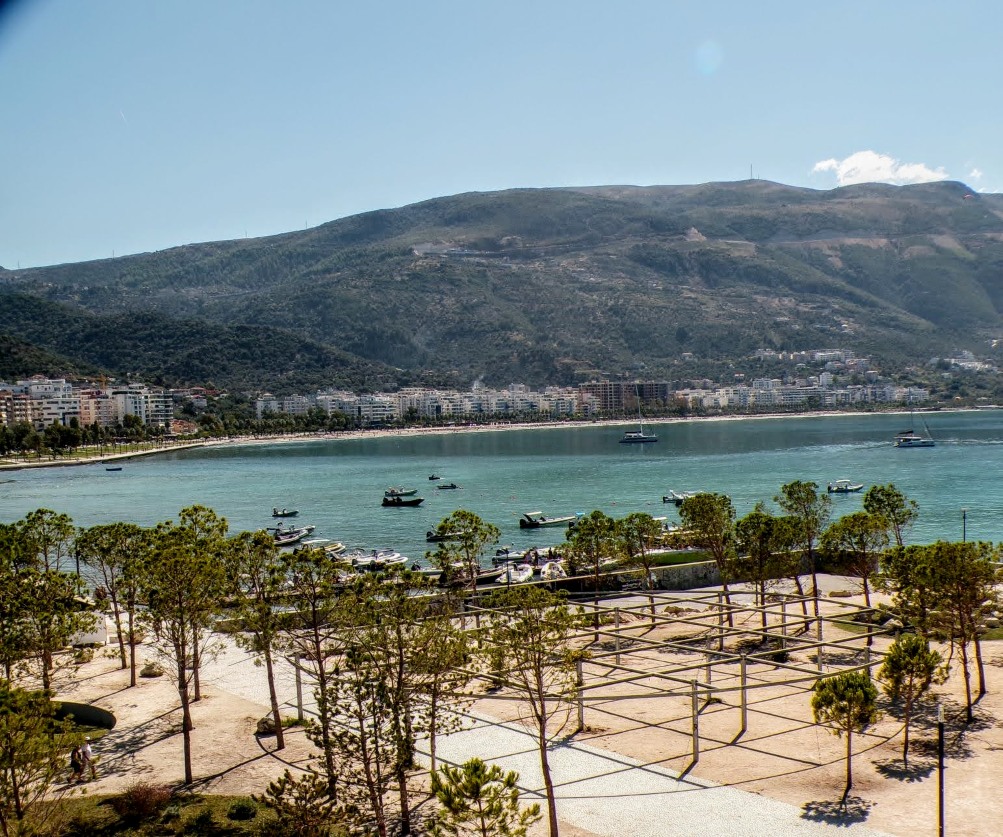
When we finished our brief tour of the museum, J and I climbed the man-made hill in front of the museum mainly because it was there and because it provided a substantive view of the nearby harbor.
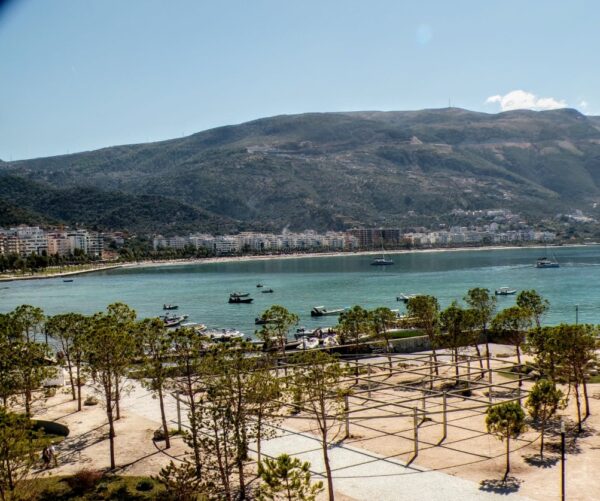
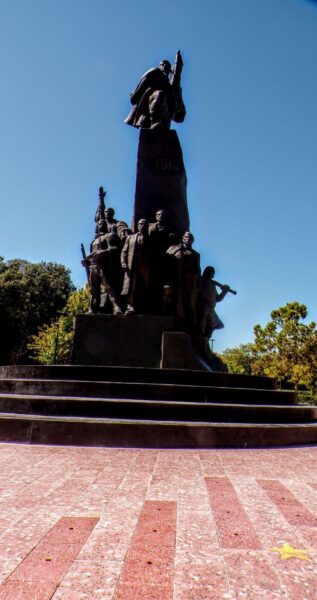
A pleasant tropæan breeze cooled our walk to Flag square and the Independence Monument
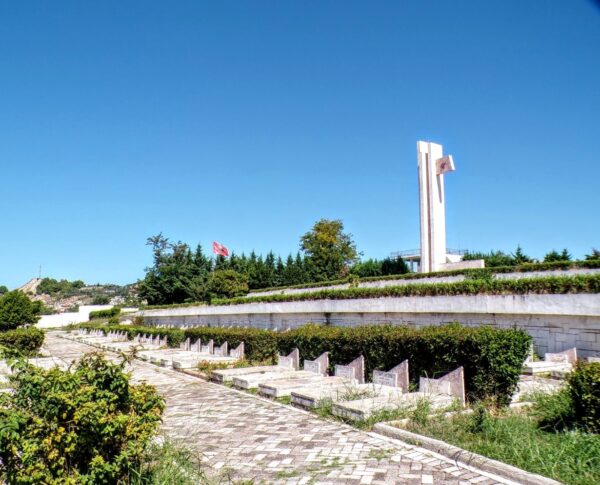
and from there, attracted by the rising pillar with the star monument, to the Partisans War Cemetery.
We descended the hill, stopped for byreks at a small shop, and grabbed some gelato on our way to trying to find a more official bus back to Orikum. We located the bus “station” with assistance from a bank clerk. It was, as I have described others, a parking lane on a major road. We boarded a bus that departed at 14:00 and would pay our 200 lekë fare (50 less than our ride into town) when we hopped off a short walk from our hotel.
I left Vlora without having gained a true sense of the bimarian environment, where it’s said that the Ionian and Adriatic seas meet. Along the coast of Albania, the southern Ionian Sea is deeper and cooler, with rocky beaches and dramatic coves while the Adriatic Sea is shallower, warmer, and features long, sandy beaches with gentle waves and calmer waters.
We’d reunite with the rest of the Intrepid group for a late afternoon hike to Tragjas village and another farm to table supper but that’s a story for another post. You can find more photos from Vlora here.
-
Reflections of the way life used to be – travel days
March 16, 2026 -
It’s getting to the point – Blue Eye and Gjirokaster
March 13, 2026 -

There’s bound to be a better ride Than what you’ve got planned – busing to Sarandë
March 11, 2026 -
If you’re looking to find a place in the summer sun – Ohrid
March 9, 2026 -
It’s just a shot away – Prizren
March 6, 2026