It’s getting to the point – Blue Eye and Gjirokaster
There’s a wide promenade along the shore in Sarandë and it’s dotted with hawkers selling services to tourists.
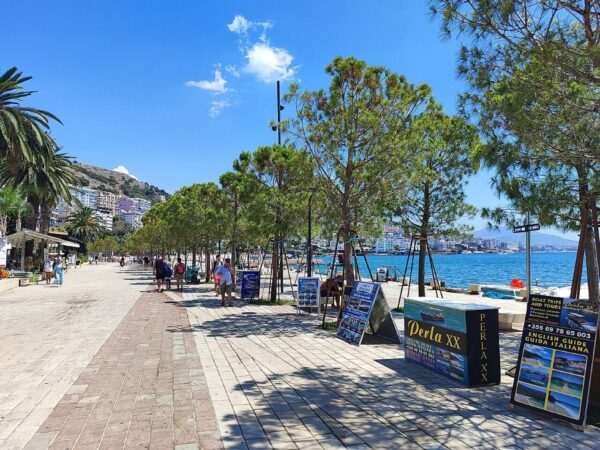
It’s along this road that I’d meet my day tour at a bit before 09:00. It was a large small tour. You see, while I rode in a 12 passenger van, the tour operator was overseeing four such vans and, it seems he was the only English speaker available as a guide. Thus, at each of our five stops, we had to gather the group from each van before he launched into his clearly rehearsed jocoserious patter. The tour had five stops enumerated. I’ve highlighted four of them on the Google Maps screenshot below. 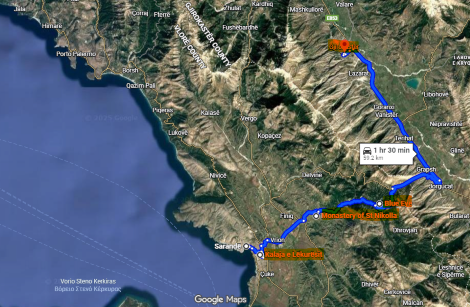
I think everyone accurately anticipated that the main highlights would be the Blue Eye and Gjirokastër – the City of Stone. I’ll describe the stops sequentially.
Kalaja e Lëkurësit
Our initial stop was at Kalaja e Lëkurësit or Lekurisi Castle. Barely more than a kilometer from the town of Sarandë, this hilltop fortress was built by Suleiman the Magnificent in 1537. Housing 200 – 220 soldiers, its purpose was controlling Sarandë’s harbor, the Sarandë–Butrint road, and defending against Venetian forces. And it did have a commanding view.
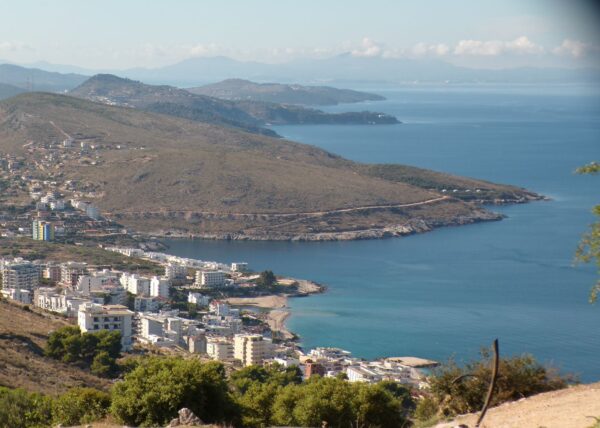
It’s been abandoned since the late 19th century.
Kisha e Manastirit të Shën Kollit
Our second stop was at the Saint Nikolas Monastery – generally considered to be among the oldest and largest churches of the Byzantine era. Built in the early 13th century, it has a double apse
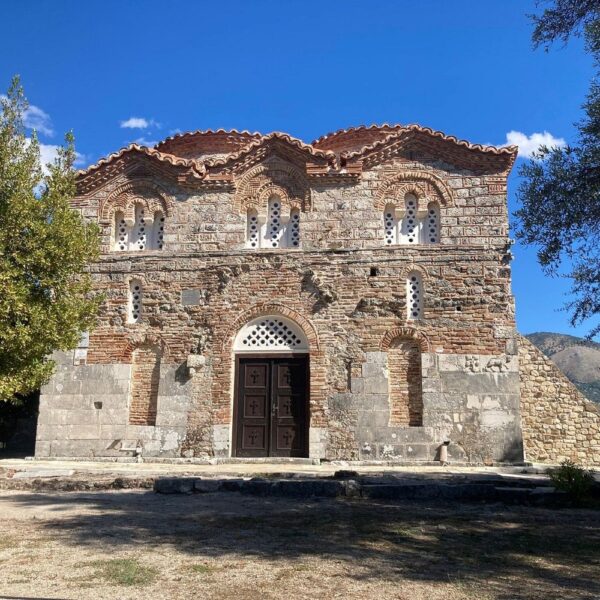
leading some researchers to believe it was used for both Catholic and Orthodox rituals.
As is often the case, the Orthodox monastery was built on the walls of a much older temple. An Albanian Heritage Foundation team found Hellenic stones dating to the 3rd and 4th centuries BCE. Notably, one of the decorative stones bears the inscription Menelau who is most likely the Spartan King Menelaus. Since his brother Agamemnon led the assault on Troy, this would connect the history of this temple to the Trojan War. That’s kinda cool.
Syri i Kaltër
It’s time for a little geology lesson (and I promise to keep it brief) as we approach our next stop – Siri i Kaltër or the Blue Eye. (In this case I’ll be writing about the Blue Eye near Sarandë not the northern one near Theth.) The Blue Eye is a karst hole or doline. (In the US, you’re more likely to see the term sinkhole used to describe this phenomenon.) I took a deep dive into the Classical Karst landscape when our group was preparing to visit the Postonja Caves in Slovenia so I won’t repeat that here.
Dolines are depressions in the ground surface formed when rainwater that’s become slightly acidic from dissolved carbon dioxide seeps into cracks and fissures in soluble bedrock of limestone or dolomite. Over time, the fissures enlarge and the overlying soil or rock collapses into the newly created void below. This then creates a a bowl-shaped, funnel-shaped, or shaft-shaped hole.
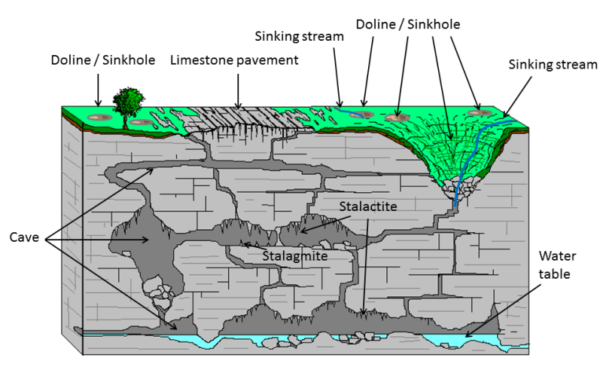
[From Geological Survey Ireland]
Located about 5km from the source of the Bistricë River, the deep (at least 50m) clear water of this doline has garnered the name Blue Eye because some see a resemblance to the human eye. (Extreme pareidolia, anyone?)
Here’s my best photo.
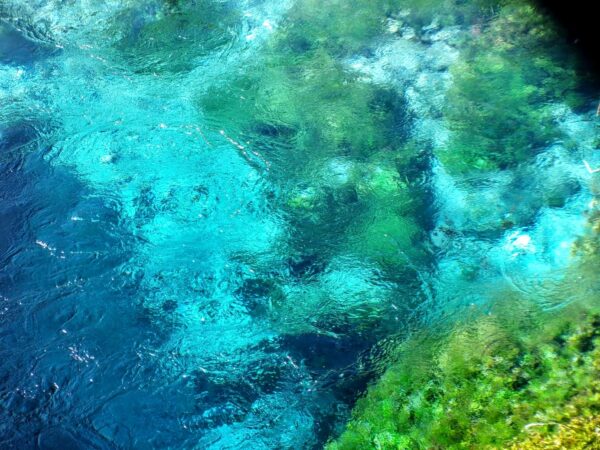
An impressive mix of shades of blue and green? Absolutely. A human eye? I don’t see it.
While on the van, I’d connected with Kostya, a young man from Ukraine who’s been living and working in Germany for about a decade. We each paid our 50 lek fee and walked 2 kilometers down the well paved hill to the spring. Our guide had told us about an optional hike that would take us to some spectacular viewpoints. Rather than turning around and walking the same route back we could complete the circle above the dam and the river. Kostya and I set out to give it a go.
After my experience at the Shala River, I was particularly cautious and I had warned him that, while the distance would pose no problem, a slippery trail with significant elevation change might. We got part of the way and had a lovely elevated view of the river
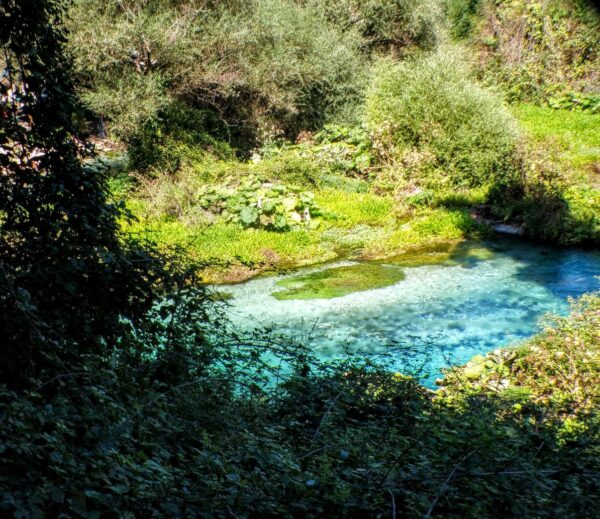
but after watching me slip and slide for 15 minutes or so, and with a significant ascent and descent ahead, he suggested it would be wiser to turn back. I said I’d be willing to try to continue but didn’t disagree very strenuously. We turned back. (After I returned to the States, I found this information about the trail on the website Wikiloc. The paved portion is on the left of the river as seen in this view.)
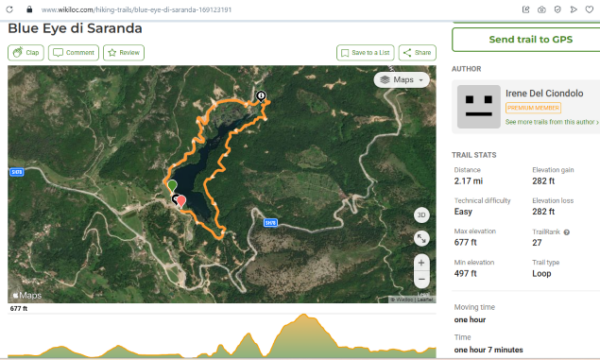
I had an “it’s a small world” coincidence on that return. We met N & C from the Intrepid group. They were headed up the trail. (In a WhatsApp exchange later that evening, they confirmed that they completed the loop.)
An Ottoman Bridge
There was a fourth stop on our way to Gjirokastër – an Ottoman Bridge. Other than giving us a little less time in the City of Stone, I’m not certain why this was on the itinerary unless it was to give our guide a chance to talk about the impact of climate change on Albania. You see, when we reached the bridge, it spanned a riverbed not a river.
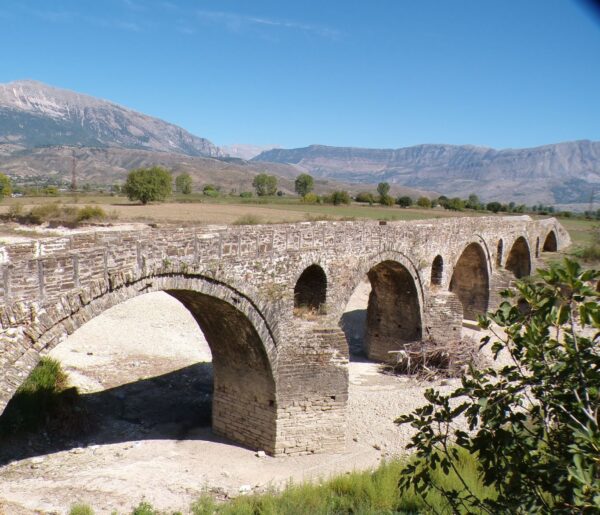
This condition, he told us, was very unusual for this time of year but was something that began happening recently and regularly. I took him at his word and expended neither the time nor resources to verify it. It’s an interesting looking old bridge, though.
Gjirokastër at last
Technically, Albania has four UNESCO World Heritage Sites: Butrint, the historic centers of Berat and Gjirokastër, the Ancient and Primeval Beech Forests of the Carpathians, and, with North Macedonia, the Natural and Cultural Heritage of the Ohrid Region. I have to conclude that UNESCO connected the cities of Berat and Gjirokastër that are separated by 100 kilometers because of their differing but associated representations of Ottoman architecture. Berat is the City of 1,ooo Windows and Gjirokastër is the City of Stone.
When the last of our vans parked at Çerçiz Topulli Square, that seemed to be a central spot from which to begin exploring the city, our guide, who seemed to have lost interest in guiding the group at this point, mustered us together in front of the Nderi i Qytetit or Honor of the City Monument.
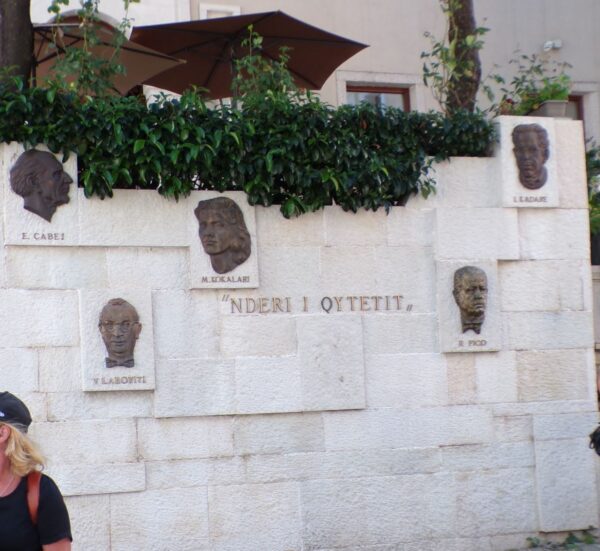
If he told us anything about the people the monument honored, he lacked the hirquitalliency to project above the ambient cacophony. He suggested we visit the castle – because, he said, no visit to Gjirokastër is complete without it – and perhaps find someplace to have lunch. He allotted us three hours before we’d reassemble to return to Sarandë.
Perhaps because I was uncertain whether I’d visit Gjirokastër I did very little research about it before I set off on this adventure. For this oversight, I to take full responsibility. The monument honors five people either born in or closely associated with the town. They are:
- Eqrem Çabej – A historian and linguist;
- Vasil Laboviti – A doctor and surgeon born in Gjirokastër whose house is preserved as a city landmark;
- Musine Kokolari – A writer and dissident considered a “Martyr for Democracy” and whose volume “As the Old Woman Told Me” (Siç më thotë nënua plakë) is often cited as the first published literary work by an Albanian woman;
- Rauf Fico – a politician important in establishing Albanian independence and whose family home – the yellow Fico House – stands as a Category 1 cultural monument;
- Ismail Kadare – the Nobel Prize nominated writer we first encountered in Tirana who was born in Gjirokastër and whose novel Chronicle in Stone is a fictional depiction of the city.
Kostya and I visited none of these places because neither of us knew of them and our “guide” failed to mention any of them.
We did manage the climb to the castle, paid the 400 lek entrance fee
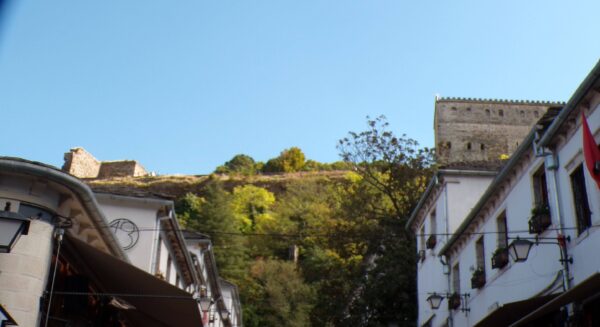
where we walked through the free bit of the military museum (the main museum had another entrance fee and neither of us was inclined to pay it)
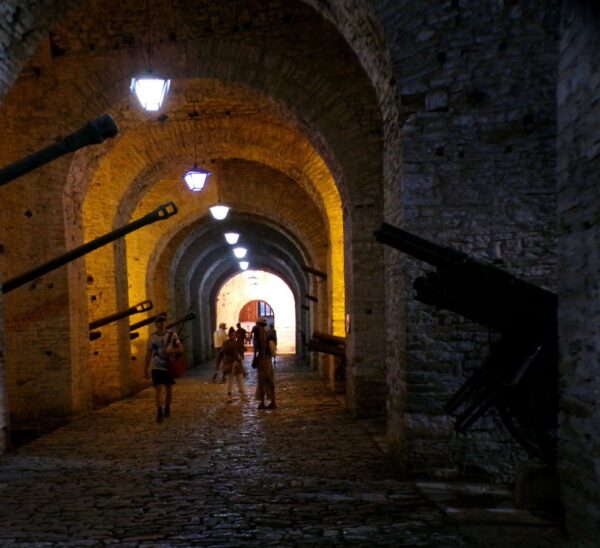
and had a commanding view of the city that allowed us to get a sense of how the residents use local gray slate and limestone in construction in the steep hillside fortress-like houses and the slate roofs that provide the city’s sobriquet.
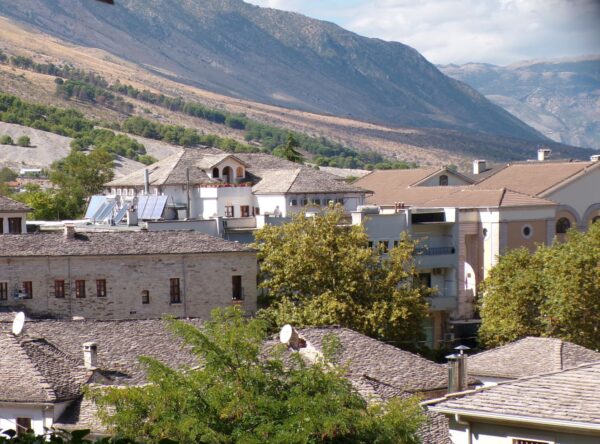
After wandering through the castle we started back down the hill, randomly picked a spot to have a perfectly adequate lunch – Kostya had a byrek and I had some sort of chicken dish – and, having used most of our available time, headed back to our designated meeting point.
Since we were going to different locations, our guide placed us on different vans so we didn’t have the chance to exchange contact information or even say a proper goodbye.
Back in Sarandë I wandered the promenade, had calamari for dinner, and prepared for the long ride back to Tirana. Before the next post, you can look at today’s unpublished photos.
-
It’s getting to the point – Blue Eye and Gjirokaster
March 13, 2026 -

There’s bound to be a better ride Than what you’ve got planned – busing to Sarandë
March 11, 2026 -
If you’re looking to find a place in the summer sun – Ohrid
March 9, 2026 -
It’s just a shot away – Prizren
March 6, 2026 -
Some things looking better, baby – Getting into Kosovo
March 4, 2026